Xeropotamou Monastery: An Orthodox Monastery on Mount Athos


Site at a Glance
- Rating
- 4.7
- Popularity
- Low
- Country
- Greece
- Primary era
- Early Modern
- Eras represented
- Medieval, Early Modern, Modern
- Civilizations
- Byzantine, Serbian
- Site type
- Religious
- Remains
- Fortified Monastery
On this page13 sections
History
Xeropotamou Monastery is an Orthodox monastery in Greece, founded or refounded during the Byzantine period and dedicated to the Forty Martyrs of Sebaste, Christian soldiers traditionally believed to have been martyred together at Sebaste in the fourth century. Its origins are associated with two traditions: one attributes its foundation to the fifth-century Byzantine empress Pulcheria, while another places its establishment in the late tenth century under the monk Paul of Xeropotamou, during the period associated with Athanasius the Athonite. The monastery ranks eighth in the hierarchical order of the monasteries of Mount Athos, and the port of Dafni is its dependency.
Origins and Byzantine restorations
The name Xeropotamou means “Dry River” and is traditionally connected with a nearby dry or seasonally flowing riverbed. Written references to the tradition of Pulcheria’s foundation appear from the ninth century onward. Paul of Xeropotamou, regarded in Athonite tradition as the founder or refounder, later established the monastery of Saint Paul on Mount Athos.
Arab raiders devastated the monastery in the eighth century during the Byzantine-Arab wars. Emperor Romanos I Lekapenos supported its restoration in the tenth century. By the thirteenth century, extensive landholdings had made Xeropotamou one of the wealthiest monasteries on Mount Athos.
The Latin conquest of Byzantium in the thirteenth century brought further destruction. In 1280 the monastery accepted the Union of Lyons, a thirteenth-century attempt to reunite the Byzantine and Roman churches. Athonite tradition connects this decision with a later earthquake and collapse, said to have occurred while Emperor Michael VIII Palaiologos was present. Emperor Andronikos II Palaiologos rebuilt the monastery in the fourteenth century.
Serbian patronage and loss of wealth
Serbian rulers and nobles supported Xeropotamou during the fourteenth and fifteenth centuries. Emperor Stefan Dušan made a donation in 1346, while Despot Đurađ Branković supported construction of the principal church, or katholikon, in 1445. Serbian patronage also contributed to a defensive tower, the surrounding walls, and a chapel dedicated to the Virgin Mary.
The fall of Constantinople in 1453 and of Smederevo in 1459 deprived the monastery of important patrons. Nevertheless, ninety monks lived there in 1489. A fire in 1507 almost completely destroyed the complex, and the monks reportedly saved mainly the treasury and other valuables. The resulting impoverishment caused Xeropotamou to fall from fifth to eighth place in the Athonite hierarchy.
Ottoman-era rebuilding
Sultan Selim I supported the monastery’s restoration after a vision of the Forty Martyrs, whom he believed had aided his campaign in Egypt. A decree issued on 9 March 1520 granted Xeropotamou gifts and tax exemptions. Wallachian princes also provided support during the sixteenth century.
Another major fire struck in 1609. To raise money for repairs, the monks carried the monastery’s principal relic, a large fragment of the True Cross, through the Wallachian lands and sought assistance from Wallachian rulers. The patriarchs Timothy II and Methodios III showed particular favour toward Xeropotamou. In 1671, Methodios III made it a patriarchal and stauropegic monastery, meaning that it was placed directly under senior ecclesiastical authority rather than the ordinary jurisdiction of a local bishop. The designation remains part of its official title.
The monastery’s reputation grew again in the eighteenth century, especially after the arrival of the monk Kaisarios Dapontes in 1757. Dapontes, a Greek monk, diplomat, and poet from Skopelos, collected donations in Greece and the Danubian principalities. With this support and the aid of Wallachian princes, Xeropotamou acquired its present general form during the eighteenth century.
War, fires, and modern continuity
During the Greek War of Independence, the struggle against Ottoman rule that began in 1821, Ottoman forces stationed a military unit at the monastery from 1821 to 1829 because its position allowed observation across the Singitic Gulf. Most of the brotherhood temporarily withdrew to dependencies on Skopelos and Naxos.
On 4 March 1952, a fire destroyed the northern and eastern parts of the monastic buildings. The monastery was subsequently restored with support from the Greek government and through the efforts of its abbot Eusebios. A further fire in 1973 damaged parts of the southern and northern wings, which were later restored. Since 1981, Xeropotamou has operated again as a coenobitic community, in which monks live under common discipline and shared administration. Its abbot is Archimandrite Joseph, and the modern brotherhood has numbered approximately 25 to 30 monks. Since 1988, the monastery has formed part of the UNESCO World Heritage listing of Mount Athos, protecting the medieval monuments of the monastic peninsula.
Remains
Monastic complex
Quadrangular buildings
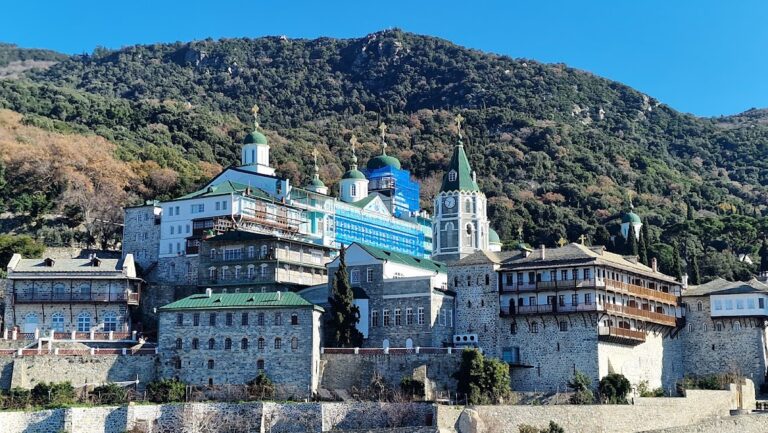
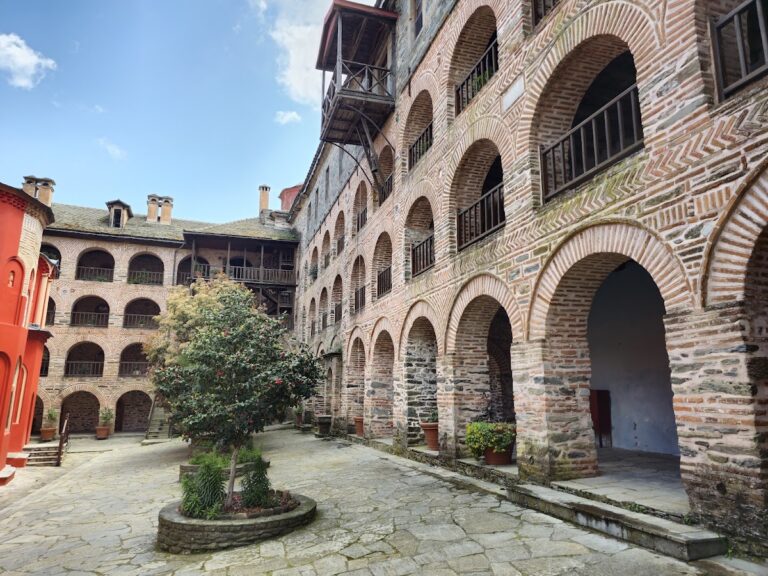
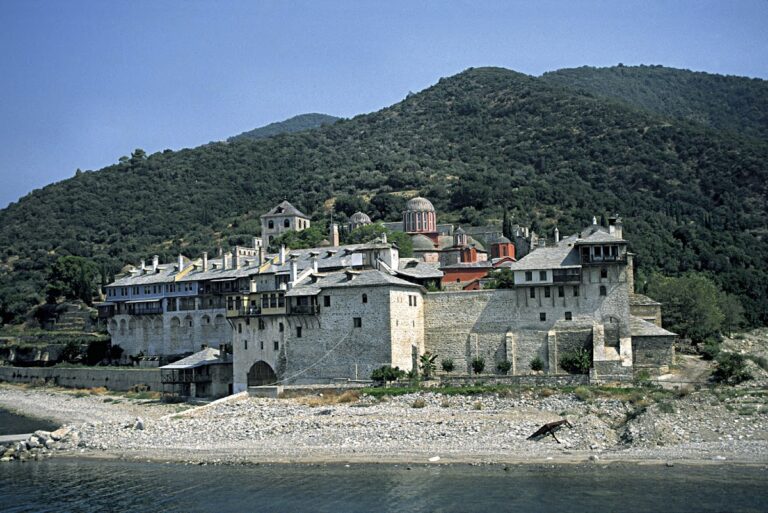
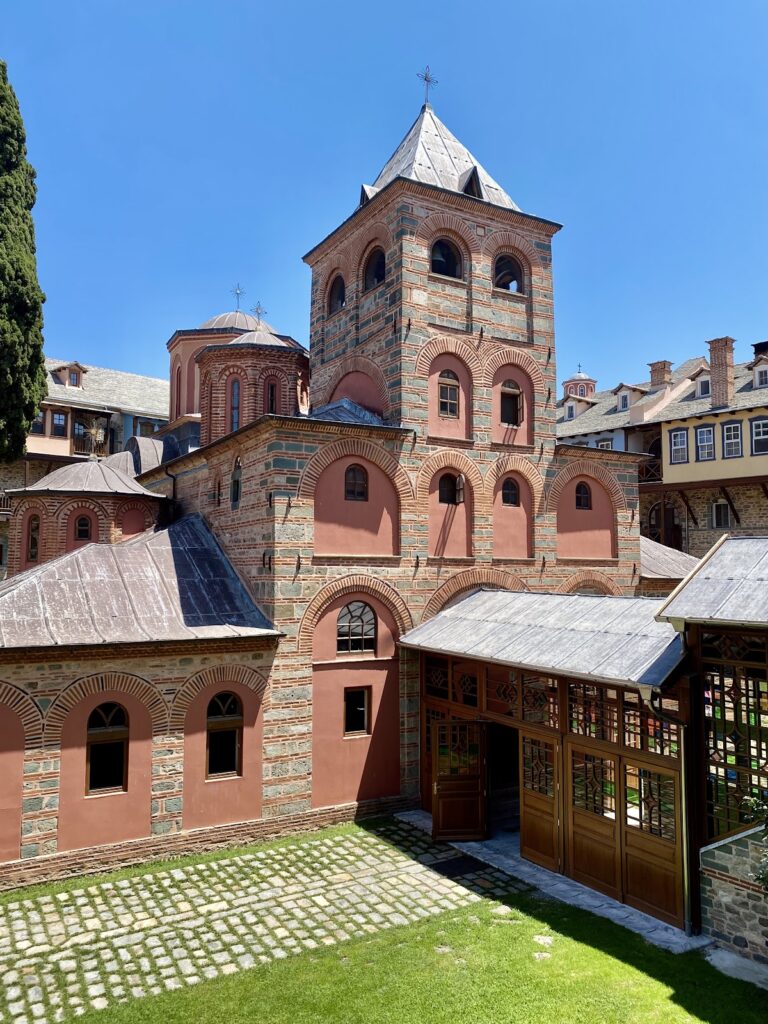
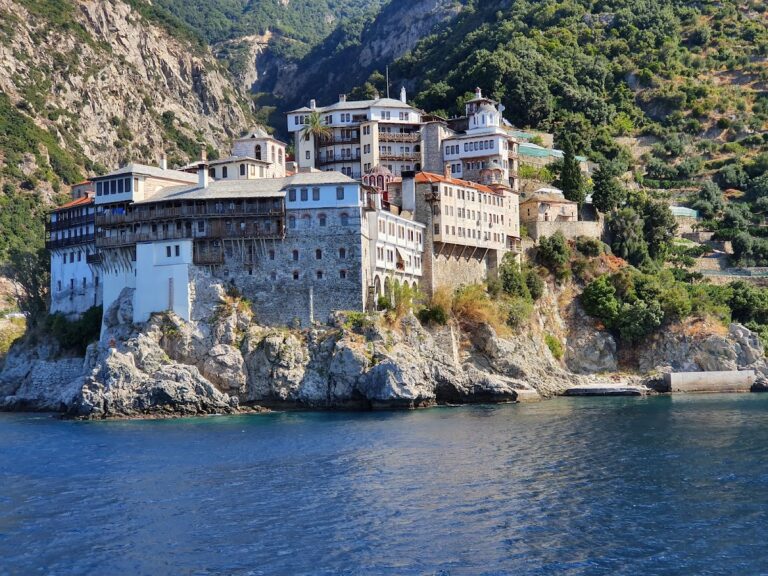
Xeropotamou stands in the central part of Mount Athos, on the southern coast above the port of Dafni and beside the Dafni to Karyes road, at an elevation of approximately 192 metres. It lies near a deep ravine or riverbed associated with the name “Dry River,” and a nearby chestnut forest forms part of its holdings. The monastery is arranged as a quadrangle, with three-storey wings forming its sides and the katholikon at the centre. The northern wing incorporates a bell tower, while the eastern side contains the entrance and the archondarikon, the monastery’s guesthouse.
The courtyard contains an eighteenth-century marble phiala, a monastic basin used for holy water. The south wing includes the refectory on its first floor, while the complex also contains a bakery, storerooms, and a library. Columns and arches provide architectural decoration, and the buildings display a noticeable Baroque influence. The eastern residential wing was erected in 1760 and the southern wing in 1796. Opposite the entrance to the katholikon stands the refectory, whose frescoes were painted in 1859 by the monks Sophronius and Nicephorus as a foundation of the Wallachian prince Alexander Ghika.
Katholikon
The katholikon, the principal church of the monastery, is dedicated to the Forty Martyrs of Sebaste. It has an inscribed-cross plan and five domes set on high drums, including a central dome. Two associated chapels are dedicated to the Archangels and to Saints Constantine and Helen. Unlike the usual eastward orientation of Orthodox churches, this church faces north because of the configuration of the terrain.
Completed in 1761, the katholikon was decorated with frescoes in 1783 by Constantine, Athanasios, and Naum of Korçë. Its iconostasis is carved in wood. A depiction of Christ Pantokrator occupies the dome, and icons of the Archangels Michael and Gabriel decorate the entrance.
Chapels
Sixteen chapels belong to the monastery, seven within the main complex and nine outside it. Five of the interior chapels contain frescoes. The chapel of the Exaltation of the True Cross occupies the southwest corner of a wing, while other chapels in the wings are dedicated to the Forerunner, the Entry of the Virgin, Saint Theodosios, and Saint George. The cemetery chapel is dedicated to All Saints.
Treasury and library
Relics and sacred objects
The treasury preserves a large piece of the True Cross, described as the largest surviving fragment of its kind. Pierced by a nail, it measures approximately 31 centimetres in length, 16 centimetres in width, and 25 centimetres in thickness. One tradition attributes it to Emperor Romanos I, while another identifies it as a gift from Empress Pulcheria. Several smaller fragments of the True Cross are also preserved.
An icon of Saint Demetrios of Thessaloniki is carved from green marble. Tradition holds that it was formerly kept in Hagia Sophia in Constantinople before 1453, and an inscription on the icon mentions Romanos and Andronikos. The treasury also contains relics associated with the Forty Martyrs of Sebaste and other saints. Fifty-one identified relic pieces are held there, while relics of sixty-one saints are identified in the collection.
Other objects include medieval chalices and crosses, medieval Gospel books with miniatures, and an icon of the Forty Martyrs traditionally regarded as a gift from Sultan Selim I. The collection also includes a diskos associated with Pulcheria, thirty grains of incense traditionally identified with gifts presented by the Magi to the infant Christ, and objects traditionally identified as portions of the Crown of Thorns, the sponge, and the cloak associated with Christ.
Manuscripts and books
The library holds 409 manuscripts and approximately 4,000 medieval books. Among its holdings is a chrysobull, a charter authenticated by a ruler’s golden seal, issued by Serbian King Milutin Nemanjic in 1292 to confirm the monastery’s possessions. The monastery also preserves the manuscripts of Kaisarios Dapontes.
Xeropotamou celebrates the Exaltation of the True Cross on 14 September according to the old calendar. A local tradition says that, on the feast of the Forty Martyrs, forty mushrooms once appeared each year on the altar wall and were distributed in pieces to worshippers as a blessing. The tradition holds that this phenomenon ceased after the monastery accepted the Union of Lyons.
Nearby sites