Philotheou Monastery: An Orthodox Monastic Foundation on Mount Athos


Site at a Glance
- Rating
- 4.9
- Popularity
- Low
- Country
- Greece
- Primary era
- Early Modern
- Eras represented
- Medieval, Early Modern
- Civilizations
- Bulgarian, Byzantine, Ottoman
- Site type
- Religious
- Remains
- Monastery
On this page14 sections
History
Philotheou Monastery is an Orthodox monastery in Greece, on the northeastern side of the Mount Athos peninsula. Traditionally founded in the tenth century, it follows Byzantine architectural and Eastern Christian monastic traditions. It is one of the twenty principal monasteries of Mount Athos and holds twelfth place in their hierarchical order. Dedicated to the Annunciation of the Theotokos, it is a Patriarchal and Stavropegic monastery, meaning that it is directly linked to the Ecumenical Patriarchate rather than governed by an ordinary diocesan bishop.
Foundation and Byzantine history
Tradition places the monastery’s foundation in 982, when Philotheos, a disciple of Saint Athanasius of Athos, established the community. Another tradition names the monks Philotheos, Arsenios, and Dionysios as founders who enlarged an existing kellion, a small dependent monastic settlement. Philotheou’s foundation history is also connected with the Small Monastery of Fteri in the Kravvatos area, where a chapel dedicated to the Prophet Elijah now stands.
The monastery is mentioned in an Athonite document from 1015, which refers to Georgios as “monk and hegumen of Philotheou.” A hegumen is the abbot of an Orthodox monastery. Over the following centuries, Philotheou received support from Byzantine rulers, including Nikephoros III Botaneiates, Andronikos II, Andronikos III, and John V. Its patrons also included the Serbian king Stefan Dusan and the kings of Kakheti, Levan I and Alexander II.
Rebuilding and later monastic life
The monastery’s early buildings were largely wooden and were repeatedly threatened with near destruction by fire. From 1752 onward, construction was carried out in stone. In 1542, Levan I and Alexander II financed renovations and the construction of the refectory. During the sixteenth century, Saint Dionysius of Olympus served for a period as hegumen, when the monastery was Bulgarian.
Philotheou’s religious history is associated with seven canonized saints: its founder Philotheos; Dometios and his disciple Domian; Theodosius; Symeon the Barefoot; Kosmas of Aetolia; and Dionysius of Olympus. In 1954, Saint Paisios of Mount Athos entered the monastery, where an uncle of his was also a monk. The community was then idiorhythmic, a form of monastic life that allowed monks greater individual control over property and daily economic arrangements. In 1957, Paisios received the Small Schema, an advanced monastic degree expressing a deeper commitment to ascetic discipline, and took the name Paisios. He left Mount Athos in 1958.
The brotherhood has traditionally included monks from different countries. Its present community numbers approximately 50 to 60 monks and affiliated monastics, including Greeks, Russians, Americans, Canadians, Germans, and Romanians. The community follows the teaching of the elder Joseph the Hesychast. Its principal feast is held on 25 March, the Feast of the Annunciation, and its hegumen is Archimandrite Nikodemos.
Icons, relics, and learning
Philotheou is particularly associated with the Glykophilousa, or “Sweet-Kissing,” icon of the Theotokos. According to its foundation tradition, the icon belonged to the patrician family of Symeon and Victoria in Constantinople between 829 and 840. During the period of iconoclasm, the Byzantine controversy over the religious use and veneration of icons, Victoria placed it on the sea after praying, and it floated away. The tradition continues with an eleventh-century appearance of the Theotokos to Philotheou’s hegumen at Easter, when she indicated where the icon could be found. Monks recovered it from the sea, and a spring appeared at the place of its discovery. The icon is traditionally associated with many miracles and is widely venerated in Greece.
The second wonderworking Marian icon, the Gerontissa, arrived at Philotheou in the fourteenth century from a dependency near Serres. After monks repeatedly returned it to its former church, it came back each time to Philotheou and remained there according to the tradition surrounding its arrival.
The monastery’s relics include a fragment of the True Cross donated by Stefan Dusan, the incorrupt right hand of Saint John Chrysostom donated by Emperor Andronikos II in 1284, a foot of Saint Panteleimon the Healer donated by Constantine XI Palaiologos, the last Byzantine emperor, and the incorrupt thigh of Saint Marina. The library preserves 250 manuscripts, including 54 written on parchment, together with approximately 20,000 printed books. About 500 of the printed books are in Russian and Romanian.
Remains
Monastic complex and churches
Katholikon
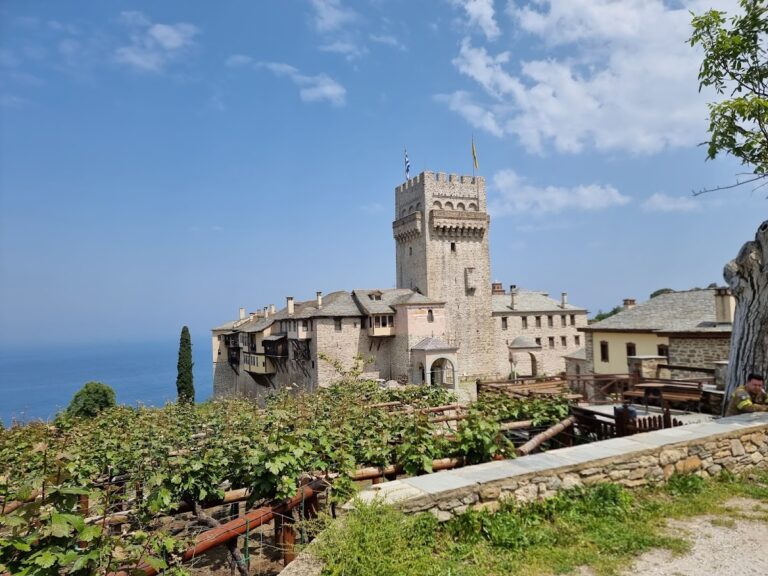
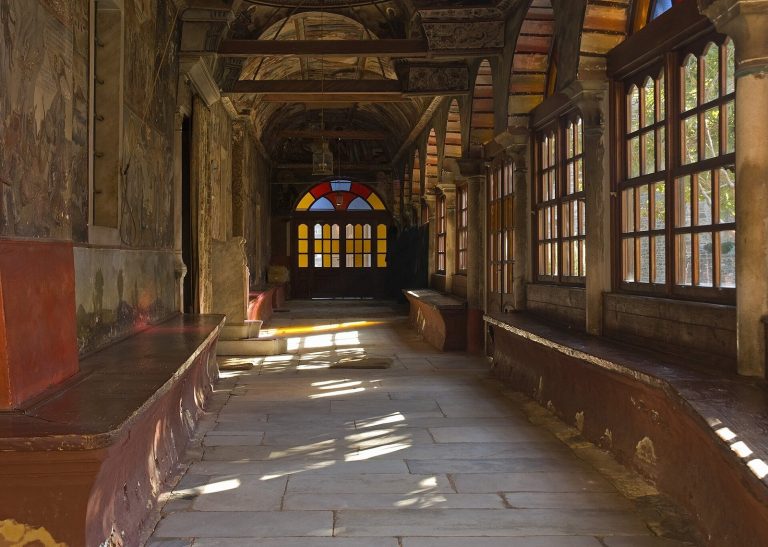
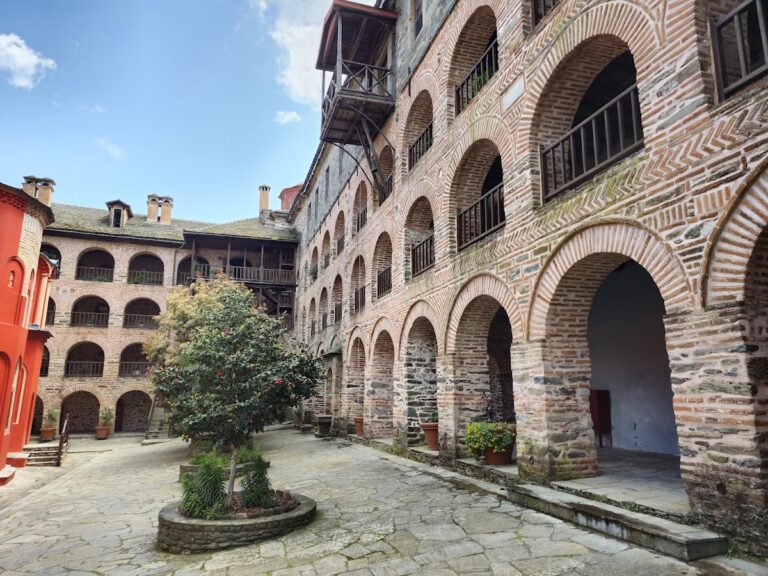
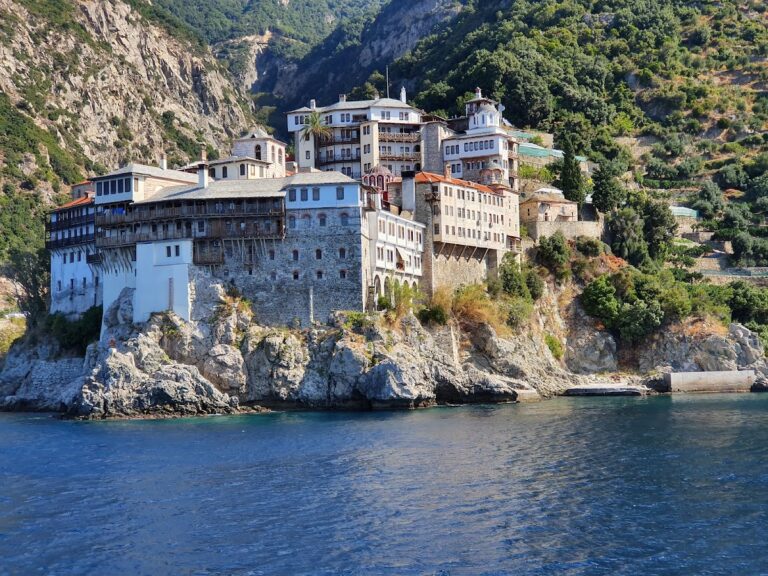
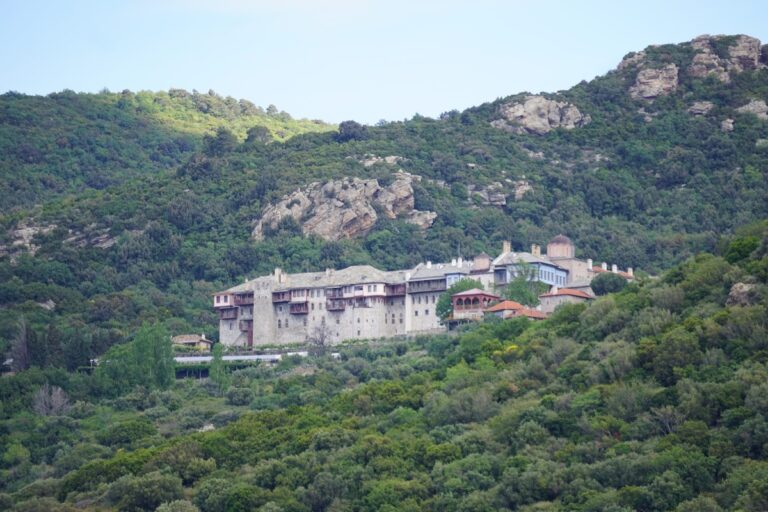
The monastery occupies an estate of approximately 7,350 stremmata, about 2.16 percent of the total area of Mount Athos. Most of the land is forested and has high forest-production potential. Within the complex, the katholikon, the principal church of an Orthodox monastery, is dedicated to the Annunciation of the Theotokos. The present building was erected in 1746 over the remains of an earlier church and received fresco decoration during the eighteenth century.
Chapels and bell tower
The katholikon contains three chapels. The chapel of the Archangels stands to the right of the lite, the principal narthex area used in certain Orthodox services, and has frescoes dated 1752. The chapel of the Nativity of Saint John the Baptist stands to the left of the lite. A chapel dedicated to Saint Marina occupies the bell tower, and the saint’s relics are kept at the monastery.
Six of the monastery’s nine chapels lie within the main complex. Other religious buildings include the chapel of the Three Hierarchs, also called Saint Tryphon, the chapel of the Nativity of the Theotokos, known as Panagouda, and the cemetery church of All Saints. Together, these buildings form part of the monastery’s surviving ecclesiastical group.
Icons and sacred water source
The Glykophilousa is a double-sided icon. One side depicts the Theotokos kissing the Christ Child; the reverse shows Christ crucified, with the Theotokos and the Apostle John the Theologian beside the Cross. Its painting style is described as unlike that of any known school of icon painting. Beside the sea is the spring associated with the icon’s traditional arrival. The water source flows continuously with a stated constant volume and temperature and lies where the icon was believed to have come ashore.
Library and associated places
Library
The library is situated in the east wing of the monastery. It contains 250 manuscripts, 54 of them on parchment, as well as approximately 20,000 printed works. These holdings preserve part of Philotheou’s written intellectual and religious heritage.
Karyes representative building
In Karyes, Philotheou maintains a representative building constructed in 1964. It includes a chapel dedicated to Saint Kosmas of Aetolia.
Dependencies and Saint Dionysius’s cave
Philotheou administers several surrounding dependencies, including five inhabited kellia dedicated to Saint George, Saint Constantine, the Holy Trinity, Saint Demetrios, and the Ascension. Its only kathisma, a small hermitage or isolated monastic dwelling, is the historic cave of Saint Dionysius of Olympus. Dionysius lived there as an ascetic before becoming hegumen of Philotheou.
Land and working infrastructure
The monastery’s present working infrastructure includes hydroelectric and diesel power stations, mountain springs used for drinking water, orchards, vineyards, olive groves, vegetable gardens, a carpentry workshop, a timber-drying facility, and stove heating. These installations and cultivated areas form part of the continuing material basis of the monastic community.