Spinola Castle: A Medieval Fortress and Marquisal Palace in Italy


Site at a Glance
- Rating
- 3.8
- Popularity
- Very Low
- Country
- Italy
- Primary era
- Medieval
- Eras represented
- Medieval, Early Modern
- Civilizations
- Holy Roman Empire
- Site type
- Military
- Remains
- Castle
On this page8 sections
History
Spinola Castle is a medieval defensive building and marquisal palace in Isola del Cantone, Italy. It probably dates from the second half of the thirteenth century, when the fief passed from the Malaspina family to the Spinola family and the site developed as a fortified noble residence.
Malaspina and Spinola rule
The fief belonged to the Malaspina family from 1235 and came under the control of the Spinola family in 1256. The castle’s position and defensive construction reflected the importance of the territory held by these prominent noble families of northwestern Italy. It served both as a stronghold and as a residence associated with the marquisal administration of the fief.
End of the fortress’s strategic role
The castle’s military purpose ended in the eighteenth century. During the French reorganization of the region, beginning in 1797, the abolition of the Imperial Fiefs removed the political and defensive framework that had sustained its strategic function. An Imperial Fief was a territory held directly from the Holy Roman Emperor rather than from a local sovereign.
In 1819, the last Spinola heirs sold the castle to the local Denegri and Zuccarino families. Later interventions transformed the former thirteenth-century residence into private dwellings. The southern part, including its seventeenth-century loggia, remained outside this private conversion and was acquired by the municipality.
Restoration and museum use
Cooperation between the municipality, the Liguria Region, and the former Province of Genoa brought structural consolidation to the castle. A later agreement between Isola del Cantone and Savignone, carried out through the regional Terre di Castelli project, led to the opening of the Archaeological Museum of the Upper Scrivia Valley in 2013.
Founded by the municipalities of Isola del Cantone and Savignone, the museum preserves archaeological finds ranging from prehistory and the Neolithic, the later part of the Stone Age associated with settled farming communities, through the medieval and feudal periods and the centuries immediately before the twentieth century. The castle now combines private residential use with municipal museum use under both private and municipal ownership.
Remains
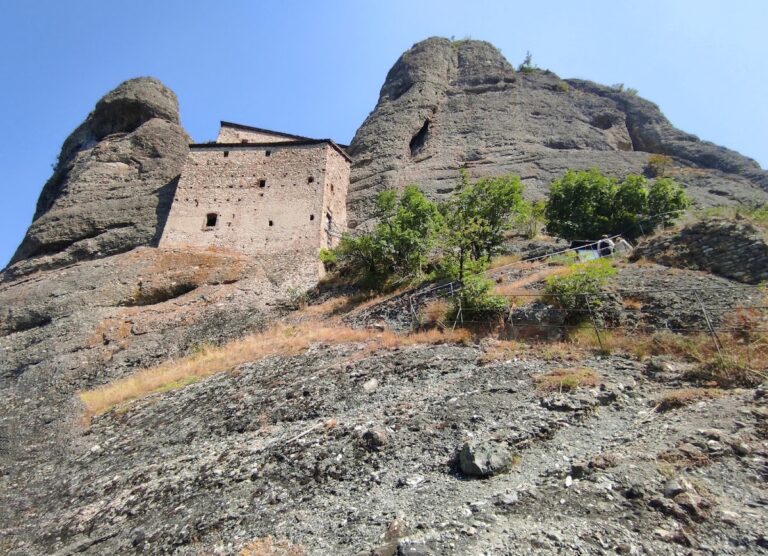
The castle occupies a steep position on the right bank of the Scrivia River, near its confluence with the Vobbia. Its original arrangement was a square enclosure with towers at the corners and a large courtyard at the center. Later construction altered much of the medieval plan, while the tower projecting above the river remained the principal exception.
Medieval fortress plan
The initial defensive complex was organized around enclosing walls, corner towers, and an internal courtyard. Its elevated riverbank position formed part of the site’s defensive setting. The river-facing tower projects beyond the main body of the castle and preserves the clearest surviving element of the original medieval arrangement.
Seventeenth-century enlargement
In 1628, builders added a loggia with a quadrangular base and attached three further floors to the main body. These additions functioned as a buttress, a projecting support intended to strengthen the building. Together with subsequent alterations, they substantially changed the form of the thirteenth-century residence.
Structural recovery and public interior
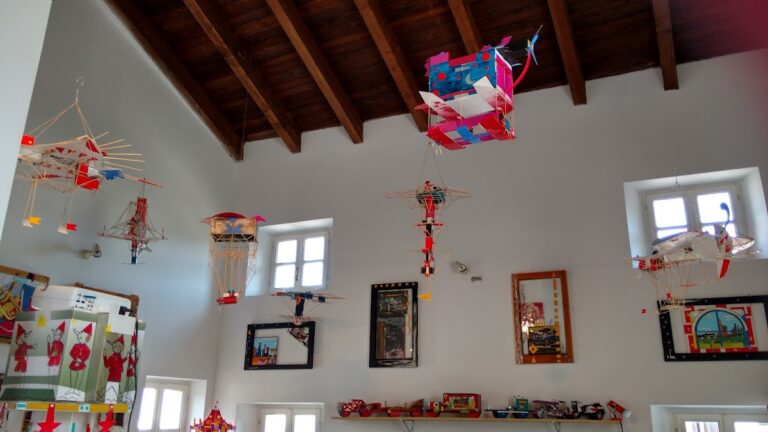
Recovery work consolidated the walls and foundations, strengthened the interior with structural reinforcing rings, and introduced a roof structure made from steel tie rods and wooden beams. The municipal section occupies two floors in the public part of the castle and houses the Archaeological Museum of the Upper Scrivia Valley, while other areas remain in residential use.
Nearby sites