Shōren-in Temple: A Tendai Monzeki Temple in Kyoto


Site at a Glance
- Rating
- 4.5
- Popularity
- Medium
- Country
- Japan
- Primary era
- Medieval
- External website
- Open
- Eras represented
- Medieval, Early Modern, Modern
- Civilizations
- Ashikaga shogunate, Japanese, Tokugawa
- Site type
- Religious
- Remains
- Monastery
On this page12 sections
History
Shōren-in Temple is a Tendai Buddhist temple in Kyoto, Japan, whose institutional origins reach back to the ninth century and the activities of Saichō, the monk who founded the Tendai school. Also called Awata Palace and Shōren-in Monzeki, it became an imperial prayer institution in 1150 and developed into a monzeki temple, a temple whose chief priest traditionally came from the imperial family or high court aristocracy. Shōren-in remains an active Tendai institution.
Origins on Mount Hiei
The institution began as Shōren-bō, a small chapel and monastic residence established by Saichō in the eastern precincts of Mount Hiei. It was associated with Enryaku-ji, the Tendai center founded by Saichō, and housed prominent monks including Ennin. Near the end of the Heian period, the chapel was transferred to Sanjō Shirakawa, slightly northwest of the present temple.
In the twelfth century, Shōren-bō became linked with Gyōgen, who was appointed head priest of Enryaku-ji in 1138. Retired Emperor Toba sent his son, Prince Kakukai, to study under Gyōgen and built a residence for the two men on the chapel site. The residence was modeled on the retired emperor’s own home in the capital, strengthening the institution’s connection with the court.
Imperial institution and medieval prosperity
In 1150, Shōren-bō became an official imperial prayer institution supported by the court and received the name Shōren-in. Gyōgen served as its first chief priest, followed by Prince Kakukai. A dispute over Kakukai’s successor later led the court noble Kujō Kanezane to pressure him to yield the position to his younger brother Jien, who became the third chief priest.
Shōren-in reached its greatest prosperity under Jien, a member of the Fujiwara family, who enlarged the complex and added several structures. Jien was a leading Tendai religious figure, served as head priest of the sect four times, and wrote Gukanshō, an important medieval Japanese historical work. Hōnen, founder of the Jōdo-shū school, and Shinran, founder of Jōdo Shinshū, also studied at Shōren-in during this period.
In 1206, the Shijōkō-hō ritual was performed for the first time in the Shijōkō-dō. This Tendai rite invoked Shijōkōbuchō for the protection of the nation and the safety of the imperial family. The ceremony helped define the religious character of the institution and its continuing association with court prayer.
Move to the present site and succession disputes
During the Kamakura period, Shōren-in moved to its present elevated location, identified with the former temple known as Juraku-in. The move was made to avoid flooding from the Shirakawa River. The name Shōren-in Monzeki first appeared in an imperial decree issued by Emperor Go-Saga on December 29, 1248.
A dispute over Jien’s successor divided the temple into two factions, and the conflict over the monzeki position continued for more than a century. Emperor Go-Daigo eventually mediated the dispute. Following the settlement, the sixteenth chief priest, Prince Jidō, transferred the position to the seventeenth, Prince Sōnen.
Shōren-in’s abbots contributed to religious scholarship and the arts. From the fourteenth century, aristocrats studied poetry, calligraphy, and other arts at the temple. Prince Sōnen, the sixth son of Emperor Fushimi, was a renowned calligrapher. His style became known as the Shōren-in style and contributed to the Goie style that spread during the Edo period. The related traditions were also called Sōnen-ryū, Shōren-in-ryū, or O-mei-ryū, and were practiced by later abbots.
Imperial connections and modern changes
During the Muromachi period, Gien served as chief priest before becoming Ashikaga Yoshinori, the sixth shogun of the Muromachi shogunate. Until the Meiji period, Shōren-in’s chief priests were members of the imperial family. The temple also became a mortuary institution for the imperial household. The official mausoleum of Emperor Hanazono lies southeast of the temple and is called Jurakuin no Ueno Misasagi.
In 1788, the Great Kyoto Fire destroyed the Kyoto Imperial Palace. Shōren-in then served as the temporary residence of Empress Go-Sakuramachi, and the temple acquired the additional name Awata Palace. The empress used Kobun-tei as her study, a function that later shaped the building’s identity as a tea room.
In November 1872, a newly established medical hospital moved into Shōren-in and began operating there. It relocated to its present location in July 1880. A major fire in 1893 destroyed most of the temple buildings, after which reconstruction took place. The present main hall was completed in 1895.
After the Second World War, Higashifushimi Kunihide, the younger brother of Empress Kōjun, became chief priest. His tenure brought arson attacks by the Japanese Communist Party and left-wing radicals, including Chūkaku-ha. Kobun-tei was burned down by Chūkaku-ha on April 25, 1993. Kunihide sold numerous Important Cultural Properties formerly held by the temple to other temples and private collectors to raise funds for restoration and maintenance. The policy was controversial, and he was questioned in the Diet of Japan. After his death at the age of 103 in 2014, his son, Jikō Higashifushimi, inherited the position of chief abbot.
The temple precincts were designated a National Historic Site in 1942. This status forms part of Shōren-in’s modern historical identity, alongside its continuing role as a Tendai religious institution.
Remains
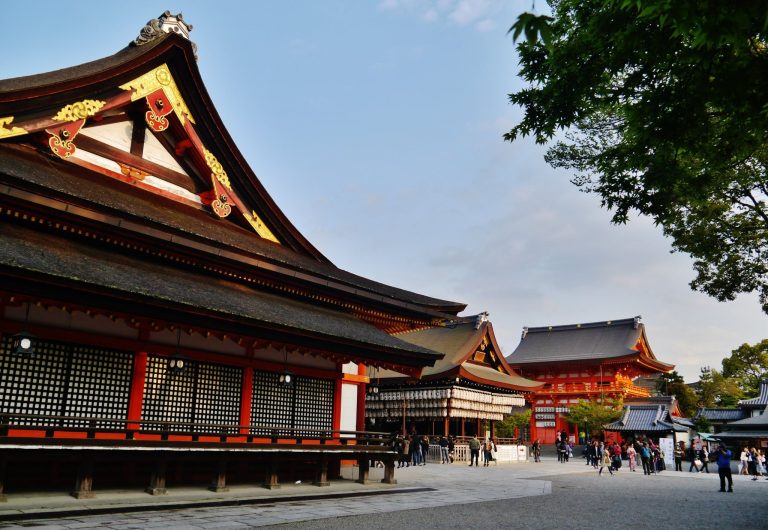
Shōren-in is arranged as a complex of buildings linked by corridors. Its central section is associated with the Muromachi period, although most of the structures were reconstructed after the fire of 1893. The principal buildings include the main gate, the Shinden, the main hall, Kogoshō, Shijōkō-dō, Kobun-tei, and Shōgundzuka-dainichi-dō. The complex also includes Seiryuden at Shōgundzuka, a detached part of the temple grounds in Higashiyama.
Temple buildings and ritual spaces
Shijōkō-dō and Kogoshō
Shijōkō-dō contains the temple’s principal treasures and is connected to Kogoshō. Its principal image is a painting of Shijōkōbuchō, also called Prajvaloshnisa, placed inside a cabinet. The image is normally hidden from public view. Shijōkōbuchō is a Nyorai, or fully awakened Buddha in Mahayana Buddhism, and serves as the central image of the Shishōkō-hō ritual. Its use as the principal image of a temple is unusual.
Main hall and Kobun-tei
The present main hall dates from the reconstruction completed in 1895. Kobun-tei began as the study used by Empress Go-Sakuramachi during her temporary residence at Shōren-in and was later converted into a tea room. The building was destroyed in the 1993 arson attack by Chūkaku-ha. Modern fusuma sliding doors by the artist Hideki Kimura use blue-lotus designs intended to evoke the Pure Land.
Shōgundzuka-dainichi-dō and Seiryuden
Shōgundzuka-dainichi-dō stands at Shōgundzuka, the detached parcel of temple territory in Higashiyama, and is associated with a view over the whole of Kyoto. Seiryuden, a large hall for goma rituals, Buddhist fire ceremonies in which offerings are burned before a sacred fire, was completed there in 2014. A replica of the temple’s National Treasure Fudō Myōō painting is displayed in Seiryuden, while the original is protected in a vault in its inner hall.
Gardens and trees
The temple gardens combine ponds and hills. Tsukiyama Sensui Teien is traditionally attributed to Sōami, a Muromachi-period painter and garden designer, and is dated to the Muromachi period. Kirishima Teien is traditionally attributed to Kobori Enshū, an early-modern garden designer, architect, and tea master, and is dated to the Edo period. A pond in the grounds includes large stones supplied by a small waterfall.
Four large camphor trees stand on the western side of the grounds. Each is approximately 800 years old, and the group is designated a Natural Monument of Kyoto City.
Paintings and associated sacred places
Shōren-in preserves a Heian-period hanging scroll from the middle of the eleventh century showing Fudō Myōō with two attendants in color on silk. Fudō Myōō is a Buddhist wisdom king represented as a fierce protector, commonly carrying a sword and a lasso. The scroll is a National Treasure and forms part of the group known as the Three Fudō Myōō of Kyoto, together with the Yellow Fudō at Onjō-ji and the Red Fudō at Myōō-in on Mount Kōya.
The original scroll was formerly on loan to the Nara National Museum. It is now protected in Seiryuden’s inner hall, while the replica provides the displayed form of the image. Shōren-in’s physical and religious setting also remains connected with the former Juraku-in site and with the nearby imperial mausoleum of Emperor Hanazono, Jurakuin no Ueno Misasagi.