Yakushi-ji Temple: A Hossō Buddhist Temple in Nara


Site at a Glance
- Rating
- 4.4
- Popularity
- Medium
- Country
- Japan
- Primary era
- Classical
- External website
- Open
- Eras represented
- Classical, Medieval, Early Modern, Modern
- Civilizations
- Japanese, Kamakura shogunate, Tokugawa, Toyotomi regime, Yamato
- Site type
- Religious
- Remains
- Monastery
On this page20 sections
History
Yakushi-ji Temple is a Buddhist temple in Nara, Japan, founded by the Japanese court in 680 during the Hakuhō period. Its principal image is the Yakushi Triad, centered on Yakushi Nyorai, the Medicine Buddha associated with healing, and it serves as the head temple of the Hossō school, a Buddhist tradition concerned with consciousness, perception, and Buddhist doctrine. Yakushi-ji is also one of the Seven Great Temples of Nanto, the group of major temples historically associated with Nara.
Foundation and completion
Emperor Temmu established the temple as a prayer for the recovery from illness of his consort, who later became Empress Jitō. Tradition places the beginning of construction in November 680. Temmu died in 686 before the work was finished, but construction continued under Jitō and Emperor Monmu. A ceremony took place at Yakushi-ji in 688, and the temple was reportedly almost complete and occupied by monks by 698.
The first Yakushi-ji stood at Fujiwara-kyō, the capital in Asuka, at the site now called Moto Yakushi-ji, meaning Original Yakushi-ji. When the capital moved to Heijō-kyō in 710, the temple was transferred to its present location in western Nara. The traditional date of the move is 718, although a wooden tablet dated 716 shows that building activity at the new site had already begun. Work continued at least until the East Pagoda was erected in 730.
From Fujiwara to Nara
The Nara complex reproduced the basic arrangement of its predecessor. Its central gate was enlarged and its cloisters were made wider, while the positions and dimensions of many buildings remained nearly identical. This close correspondence indicates an effort to recreate the earlier temple in the new capital. Excavations at Moto Yakushi-ji uncovered eighteen foundation stones whose spacing matches that of the Nara temple, together with stairways and an underlying road system related to the grid of Fujiwara-kyō.
Moto Yakushi-ji continued alongside the Nara temple until about the tenth century, when it was abandoned. Whether particular buildings and Buddhist images were transferred between the two complexes remains debated. One interpretation proposes that the West Pagoda was moved from Fujiwara, while another holds that an early plan to reuse buildings was altered during construction at Nara. The East Pagoda is generally regarded as a new structure built at Nara in 730.
Fire, destruction, and rebuilding
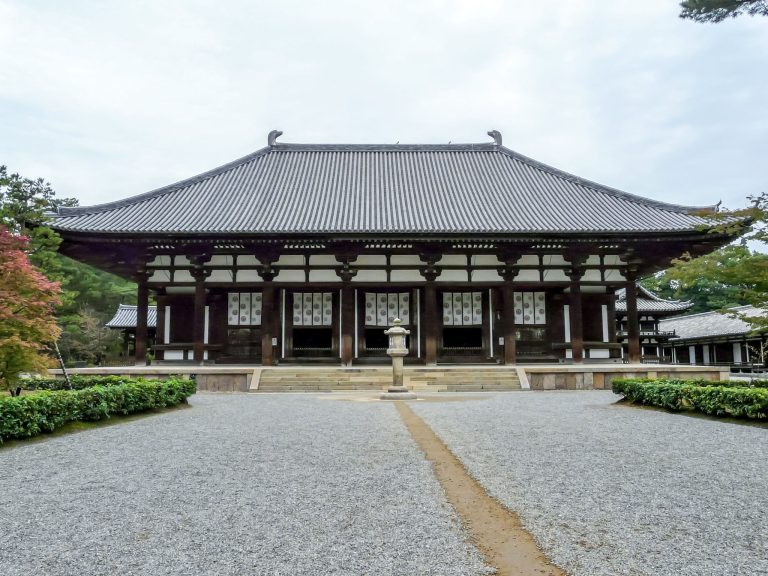
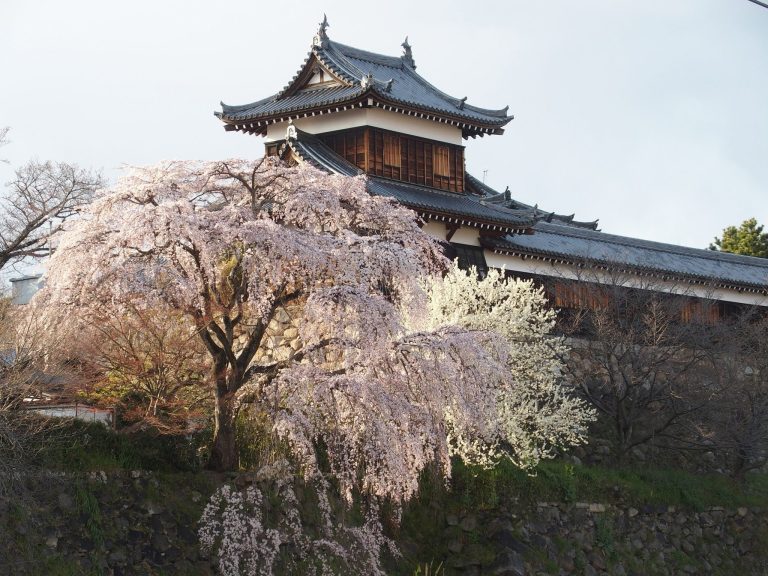
A fire in 973 destroyed the Lecture Hall, the monks’ quarters, the South Main Gate, and many other buildings. The Main Hall and both pagodas survived that disaster. On 7 September 1528, forces led by Tsutsui Junko burned almost the entire temple complex. The East Pagoda and East Cloister Hall were left standing. Masuda Nagamori, lord of Koriyama Castle, rebuilt the Main Hall in 1600, and the Great Lecture Hall was reconstructed in 1852.
The East Pagoda endured repeated repairs after earthquakes and storms. Work took place in 1524, 1644, 1783, 1808, 1856, 1898, and 1950. The Muroto Typhoon of 1934 destroyed the belfry and seriously damaged the pagoda. A major dismantling and repair campaign began in 2009 and continued until December 2020, about 110 years after the previous complete dismantling. The work was formally completed in 2021, followed by a completion consecration ceremony in April 2023.
Revival and continuing religious life
Under the abbot Takada Kōin, appointed in 1967, Yakushi-ji began a large project to revive the appearance of the Hakuhō precinct. The work was supported by a call for one million handwritten copies of Buddhist sutras. The Main Hall was rebuilt in 1976, the West Pagoda in 1981, the Central Gate in 1984, parts of the east and west cloisters in 1995, the Great Lecture Hall in 2003, and the Dining Hall in 2017.
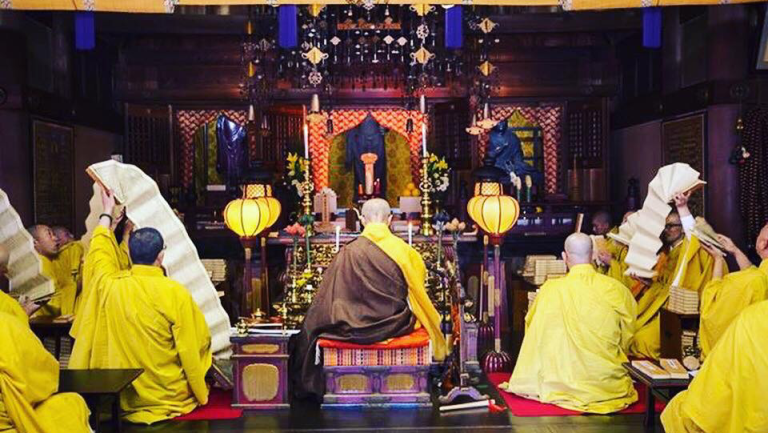
Yakushi-ji has maintained the Shuni-e, or Flower Ceremony, since the Nara period. This penitential rite is dedicated to Yakushi Buddha and includes prayers for national prosperity and plentiful harvests. Its closing night features the Oni-Oi-shiki ceremony, in which demons are expelled. The Kichijō-keka rite, first recorded in 771, has continued for more than a thousand years as a prayer for blessings, peace, and the removal of sin. The Saishō-e, once associated with national security, good harvests, and the examination of candidates for official monk appointments, was revived in 2003 after an interruption of about five centuries.
Yakushi-ji has also maintained a religious connection with neighboring Koyugaoka Hachiman Shrine since the shrine was founded in 896. The shrine remained affiliated with the temple as its guardian shrine despite the separation of Buddhism and Shinto during the Meiji period. In 1998, Yakushi-ji became part of the UNESCO World Heritage property Historic Monuments of Ancient Nara. Moto Yakushi-ji is designated a Special Historic Site, while several buildings and images at the Nara temple are nationally designated treasures. In 2017, Yakushi-ji and Ryukoku University began a cooperation covering cultural-property protection, Buddhist research and education, and monk training.
Remains
Yakushi-ji follows a symmetrical, grid-like plan associated with the Fujiwara complex. The Golden Hall occupies the center of the principal precinct, with the East and West Pagodas placed symmetrically in front of it. A Central Gate and cloisters enclose this core, while the Lecture Hall stands behind the Golden Hall. This arrangement is known as the Yakushi-ji style and preserves the temple’s relationship to the planned capitals of ancient Japan.
Pagodas and early structural remains
East Pagoda
The East Pagoda is a three-story Buddhist tower that appears to have six levels because of its three mokoshi, subsidiary pent roofs set below the main roof. Including its finial, it rises 34.1 meters. It is the only surviving Yakushi-ji building from the Nara period and is generally dated to 730. Its bronze finial includes openwork water-smoke ornaments with flying figures.
The pillar at the top of the tower carries the East Pagoda Inscription. It explains the purpose of the temple’s foundation and the making of its principal image, attributing completion of the work to Empress Jitō after Emperor Temmu’s death. The tower is often called “frozen music” because of its distinctive form, although the phrase was already in circulation before it was mistakenly attributed to Ernest Fenollosa. Stone monuments within the precinct commemorate poets Sasaki Nobutsuna and Aizu Yaichi, both of whom wrote poems about the pagoda.
The tower combines technically advanced elements with older forms. Its bracket complexes rise through three projecting tiers, and its rafters use a pattern of rounded lower rafters with square flying rafters. Archaic characteristics include the lack of a diagonal support between the wall and eaves, a ceiling beneath the eaves, square outer eave beams, and straight tail rafters cut vertically at their ends. Some structural members were joined with iron nails, while the spaces between stories relied on timber joinery without nails.
The 2009 to 2020 investigation found that the original rammed-earth foundation platform remained in good condition beneath later changes. The central foundation stone and the stones supporting the four inner pillars and perimeter pillars retained their original positions. Four Wadō Kaihō coins were found below the foundation. The original platform was preserved beneath a new reinforced-concrete supporting base. About 90 percent of the original timber was reused during the repair; the rest was repaired or replaced.
Insect damage had affected the lower two meters of the central pillar, or shinbashira, the main internal support of the pagoda. That section was removed and filled with new timber. Pigments protected by the shadows of the structural members survived well around the ceiling paintings. Clay groups depicting eight principal episodes from the life of Shakyamuni were originally placed inside the first story of both pagodas. Fragments and wooden cores are now preserved separately.
Golden Hall and Yakushi Triad
The Golden Hall houses the Yakushi Triad. Yakushi Nyorai stands at the center, accompanied by Sunlight Bodhisattva and Moonlight Bodhisattva. The bronze figures date from the late Asuka Hakuhō period to the Nara period, between the seventh and eighth centuries. Yakushi Nyorai is 254.7 centimeters high, while the two attendants measure 317.3 and 315.3 centimeters.
The central figure has auspicious wheel designs incised on the palms and soles, along with a swastika-flower pattern on the toes. The draped pedestal carries grape-vine decoration, foreign-looking figures, and the Four Guardian Animals, the Azure Dragon, White Tiger, Vermilion Bird, and Black Tortoise, which represent the four directions in East Asian religious tradition.
The sculptures combine naturalistic bodies, sharply cut drapery, and the influence of early Tang art. The attendant bodhisattvas turn their necks and waists in the three-bend pose, a convention that reached Japan through Tang China from Gupta-period India. The Triad’s date and original location remain uncertain. Proposed dates place its creation before the 688 ceremony, in 697, or after the transfer to Nara.
Cloister images and lecture-hall monuments
East Cloister Hall and Sacred Kannon
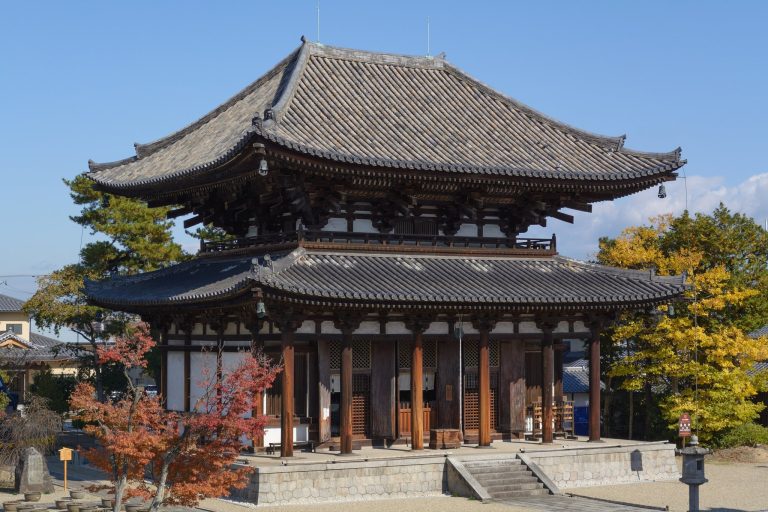
The East Cloister Hall is a Kamakura-period building that houses a standing bronze image of the Sacred Kannon, 188.9 centimeters high. The figure was made by lost-wax casting, a process in which a wax model is replaced by molten metal, and its right hand and portions of the floating scarf were cast separately. Most of the gilding has peeled away, while the wooden halo is a later replacement.
The Sacred Kannon stands on a lotus pedestal with the right arm lowered and the left arm raised, its palm facing forward. Naturalistic modeling appears alongside older features, including a faint archaic smile, a sharply formed nose and philtrum, strongly symmetrical drapery, and arabesque decoration around the hair. Its date is debated between the late Hakuhō period and the Nara period, and its original location before the medieval period is unknown.
A temple tradition in the Yakushi-ji origin account connects the establishment of the hall with prayers for the recovery of the retired Empress Genmei during the Yōrō era. The tradition does not establish that the Sacred Kannon was the hall’s original principal image.
Great Lecture Hall
The Great Lecture Hall contains the Buddha Footprint Stone, made in 753. Its long inscription says that the design was copied from a footprint brought from Tang China by Kōsho Honjitsu. The reproduction was made for memorial prayers for the wife of the donor, Fumeno Mahito Chino.
The hall also preserves the Buddha Footprint Song Stele, a 194-centimeter stone monument inscribed in man’yōgana, an early writing practice that uses Chinese characters for their sounds. Its twenty-one poems use a six-line Buddha Footprint Song form rather than the customary five-line waka. It remains uncertain whether the stele and the footprint stone originally belonged to one set.
Northern precinct
The northern precinct contains the Main Administrative Residence, the Sutra-Copying Hall built in 1972, Mahoroba Hall, the Kaimon Gate, the Great Gate built in 1991, Xuanzang Hall, the Tang Western Regions Mural Hall, the East Repository, the West Repository, and the Courtesy Gate.
Xuanzang Hall
Xuanzang Hall is an octagonal building surrounded by a mokoshi. It enshrines a seated image of Xuanzang, the seventh-century Chinese Buddhist monk, translator, and pilgrim whose journey to India and translation of scriptures strongly influenced East Asian Buddhism and the Hossō tradition. The hall also holds part of his skull relic. The relic reached Japan in 1944 after the Japanese army discovered Xuanzang’s destroyed tomb in Nanjing. Half was returned to Taiwan in 1955, and a portion was later divided with Yakushi-ji in 1981.
The plaque bearing the words “Not Turning East” refers to a vow to continue westward until reaching India. The hall therefore links Yakushi-ji’s Hossō identity with the figure whose teachings and travels shaped that Buddhist tradition.
Tang Western Regions Mural Hall
The Tang Western Regions Mural Hall houses a mural by Hirayama Ikuo, produced over thirty years. It measures 2.2 meters high and 49 meters long, with seven scenes arranged across thirteen wall sections. The central three panels represent the principal image, the Western Pure Land, and Mount Sumeru.
Jion Hall
Jion Hall was moved to Yakushi-ji from Chōkyū-ji in central Osaka when road widening required its relocation. Its sixty-six wall paintings, titled “Fusion of East and West,” were produced over six years by former Prime Minister Hosokawa Morihiro.
Shrines and associated buildings
Sontarō Inari Shrine
South of the main precinct stands Sontarō Inari Shrine. Its enshrined deity was moved through several locations, beginning at a shrine on Mount Karasawa in Sano, continuing to the area below Himeji Castle, and reaching its present site in the early Edo period.
Koyugaoka Hachiman Shrine
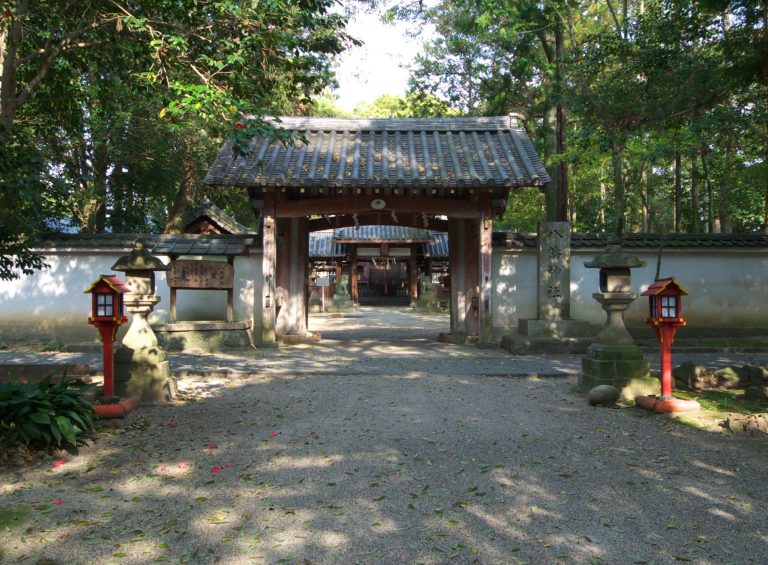
Koyugaoka Hachiman Shrine stands across the public road outside the South Gate and serves as Yakushi-ji’s guardian shrine. Its Main Sanctuary, North Flanking Hall, and South Flanking Hall were rebuilt in 1603 under Toyotomi Hideyori, with Katagiri Katsumoto acting as superintendent. The North and South Seating Halls were also rebuilt during the Keichō era, and the North Seating Hall now serves as an office.
The principal sanctuary contains the monk-form Hachiman deity, Empress Jingū, and Princess Nakatsu. Hachiman is associated with warfare and protection of the state, while Empress Jingū is a legendary figure in early Japanese tradition. The shrine’s origin is linked to the transfer of Hachiman worship from Usa, although traditions place its first establishment in either 749 or 896.
Designated treasures
Yakushi-ji’s nationally designated treasures include the East Pagoda, East Cloister Hall, Yakushi Triad, standing bronze Kannon, wooden seated figures of the monk-form Hachiman deity, Empress Jingū, and Princess Nakatsu, the Hemp-Cloth Painting of Kichijōten, a silk painting of the Buddhist master Cien, the Buddha Footprint Stone, and the Buddha Footprint Song Stele. The Hachiman figures are deposited at the Nara National Museum. The Kichijōten image is displayed in the Golden Hall during the first three days of the year and on limited dates in the temple’s Great Treasure Hall.