Yasaka Shrine: Kyoto’s Shinto Shrine and Home of the Gion Festival


Site at a Glance
- Rating
- 4.4
- Popularity
- Very High
- Country
- Japan
- Primary era
- Early Modern
- External website
- Open
- Eras represented
- Medieval, Early Modern
- Civilizations
- Tokugawa
- Site type
- Religious
- Remains
- Sanctuary
On this page19 sections
History
Yasaka Shrine is a Shinto shrine in Kyoto, Japan, at the eastern end of Shijo Street in the Gion district. Its history is traditionally traced to 656, during the reign of Empress Saimei, and its principal sanctuary follows the Gion-zukuri, or Yasaka-zukuri, architectural style. The shrine is the principal institution associated with the Gion Festival and claims to be the head shrine of approximately 2,300 shrines dedicated to Susanoo and related deities.
Origins and the Gion deity
One foundation tradition says that Iri Shiomi, an envoy from Goguryeo, established a shrine to Susanoo in 656. The deity was associated with Mount Gozu in Silla. A second tradition places the beginning of the institution in 876, when Ennyo, a monk from Nara, built a Buddhist hall at the foot of the Higashiyama hills. In the nearby Gion Grove, the Gion deity then appeared.
The historian Kubota Osamu judged that the second tradition best explains the shrine’s development. In this interpretation, Kankeiji was founded in 876, followed by the appearance of the Gion deity, and the institution later developed into a jinguji, a Buddhist temple established to administer or serve a shrine. The early deity was recorded simply as the Gion deity or Tenjin. Gozu Tenno and Susanoo were gradually identified with this figure, probably by no later than the Kamakura period. The theory that the deity had been transferred from Hiromine in Harima is not supported by surviving Heian-period records.
The institution was first known as Gion Shrine, Gionsha, or Gion Kanjin-in. Its strong Shinto-Buddhist syncretism, meaning the long interweaving of Buddhist institutions and rituals with Shinto kami, shaped its administration. Kofukuji initially controlled the shrine, and Enryakuji later exercised authority over it. The shrine was not included in the mid-Heian Engishiki register of shrines, but it became one of the Twenty-Two Shrines by 995. This was a privileged group that received special imperial attention and offerings during the Heian period.
The Buddhist-Shinto institution
Kanjin-in was established in 934 as a subsidiary temple of Kankeiji. It soon became the principal temple administering Gion Shrine, which consequently acquired the name Gion Kanjin-in. The shrine had long been a branch institution of Kofukuji, the principal temple of the Hosso school, but a dispute led to its affiliation with Enryakuji in 974. By this period, the shrine had gained a broad local following as an ujigami, or guardian deity of the surrounding community, while also receiving strong imperial patronage.
The Gion Festival grew from a spirit-pacification ceremony held at Shinsen-en in 869 during an epidemic. A related ceremony took place at the shrine, then called the small shrine of Higashiyama, in 877. That event helped promote the institution’s development. In the same year, Fujiwara no Mototsune donated his residence for use as the shrine’s sacred precinct. In 879, Emperor Yozei donated twelve cho of land at Horikawa, and 360 timber merchants from the area became shrine-affiliated persons. The festival became an annual shrine ceremony around 970. Its religious purpose included pacifying dangerous spirits and warding off epidemics.
In 974, Emperor Enyu ordered the establishment of the Otabisho of the Grand Steward and elevated the Gion spirit-pacification rite into an imperial festival. An otabisho is an external or temporary shrine where a deity or portable shrine rests during a procession. In 1070, Kanjin-in received recognition of a large precinct west of the Kamo River, extending between the Higashiyama, Gojo, Kamo River embankment, and Sanjo boundaries, together with exemption from outside administrative intrusion. Around this time, members of the Kii family began hereditary control as the shrine’s executive administrators.
Emperor Go-Sanjo visited the shrine on 24 March 1072, beginning a series of imperial visits and pilgrimages by emperors and retired emperors. In 1227, Enryakuji ordered the shrine’s Inugami people to demolish the tomb of Honen. This episode is associated with the Karoku Persecution.
Separation from Enryakuji and later rebuilding
Ashikaga Yoshimitsu separated Gion Shrine from Enryakuji in 1384. The shrine did not thereby become an institution of the Muromachi shogunate, but Ashikaga shoguns donated estates, sponsored repairs, and employed the shrine’s executive administrator for their family prayers. During this period, responsibility for the Gion Festival increasingly passed to Kyoto’s prosperous town communities.
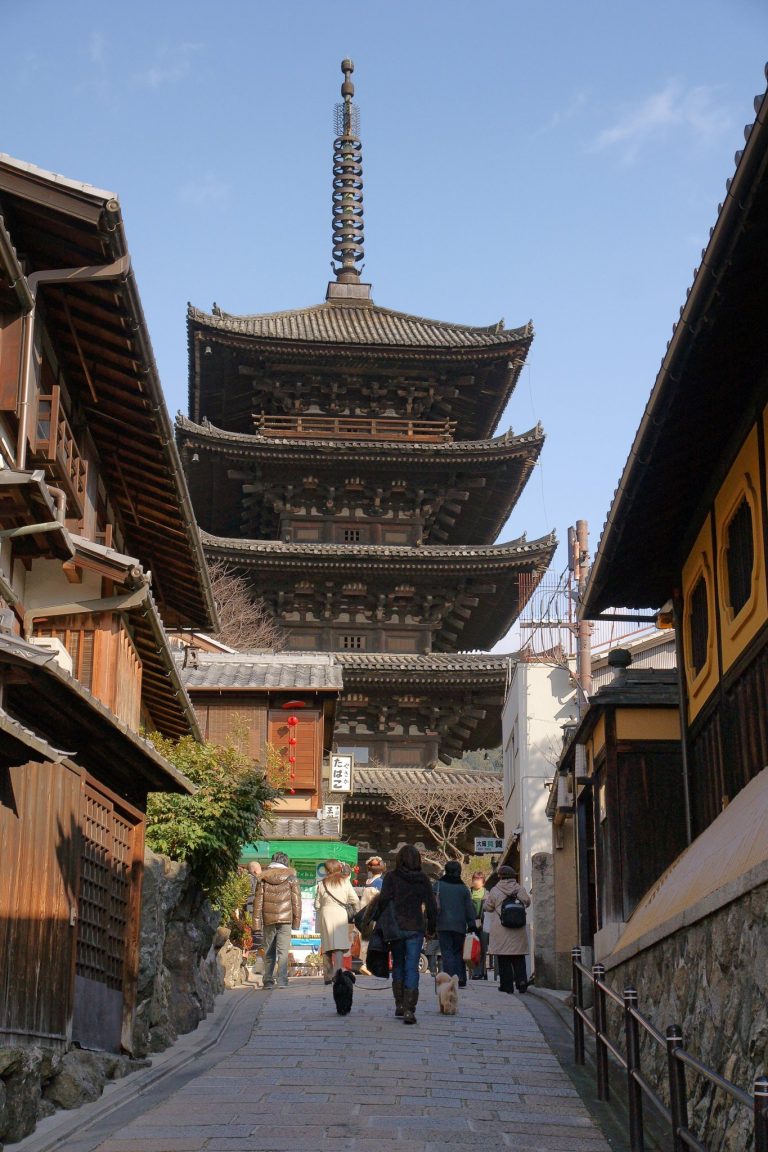
The outbreak of the Onin War in 1467 devastated Kyoto, and the Gion Festival was suspended for 33 years. Enryakuji’s destruction during Oda Nobunaga’s assault on Mount Hiei in 1571 further weakened that temple’s control over the shrine. Toyotomi Hideyoshi prayed at the shrine in 1590 for the recovery of his mother, known by the title Grand Steward, and rebuilt the pagoda while donating an income of 10,000 koku, a historical measure of rice yield and land income.
The Tokugawa shogunate repaired the main hall in May 1646, but a fire destroyed it on 18 November of that year. The shogunate rebuilt the building in 1654. This was its last direct construction project for a shrine or temple before it ended its policy of preferential support for religious institutions. The pagoda later burned during the Kansei period, from 1789 to 1801. Repairs to the shrine buildings were funded by the communities responsible for the Gion Festival floats, the communities serving the portable shrines, and the shrine’s parishioners during 1684 to 1688, 1764 to 1772, and 1818 to 1831.
Meiji reorganization and modern status
The 1868 policy separating Buddhism and Shinto abolished Kanjin-in and demolished the Kankeiji Yakushido beside the main hall. The institution was renamed Yasaka Shrine, and worship formerly centered on Gozu Tenno was reorganized around Susanoo. Gozu Tenno, a Buddhist-Shinto deity associated with protection from epidemic disease, had been identified with Susanoo in medieval Japan. The former Yakushido’s standing image of Yakushi Nyorai and its standing image of Eleven-Headed Kannon were transferred to Dairenji, while the bell went to Daiun-in.
Yasaka Shrine became a government-supported Kanpei-chusha shrine in 1871 and was promoted to Kanpei-taisha in 1915. In 1948 it became a Beppyo Shrine of the Association of Shinto Shrines, a listing that reflects institutional standing. The West Tower Gate was moved 6 meters east and 3 meters north in 1913 to accommodate the widening of Shijo Street. Major restoration and rebuilding followed in 2002.
On 23 December 2020, the main hall was designated a National Treasure, while 26 additional buildings, including subsidiary and auxiliary shrines, were designated Important Cultural Properties. Together with the previously designated West Tower Gate, Ebisu Shrine building, and stone torii, the designation covered 29 buildings. Yasaka Shrine is also known as Gion-san or Yasaka-san and remains the principal institution associated with the Gion Festival.
Deities and religious traditions
Susanoo occupies the central sanctuary, Kushinadahime, his mythological wife, the eastern sanctuary, and the eight offspring deities known collectively as the Eight Mikogami the western sanctuary. The eastern sanctuary also contains Kamooichi-hime and Samirahime, described as additional wives of Susanoo. The western sanctuary contains Inada no Miyanushi Suga no Yatsumimi.
Before the Meiji separation of Buddhism and Shinto, the principal triad consisted of Gozu Tenno, his consort Harisaijo, and the Eight Princes. These figures were identified respectively with Susanoo, Kushinadahime, and the calendrical Eight Guardian Deities. Kushinadahime was also associated with Toshitokujin, the deity of the auspicious direction and the New Year calendar.
The shrine venerates Dadokuke-no-Kami in the eastern sanctuary. This deity is described either as Ima-no-Gozen, a daughter of the dragon king Sagara, or as a transformation of the Yamata-no-Orochi tradition. The shrine tradition does not give a single clear explanation of the deity’s identity.
Remains
Yasaka Shrine stands at the foot of the Higashiyama hills, with Maruyama Park adjoining its eastern side. One description identifies the park as land formerly included within the shrine precinct. The complex contains principal and subsidiary sanctuaries, gates, a ritual and performance stage, ablution pavilions, a sacred-horse stable, an ema hall for votive plaques, a portable-shrine storehouse, and enclosing elements. Its principal sanctuary is built in Gion-zukuri, in which the honden, the sanctuary housing the kami, and the haiden, the worship hall, are combined in one structure. This arrangement reflects the influence of Buddhist main-hall architecture.
Gates and principal buildings
West Tower Gate
The West Tower Gate is a large, brightly colored, two-story entrance dated to 1497. Guardian figures occupy the gate, which was moved eastward and northward in 1913 when Shijo Street was widened. It is one of the buildings included in the shrine’s cultural-property designations.
Stone torii and South Tower Gate
The stone torii before the southern entrance was erected in 1646 and repaired after the earthquake of 1666. It is described as possibly the largest stone torii in Kyoto. The South Tower Gate forms another principal entrance, while red wooden torii mark the eastern entrance.
Main hall
The present main hall was rebuilt in 1654 after the Tokugawa shogunate’s 1646 repair was followed by fire. It contains the combined sanctuary and worship hall characteristic of Gion-zukuri and is described as the largest surviving example of that style in Japan. The building was designated a National Treasure on 23 December 2020.
Subsidiary and auxiliary shrines
Shrines associated with Susanoo and protection
Ekijinja, dedicated to Somin Shorai, was built around 1823. Akuojisha, dedicated to the vigorous spirit of Susanoo, was transferred to Yasaka Shrine in 1877. Kanjadensha is dedicated to the spiritual essence of Susanoo at the time of his oath with Amaterasu. Otoshi Shrine, dedicated to Otoshi and Chimata-no-Kami, was built around 1654. Tokiwa Shrine is dedicated to Susanoo, while the Ancestral Spirits Shrine honors important former chief priests and other principal shrine associates.
Shrines of prosperity, beauty, and the natural world
Kitamuki-Ebisu Shrine, dedicated to Kotoshironushi, was built in 1646. Okuninushi Shrine is dedicated to Okuninushi, Kotoshironushi, and Sukuna-bikona. Utsukushigozen Shrine, dedicated to the Three Munakata Goddesses, was built in 1591 and has a spring called the Beauty Water before it. Gyokko Inari Shrine is dedicated to Ukanomitama, while Myobu Inari Shrine is dedicated to the Three Fox Deities and was repaired in 2008. The two Inari shrines are treated as a single paired institution.
Daijingu Shrine is dedicated to Amaterasu and Toyouke and was repaired in 2016. Hamono Shrine, dedicated to Amenomahitotsu, was repaired in 2012. Itsukushima Shrine, dedicated to Ichikishimahime, was repaired in 2018. Hiyoshi Shrine, dedicated to Oyamakui and Onamuchi, was built in the mid-nineteenth century. Ota Shrine, dedicated to Sarutahiko and Uzume, was built in 1913.
Ten Shrines and Five Shrines complexes
The Ten Shrines complex contains the shrines of Taga, Kumano, Hakusan, Atago, Kinmine, Kasuga, Katori, Suwa, Matsuo, and Aso. The Five Shrines complex contains Hachiman, Kamado, Wind, Tenjin, and Water shrines. It was built in 1927.
Festival buildings and external shrines
Shijo Otabisho
The Shijo Otabisho outside the main precinct has eastern and western halls. The eastern hall, dating to 1837, is dedicated to the Eight Mikogami. The western hall, rebuilt in 1901, is dedicated to Susanoo and Kushinadahime. Between them stands a portable-shrine storehouse that houses three mikoshi, or portable shrines, during the Gion Festival from 17 to 24 July.
The former Grand Steward Otabisho and former Shoshoi Otabisho once received different festival processions. The former received Susanoo and the Eight Princes, while the latter received Kushinadahime. Toyotomi Hideyoshi ordered their consolidation at the Shijo-Kyogoku Otabisho in 1591. The former Shoshoi site later received a Tenno Shrine, which was moved to the grounds of Munakata Shrine in the Kyoto Imperial Park in 1877.
Matatabi and Grand Steward shrines
Sanjo Goku Shrine, also called Matatabi Shrine, is an external shrine where the three mikoshi are housed during the return procession on 24 July. Another Matatabi Shrine, dedicated to Susanoo, Kushinadahime, and the Eight Mikogami, was built in 1789. An external Kanjadensha dedicated to the fierce spirit of Susanoo was built in the early Meiji period.
The Grand Steward Shrine, an external shrine dedicated to Susanoo and the Eight Mikogami, was built in 1912. The former site of the Grand Steward Otabisho lies below Karasuma Street near Bukkoji Street. A small shrine stands there, and the naginata, a traditional Japanese polearm, from the Naginata Hoko float is deposited there on 15 July before the sacred-sword reception ceremony on 16 July.
Records and former Buddhist objects
The ema hall displays a reconstructed mathematical votive plaque made in 1691 by Hasegawa Rin-kan. The shrine’s historical records include the Gion administrative diaries in nine volumes with 59 supplementary records, as well as the Yasaka Shrine documents, comprising 2,205 documents in 89 scrolls, 40 books, one bound volume, and one individual document. Together, these materials preserve evidence about the shrine’s administration and history.
The former Buddhist material associated with the Yakushido is now preserved outside the shrine precinct. The standing Yakushi Nyorai and standing Eleven-Headed Kannon images are at Dairenji, while the Yakushido bell is at Daiun-in. Their removal reflects the institutional reorganization that followed the 1868 separation of Buddhism and Shinto.