Yabo Tenmangū: A Historic Tenjin Shrine in Kunitachi, Japan


Site at a Glance
- Rating
- 4.3
- Popularity
- Medium
- Country
- Japan
- Primary era
- Unclassified
- External website
- Open
- Eras represented
- Unclassified
- Civilizations
- Unclassified
- Site type
- Religious
- Remains
- Sanctuary
On this page6 sections
History
Yabo Tenmangū is a Shinto shrine in Kunitachi, Tokyo, Japan, dedicated to Sugawara no Michizane, a court scholar and statesman venerated as Tenjin, the deity of learning. Shrine tradition dates its foundation to 903, when Michizane’s third son built a mausoleum and enshrined his father after his death. The existence of this purported son remains historically uncertain. Yabo Tenmangū stands beside the Kōshū Kaidō highway and is traditionally regarded as the oldest Tenman-gū in eastern Japan.
Foundation and early traditions
According to shrine tradition, the purported founder died in 921 and was then enshrined together with Michizane. Another tradition places the shrine’s relocation at the present site in 1181. Yabo Tenmangū is also regarded as a possible claimant to Anazawa Shrine, a shrine listed in the Engishiki, a tenth-century compendium of officially recognized rites and shrines. The shrine was formerly classified as a prefectural shrine and has Dazaifu Tenmangū as its head shrine.
Alongside Kameido Tenjin and Yushima Tenmangū, Yabo Tenmangū is known as one of the three major Tenjin shrines of the Kantō region. An Edo-period anecdote connects the expressions “yaboten” and “yabo” with a kyōka poem by Ōta Nampo, but this explanation is regarded as a later interpretation rather than a reliable account of the expressions’ origin.
Modern history and observances
On 1 August 1908, a motor procession travelled from the Kōshū Kaidō toward Tachikawa under the leadership of Prince Arisugawa Takehito, a member of Japan’s imperial family and a Meiji-era military figure. His Darracq led eleven vehicles, including three domestically produced Takuri cars, and the participants held a luncheon in the shrine’s plum grove. The event is regarded as Japan’s first touring drive, and a commemorative monument remains in the grove.
Major observances include New Year’s rites, the brush memorial service on 25 January, the annual festival on 25 September, the garden-torch and bullfinch-exchange rites on 3 November, the November Ōtori Festival, and the Niiname Festival on 23 November. The September festival includes a lantern procession, floral lanterns, and a traditional lion dance. A major festival is held once every 100 years.
The shrine’s long history and its association with Tenjin have encouraged prayers for success in examinations. During the examination season, many votive plaques are hung within the precincts.
Remains
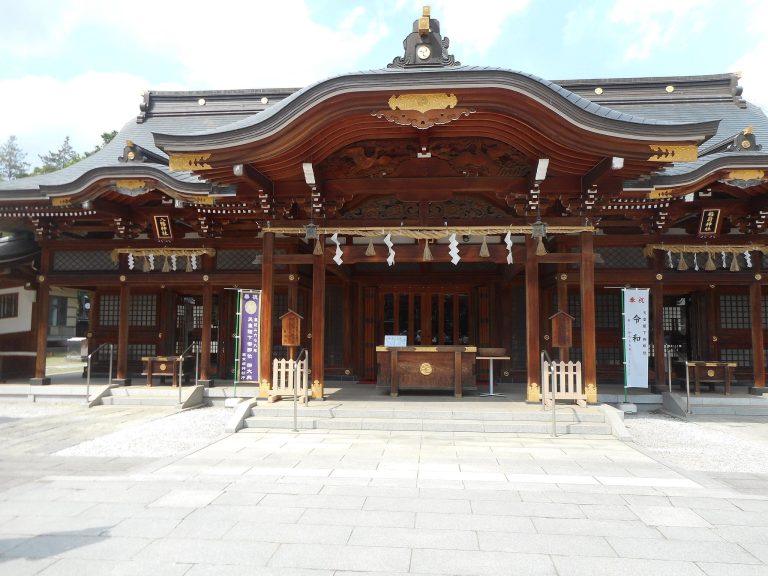
Yabo Tenmangū follows the Tachikawa escarpment, a river-terrace formation along the Tama River. Visitors approach the precinct by descending stone steps from the Kōshū Kaidō, creating a downward-oriented layout that is unusual among Tenman-gū shrines. The main sanctuary uses the nagare-zukuri style, characterized by a gabled roof with a gracefully curved overhanging eave at the front.
Shrine halls
The precinct includes the Three-Shrine Combined Hall, also called the Inari Combined Hall, together with the Dairoku-ten Shrine, the Benten Shrine, also called the Itsukushima Shrine, the Five-Shrine Combined Hall, and Saburō Hall. An additional Itsukushima Shrine is also located within the precinct. The associated Nisshin Inari Shrine stands outside the main precinct. Dairoku-ten refers to the “Sixth Heaven,” a religious figure associated with the sixth heaven in the realm of desire in Buddhist cosmology.
Plum grove and commemorative monument
On the Kōshū Kaidō side of the precinct, the plum grove is known for its plum trees. It was the setting for the luncheon held during the 1908 motor procession, and the commemorative monument for that event remains there.