Awata Shrine: A Shinto Shrine and Guardian of Travelers in Kyoto


Site at a Glance
- Rating
- 4.2
- Popularity
- Low
- Country
- Japan
- Primary era
- Early Modern
- External website
- Open
- Eras represented
- Early Modern
- Civilizations
- Tokugawa
- Site type
- Religious
- Remains
- Sanctuary
On this page14 sections
History
Awata Shrine is a Shinto shrine in Kyoto, Japan, traditionally founded in 876 during the Heian period. Its foundation is linked to an imperial response to warnings of warfare in a neighboring region and epidemics expected later that year. The shrine’s principal deities are Susanoo, a kami associated with storms and violence, and Okuninushi, a kami connected with land, community formation, and social relationships.
Foundation Traditions
According to one foundation tradition, Fujiwara no Okitsugu, Governor of Dewa and an imperial envoy, prayed for seven days and seven nights at Gion Kanjin-in, now Yasaka Shrine. On the final night, Okuninushi appeared as an old man and directed him to establish a shrine northeast of Gion, at a pure place associated with Gozu Tenno, a deity identified with Susanoo. The shrine was then built by imperial command.
Another tradition credits the Awata clan with founding the shrine. The clan was said to descend from Emperor Kōshō and to have governed the area, establishing Awata Shrine as its ujigami, or clan and local tutelary deity. The shrine later became the guardian shrine of Shoren-in. Since it enshrined the same principal deities as Gion Kanjin-in, it was called Kanjin-in Shingu, meaning “New Shrine of Kanjin-in.” It was also known as Awata Tenno-gu and Awata Tenno Shrine.
Awataguchi and Swordsmithing
Awata Shrine stands at Awataguchi, one of Kyoto’s traditional seven entrances, with the Tokaido passing in front of it. This position gave the shrine a protective association with travelers beginning journeys. People continue to make votive offerings and obtain amulets before setting out.
Awataguchi was also associated with swordsmiths. Their workshop name was Awataguchi, or Sanjo Kokaji because their workshops faced Sanjo Street. Celebrated smiths active from the Heian through Kamakura periods included Sanjo Munechika and Awataguchi Yoshimitsu. The area’s reputation later became the subject of the Muromachi-period kyogen play Awataguchi.
Festival Traditions
The Awata Festival, also called the Awata Shrine Grand Festival or Awataguchi Festival, consists of a Night Procession on the eve of Sports Day, a ritual procession on Sports Day, and the annual festival on October 15. Its origin is traditionally placed in 1001, when a divine child appeared at Gion Shrine and foretold that a miraculous light would appear seven days later northeast of Gion. The light was then said to have appeared at the site of Awata Shrine.
The annual festival was formerly held on the fifteenth day of the ninth lunar month. Its procession includes sword-pole standards and a portable shrine, and the sword-pole procession is traditionally regarded as a prototype for the floats of the Gion Festival. During the Muromachi period, when the Gion Festival was not held, the Awata Festival is said to have served as the local goryoe, a rite intended to appease spirits believed to cause epidemics and other calamities.
A record compiled around 1717 describes a portable-shrine procession that traveled from Awataguchi along the road toward Sanjo, Kurodani, and Nijo Street, reaching the general gate of Nanzenji at Matsubara. The procession stopped after a typhoon damaged the worship hall’s roof in 1959 and repair costs became burdensome. It resumed in 2000, the thousandth anniversary traditionally associated with the beginning of the Awata Festival. The festival date once coincided with that of Okazaki Shrine, whose event was later moved to October 16.
Modern Changes and Religious Associations
During the Meiji period, the shrine was renamed Awata Shrine and classified as a prefectural shrine under the former shrine-ranking system. The shrine’s Buddhist associations also changed during the Meiji-period suppression of Buddhism, which removed the Shoten hall that had stood along the approach.
Lanterns resembling Nebuta lanterns were used at the shrine until the 1830s, after which the practice lapsed. Large lanterns were revived in 2008. Awata Shrine is associated with the Kyoto Sixteen Shrines pilgrimage and the Kyoto Sword Goshuin Pilgrimage. Its honden, heiden, and haiden are designated tangible cultural properties by Kyoto City.
Remains
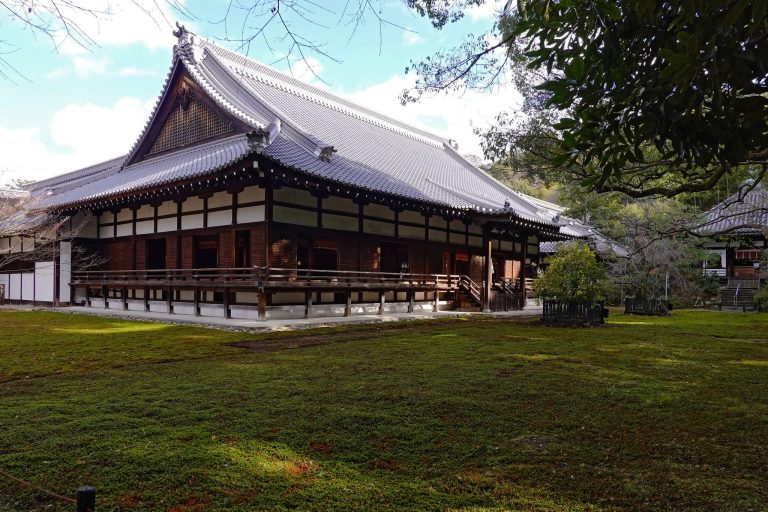
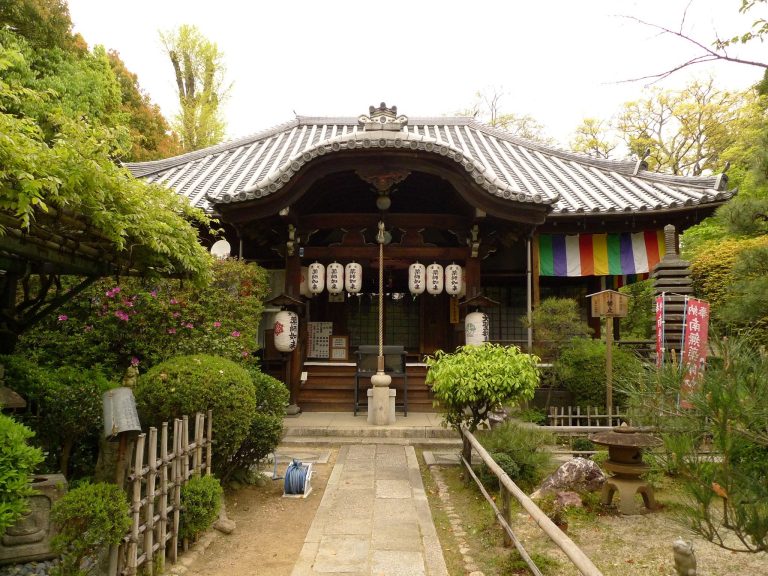
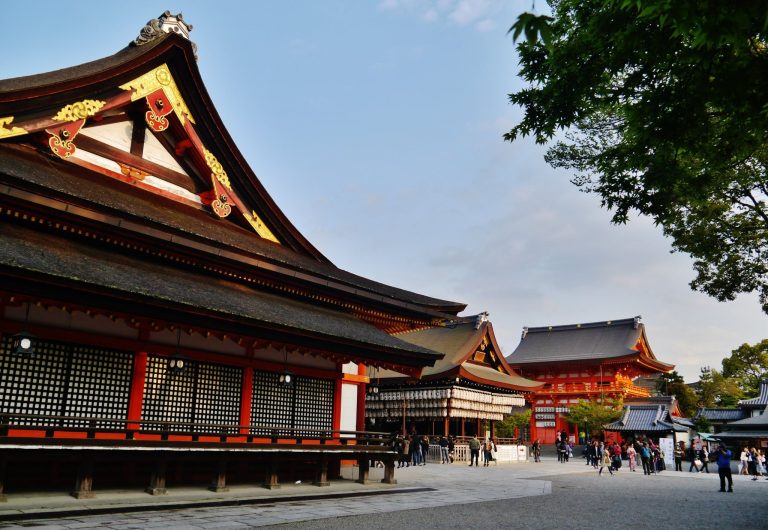
The shrine complex contains the honden, or main sanctuary, the heiden, or offering hall, the haiden, or worship hall, a kaguraden used for sacred music and dance, and shrine offices. The honden follows the three-bay nagare-zukuri style, whose pitched roof extends forward over the entrance. The worship hall was rebuilt in 1703 and its roof was reroofed in August 2009.
Subsidiary Shrines
Kaji Shrine
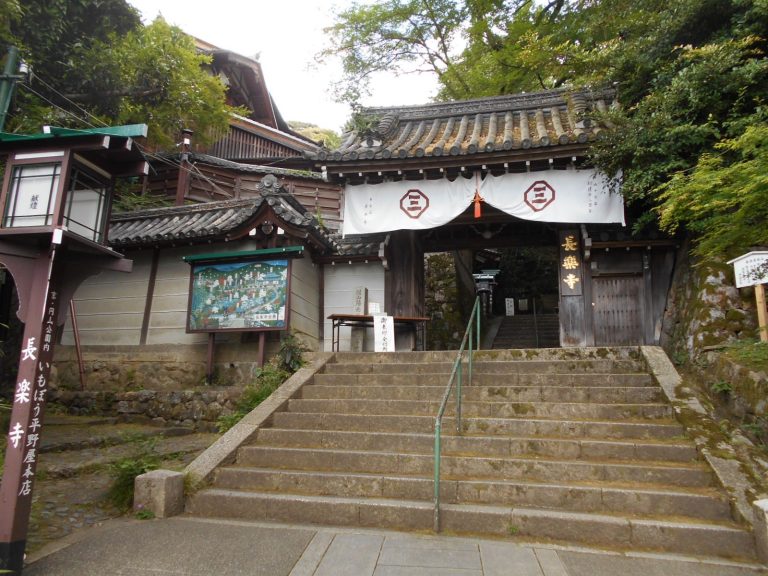
Kaji Shrine stands on the eastern side of the approach, approximately halfway up the precinct. It enshrines Sanjo Kaji Munechika, Awataguchi Toshiro Yoshimitsu, and Amenomehitotsu-no-kami, regarded as the ancestor of metalworkers. The shrine expresses Awata’s association with bladesmithing and metalworking, as well as with victory and success.
Kitamuki Inari Shrine
Kitamuki Inari Shrine is dedicated to Yukimaru Inari and three other deities. Tradition holds that Yukimaru Inari assisted Sanjo Munechika by striking in rhythm while he forged a sword on the imperial order of Emperor Ichijo.
Shusse Ebisu Shrine
Shusse Ebisu Shrine enshrines Ebisu. It was first worshipped in Ebisu Valley at Keage, later housed at Konzoji north of Awata Shrine, and moved to its present position during the Meiji period. Its sacred image is traditionally attributed to Saicho and is described as Japan’s oldest wooden Ebisu image made from separately joined pieces.
Shoten Shrine
Shoten Shrine preserves a statue of Shoten carved by Tankai Hōzan, a former Buddhist administrator of the shrine. Shoten is a Buddhist deity associated with prosperity and the removal of obstacles. A hall for Shoten formerly stood before the Buddhist administrator’s residence halfway along the approach.
Daijingu
The Daijingu was originally the guardian deity of the Torii-koji family, an official family of Shoren-in, and stood within the family residence before being moved to the shrine precinct during the Meiji period. The family was believed to descend from Takashina Morinao, whose mother was said to have had an illicit relationship with Ariwara no Narihira while serving as a priestess of Ise Shrine. According to the family tradition, descendants suffered illness or misfortune whenever they attempted to pilgrimage to Ise, so the family enshrined the Daijingu at home and worshipped it locally.
Other Subsidiary Shrines
Other subsidiary shrines include Taga Shrine, Asahi Tenmangu, Kichibei Shrine, and Tarobei Shrine. Asahi Tenmangu enshrines Sugawara no Michizane. Kichibei Shrine and Tarobei Shrine were formerly land-protection shrines beside the eastern and western sides of the gate of Shoren-in near Sanjo and Jingu-michi.
Sword-Pole Standards and Lanterns
The shrine preserves 18 sword-pole standards dating from the Muromachi and Edo periods. These tall ritual objects, carried in processions to represent and honor divine spirits, are large spear-like implements approximately 7 to 8 meters long and weighing 40 to 60 kilograms. During the festival, one bearer raises and carries a standard vertically.
The sword-pole tradition was maintained by 51 shrines in Kyoto by 2012. At Awata Shrine, the number of standards appearing in the festival had increased from one to six by that year, and a new standard named Tsuruhoko was produced in 2011. Until 1996, bearers were recruited from outside the area; thereafter, the Sword-Pole Support Association increased participation by people from the local community.
The 2008 revival of the lantern tradition produced five large lanterns. Each is approximately 2 meters wide, 2.5 meters high, and 3 meters deep, recalling the lantern displays once associated with the shrine.