Chion-in Temple: Head Temple of Jōdo-shū in Kyoto


Site at a Glance
- Rating
- 4.5
- Popularity
- Medium
- Country
- Japan
- Primary era
- Early Modern
- External website
- Open
- Eras represented
- Early Modern
- Civilizations
- Ashikaga shogunate, Tokugawa
- Site type
- Religious
- Remains
- Temple
On this page15 sections
History
Chion-in Temple is the head temple of Jōdo-shū in Kyoto, Japan, the Pure Land Buddhist sect founded by the monk Hōnen. The temple originated in 1175 at Yoshimizu in Higashiyama, where Hōnen established a hermitage and preached the practice of sincerely reciting Amida Buddha’s name to seek rebirth in the Pure Land. Its principal religious images are a statue of Hōnen in Mieidō and an image of Amida Buddha in Amidado.
Hōnen and the early institution
Yoshimizu, near the present Seishidō, became closely associated with Hōnen’s later life. During the 1207 persecution of his teachings, he was exiled to Sanuki Province. When he returned to the capital in 1211, he found the Yoshimizu hermitage ruined and moved to the nearby Ōtani Zenbō, identified with the present Seishidō. He died there on January 25, 1212, at the age of 80.
After Hōnen’s death, his disciples established a mausoleum beside Ōtani Zenbō. Enryakuji monks destroyed it in 1227 during the Karoku persecution. In 1234, Hōnen’s disciple Seikanbō Genchi restored the institution. Emperor Shijō granted it the name Kachō-zan Chion-kyō-in Ōtani-dera, and it became a base for the Murasakino branch of Hōnen’s disciples.
Medieval divisions and reconstruction
In 1276, the Kyoto branch associated with Genchi entered doctrinal discussions with the Chinzei branch, a major lineage within Jōdo-shū. The two sides were judged to have no doctrinal differences, and Genchi’s lineage joined the Chinzei branch. Chion-in and Hyakumamben Chion-ji consequently became important Chinzei centers in Kyoto.
Fire repeatedly altered the temple’s history. Chion-in burned in 1431 and was soon rebuilt. When the Ōnin War, a civil conflict that began in 1467, reached Kyoto, the temple’s twenty-second head priest, Shūhō Shurin, evacuated to Konren-ji in Ikaritate, in Ōmi Province. He took Hōnen’s image, Buddhist statues, and treasures to a nearby hermitage. The refuge was reorganized as Shin-Chion-in, while Chion-in itself was restored in 1478. Another fire destroyed the temple in 1517.
A dispute with Hyakumamben Chion-ji over precedence within Jōdo-shū ended in Chion-in’s favor in 1523, making it the sect’s leading head temple. Seishidō was rebuilt in 1530, and the temple received imperial calligraphy and plaques bearing the titles “Chion-kyō-in” and “Ōtani-dera.” In 1548, the Ikkōshin-in lineage, a dedicated nembutsu movement associated with En’yō Shōnen, separated from the Chinzei branch and established Isshin-in opposite Hōnen’s mausoleum.
Recognition and Tokugawa patronage
In 1575, Emperor Ōgimachi recognized Chion-in as a principal Jōdo-shū temple and granted it authority over the awarding and withdrawal of purple robes, which traditionally signified high clerical rank, for Jōdo-shū priests throughout Japan. Toyotomi Hideyoshi, the late-sixteenth-century military ruler who helped unify Japan, donated a holding assessed at approximately 190 koku, a historical measure based on land and expected rice yield, in 1585.
In 1603, Tokugawa Ieyasu, founder of the Tokugawa shogunate and its first shogun, designated Chion-in as a permanent family memorial temple and granted it more than 703 koku of land. From 1604, land belonging to neighboring Shōren-in was transferred to Chion-in, allowing the precinct to expand and major halls to be built. Ieyasu’s patronage also made the temple a memorial institution for his mother, Lady Odai.
The Tokugawa family’s support reflected its adherence to Jōdo Buddhism and its political aim of creating a major Tokugawa base in Kyoto alongside Nijō Castle. Chion-in’s elevated position also allowed the shogunate to display its authority and exert pressure on the imperial court. In 1607, Imperial Prince Ryōshun became the temple’s monzeki, meaning that the institution was traditionally headed by a member of the imperial family. During the Edo period, successive monzeki and heads were appointed from the imperial family, while the princes were also adopted by the Tokugawa shogunal family. Imperial princes served as Chion-in’s heads from 1619 to 1869.
Edo-period rebuilding
Construction continued under Tokugawa Ieyasu’s successor, the second shogun Hidetada. The present Sanmon and Kyōzō were built in 1621. A fire in 1633 destroyed most of the complex, but Sanmon, Kyōzō, and Seishidō survived. Reconstruction under the third shogun, Tokugawa Iemitsu, was substantially complete by 1639. The restoration took eight years, after which the precinct expanded greatly.
Emperor Higashiyama bestowed the posthumous title Enkō Daishi on Hōnen in 1697. In 1710, Amidado was moved from the front of Seishidō to its present site, and the retired Emperor Reigen granted imperial calligraphy and a plaque bearing the title “Kachō-zan.” These acts reinforced the temple’s religious and imperial connections.
Modern institutional history
The confiscation of temple lands during the Meiji period caused severe economic hardship. In 1872, the precinct was used as an exhibition venue visited by Emperor Meiji. The Meiji Restoration and its religious reforms also ended the tradition of appointing Chion-in’s heads from the imperial family.
From the late 1870s, the temple gradually recovered. In 1887, its head was recognized as the patriarch of Jōdo-shū. In 1947, Chion-in proposed the “One Sect, One Institution” movement and formed Honpa Jōdo-shū, later renamed Jōdo-shū Honpa, as a separate organization centered on Hōnen’s mausoleum. Chion-in and the separate organization returned to Jōdo-shū in 1962, after observances marking Hōnen’s 750th memorial, and Chion-in again became the sect’s head temple.
A major conservation project begun in 2011 included partial dismantling of Mieidō, replacement of its roof tiles, repair or replacement of decayed and damaged parts, correction of the eaves, and structural reinforcement based on seismic investigations. The main work was completed in 2019, followed by interior restoration. The rededication ceremony took place on April 13, 2020, on a greatly reduced scale because of the COVID-19 pandemic. Chion-in is also the twenty-fifth station on a pilgrimage circuit honoring Hōnen. Its principal buildings and associated works are protected as major Japanese cultural properties, and the Hōjō Garden became a national Place of Scenic Beauty in 2021.
Remains
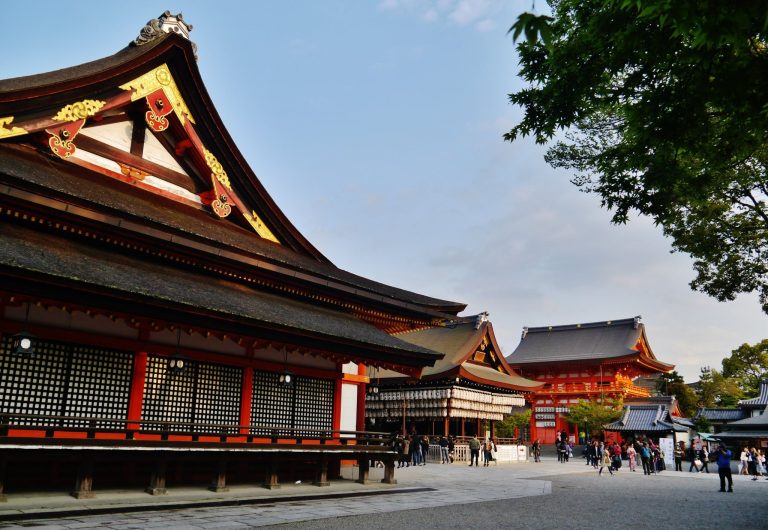
Chion-in occupies three levels. The lower section contains Sanmon and subtemples, the middle section holds the central halls including Mieidō, and the upper section contains Seishidō and Hōnen’s mausoleum. The upper level occupies the original temple area, while the large middle and lower complexes developed with shogunal support during the Edo period. Principal halls are connected by covered corridors, and the precinct also includes the Hōjō buildings, Hōjō Garden, Yūzen-en Garden, Karamon, the Daishōrō bell tower, and other subtemples.
Principal halls and gates
Mieidō and Shūedō
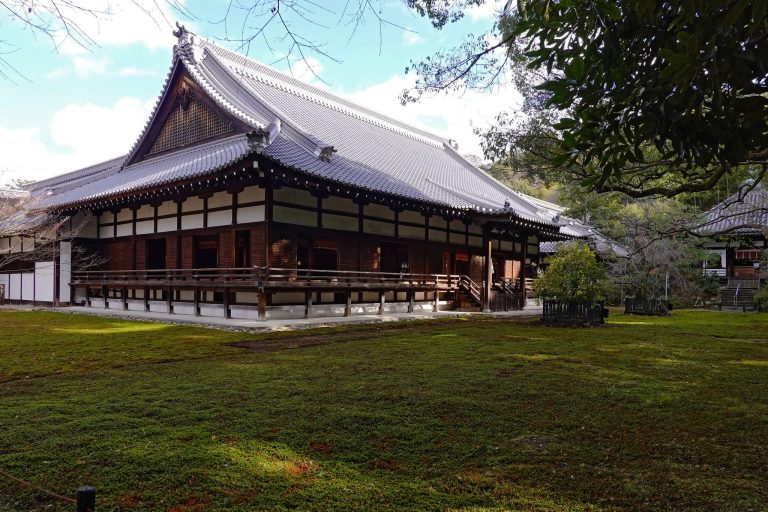
Mieidō, also called the Founder’s Hall or Main Hall, enshrines Hōnen’s image and is a National Treasure. A covered passage is attached to the hall, which is connected to Shūedō by a long covered corridor. The relationship between these buildings is reinforced by the 550-meter Uguisubari corridor, or Nightingale Hallway. Its wooden floorboards have metal ends that rub against metal joints, producing a deliberate squeaking sound intended to make intruders easier to detect.
Sanmon
Sanmon is the colossal main gate and central entrance. Built in 1621, it has an irimoya-zukuri roof, a Japanese form combining a hipped lower section with a gabled upper section. The gate is a National Treasure and is described as the largest surviving structure of this type in Japan. Its interior contains the plain coffins of Gomi Kin’uemon and his wife, who are said to have built the gate and carved wooden images of themselves before taking their own lives after its completion.
Ohojo and Kohojo
The Ohojo and Kohojo are large and small guest halls built in 1641 in the irimoya roof style. Their interiors contain wall paintings associated with the Kano school, a major tradition of Japanese painting used extensively in temples, castles, and elite residences. Both halls are designated Important Cultural Properties. A sliding-door painting by Kano Nobumasa in Ohojo depicts white chrysanthemums. Tradition says that sparrows painted in the work came to life and flew away.
Kyōzō and the sutra repositories
Kyōzō, the sutra repository, was built in 1621 and survived the fire of 1633. A separate round sutra repository houses a Chinese Buddhist canon from the Song dynasty. Together, these repositories reflect the temple’s role in preserving Buddhist texts as well as supporting religious practice.
Seishidō and Amidado
Seishidō is dedicated to Seishi, a bodhisattva associated with wisdom and devotion to Amida. It stands on the site identified with Hōnen’s original hermitage and was rebuilt in 1530. The hall also survived the 1633 fire. Amidado houses an image of Amida Buddha, the central Buddha of Pure Land Buddhism, who is associated with the Western Paradise, or Pure Land. The building was moved to its present position in 1710.
Bell, gardens, and associated features
Chion-in’s temple bell was commissioned in 1633. It weighs 74 tons and is described as Japan’s largest temple bell. The temple formerly required a team of 25 people to sound it, while its current figure is 17. Other built features include the Karamon Chinese-style gate, the Daishōrō bell tower, the Hōjō buildings, the corridors linking the principal halls, Hōnen’s mausoleum, and the Hōjō and Yūzen-en gardens.
Tokugawa hollyhock crests, each formed from three leaves, are carved into the roof beams. An umbrella placed among the rafters outside the Main Hall is associated with traditions that it was left by the carpenter Hidari Jingorō or delivered by a white fox. These traditions connect it with protection from fire through its association with water.
Several features preserve religious symbolism and local tradition. In Ohojo, the “Cat That Sees in Three Directions” is a painting whose gaze appears to follow viewers from different positions. It represents parental compassion and the compassion of Amida. A large rice paddle, called the “Large Rice Paddle,” uses a wordplay between “scooping” and “saving” to symbolize Amida’s salvation of all people. The “Cucumber Rock,” a large stone in front of Kuromon, is said to predate Chion-in. One tradition connects it with Gozu Tennō and says that gourds grew from it in a single night.
Manuscripts, paintings, and sculpture
Chion-in’s associated National Treasure works include 48 illustrated scrolls recounting Hōnen’s life, a Kamakura-period painting of Amida accompanied by twenty-five bodhisattvas, a copy of the Bodhisattva Embryo Sutra made in 550, a copy of the Dairutan Sutra made in 673, and the sole surviving manuscript of a biography of Prince Shōtoku dating from the late Heian period. The paintings and calligraphic works among these National Treasures are deposited at the Kyoto National Museum and Nara National Museum.
The three early manuscripts were collected by Uryū Tetsujō, who served as Chion-in’s head during the late Edo and early Meiji periods. The temple also possesses a large archive of old manuscripts, sculptures, and paintings, extending the surviving remains of Chion-in beyond its buildings and gardens to the historical records and religious works preserved through its long institutional history.