Shinshou-ji Temple: Shingon Buddhist Temple and Pilgrimage Site in Muroto, Japan


Site at a Glance
- Rating
- 4.2
- Popularity
- Low
- Country
- Japan
- Primary era
- Modern
- External website
- Open
- Eras represented
- Modern
- Civilizations
- Japanese
- Site type
- Religious
On this page11 sections
History
Shinshou-ji Temple is a Shingon Buddhist temple in Muroto, Kochi, Japan, traditionally founded in 807 by Kukai, the ninth-century monk who established the Shingon school of Japanese Buddhism. It belongs to the Buzan branch, an institutional lineage of Shingon, and is traditionally counted as temple 25 on the Shikoku Pilgrimage, a circuit of 88 Buddhist temples associated with Kukai and the island of Shikoku.
Foundation and early traditions
Temple tradition places the foundation of Shinshou-ji in 807, when Kukai visited the area. He is said to have recognized the jewel-like shape of the mountain as a sign of sacredness, carved an image of Enmei Steersman Jizo Bodhisattva by the one-cut, three-bows method, and established a temple hall. Jizo is a Buddhist bodhisattva associated with protecting vulnerable beings and assisting those in difficult circumstances. The temple is also described as having been established by the Chosokabe, a regional warrior family that ruled much of Shikoku during the sixteenth century, and later supported by the Yamanouchi, the feudal ruling house of Tosa during the early Edo period.
The temple appears in the medieval collection Konjaku Monogatari under the name Tsudera. Its story describes a fire in the main hall and a miraculous warning. Jizo is said to have left the hall in the form of a monk and alerted the villagers, enabling them to escape. The tradition helped connect the principal image with protection from fire as well as with the temple’s later association with safe passage.
Murotsu Port and the Steersman Jizo
Shinshou-ji’s traditions are closely linked to Murotsu Port. The Tosa Diary records that Ki no Tsurayuki, a Heian-period court official and poet, was held at the port for ten days in 935 by stormy seas while returning to the capital after completing a five-year term as governor of Tosa Province. He could not pass Cape Muroto until the weather allowed him to continue.
A later story dates the temple’s association with maritime rescue to 1602. Yamanouchi Kazutoyo, lord of Tosa, was caught in a storm offshore from Muroto when a powerful monk appeared and guided his boat safely into Murotsu Port. The monk then disappeared. A trail of water was said to lead to the front of Shinshou-ji’s main hall, and the principal image was found wet. It consequently became known as the Steersman Jizo. The title preserves the image’s connection with both the rescue of Kazutoyo’s vessel and the earlier story of the fire warning.
Suppression and re-establishment
In 1871, the temple was abolished under the Meiji-era policy separating Buddhism and Shinto. Its residential quarters were used as an elementary school, while the temple land was distributed among local farmers. The complex was re-established in 1883 on a smaller site, preserving Shinshou-ji as a religious institution.
The temple’s formal name is Hōjuzan Shingon-in Shinshou-mitsuji. Its position within the Shikoku Pilgrimage and its religious affiliation are part of its formal institutional identity. In 2015, the pilgrimage route, together with its other 87 temples, received designation as Japan Heritage, a national designation for cultural narratives that connect related historical and cultural assets.
Remains
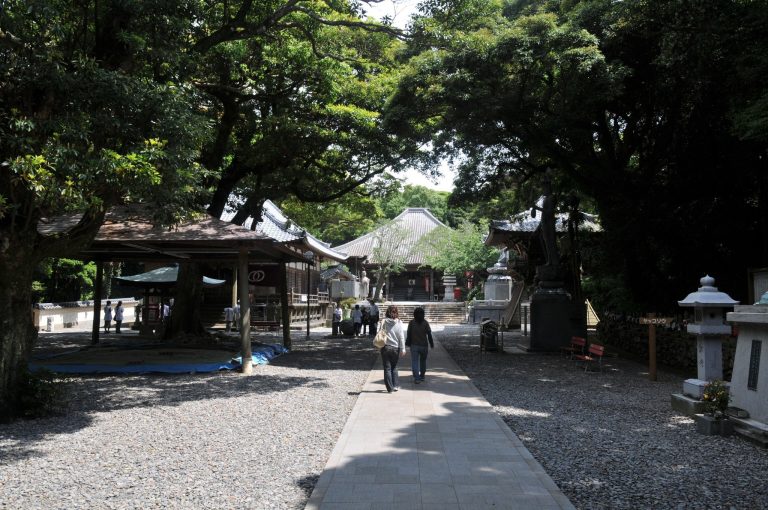
The precinct stands on a hill above Murotsu at an elevation of 15.8 metres. A simple entrance gate leads into the grounds, and a stairway of 125 stone steps climbs towards the main hall. The layout combines Buddhist halls, shrines, memorial stones, and images along the hillside, while the main hall provides a view of the harbor and the port town.
Entrance and hillside approach
The Sanmon, or entrance gate, is formed by roofed pillars. Immediately inside it, the Daishidō and the temple office stand on the right, while the Ichiki Shrine is on the left. The approach then rises by stone steps towards the upper precinct. Partway up the ascent stands an unusual two-story bell gate known as the Buddha Lighthouse. Its bell occupies the upper level, and Niō guardian statues, the paired figures traditionally placed at temple entrances, are enshrined on both sides. The structure is also described as resembling a gate to the Dragon Palace, the mythical underwater palace of the dragon king.
Halls and sacred images
Main hall
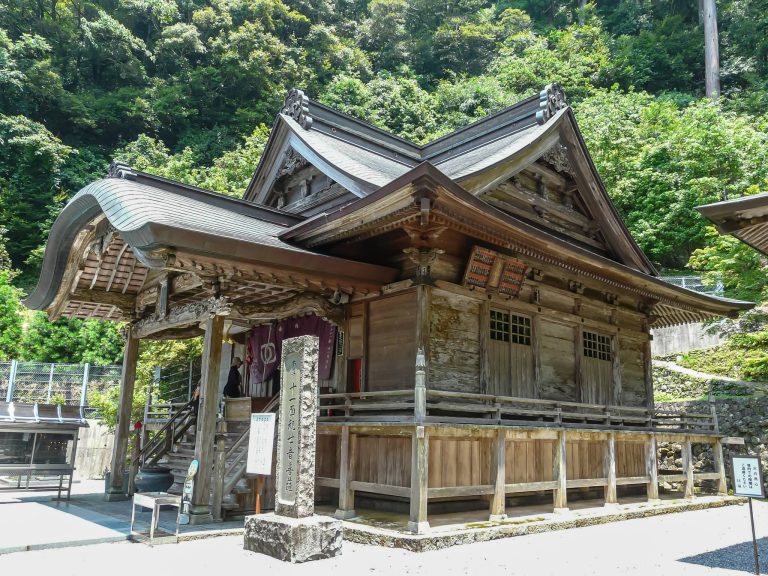
The concrete main hall was rebuilt in 1975. It houses the principal image, the Enmei Steersman Jizo Bodhisattva, traditionally attributed to Kukai. The image is associated with the fire-warning miracle and with the story of Yamanouchi Kazutoyo’s vessel being guided into Murotsu Port.
Daishidō and Jizo images
The Daishidō, the hall dedicated to the founder, was rebuilt in 1963. In front of it stands a stone image of the three Jizo. A separate stone statue of Shakyōdaishi, representing a priest engaged in copying Buddhist sutras, is located within the temple grounds.
Shrines within the precinct
An Inari shrine stands partway up the steps on the right side of the approach to the main hall. It serves as the guardian shrine of the precinct and enshrines Inari Daimyōjin, a kami associated especially with rice, agriculture, prosperity, and commerce. The Ichiki Shrine stands at mid-height on the same hill, on the precinct or its immediate western side. It commemorates Ichiki Gonbei, who died after completing difficult improvements to Murotsu Port.
Stones and commemorative features
Three poem stones are placed at different points in the precinct. One stands beside the purification basin to the left of the three-Jizo image, another is on the left after twelve steps up the stairway, and the third is to the right of the bell gate. Their verses concern the rising moon, a boat beneath a lightly clouded sky, and the beginning of the New Year’s Eve bell. The third poem is attributed to Sudō Tōgetsu.
Below the steps, a memorial stone commemorates the person who transmitted the technology of making Kishu Binchōtan charcoal. Together with the poem stones, the memorial contributes to the visible record of local religious, literary, and craft associations within the temple grounds.