Ninomiya Shrine: A Shinto Shrine in Funabashi, Japan


Site at a Glance
- Rating
- 4.3
- Popularity
- Medium
- Country
- Japan
- Primary era
- Early Modern
- External website
- Open
- Eras represented
- Early Modern
- Civilizations
- Tokugawa
- Site type
- Religious
- Remains
- Sanctuary
On this page8 sections
History
Ninomiya Shrine is a Shinto shrine in Funabashi, Japan, traditionally founded during the Konin period, approximately 810 to 824, under the direction of Emperor Saga. It is traditionally identified as a possible Samukawa Shrine listed in the Engishiki, a tenth-century compilation of governmental regulations and ritual procedures, and is traditionally regarded as the second-ranked shrine of Shimousa Province. Tamazaki Shrine in Asahi also claims that distinction.
Early traditions and names
According to tradition, Emperor Saga ordered the shrine’s establishment during his reign, which lasted from 809 to 823, although the traditional foundation period extends to 824. The place-name Miyama is likewise traditionally derived from the shrine. The Miyama clan served as hereditary shrine priests, linking the institution with the local community over generations.
The shrine was formerly called Miyama Myojin or Ninomiya Myojin and was also associated with the name Samukawa Shrine. The designation Ninomiya was already in use during the Kamakura period. A bell dated 1303, now preserved at Shoho-in in Narita, carries the expression “Soshu Ninomiya shrine altar,” providing an early reference to the name.
Shogunal patronage and modern reorganization
In 1591, Tokugawa Ieyasu granted Ninomiya Shrine 10 koku of vermilion-seal land. The shoguns of the Edo government later made additional donations on several occasions. A pilgrimage guide published in 1858 introduced the shrine as Miyama Myojin, reflecting the continued use of its earlier name.
During the Meiji period, when the government introduced a modern system for ranking shrines, Ninomiya Shrine was classified as a village shrine. In 1910, it absorbed Wakamiya Hachiman Shrine and the former auxiliary shrine Awa Hachiman Shrine. The shrine buildings and associated cultural features now have municipal cultural-property protection. The buildings are protected as a tangible cultural property, while the shrine’s ginkgo is designated as a natural monument.
Deities and continuing traditions
The shrine enshrines Susanoo, a Shinto kami associated with storms, the sea, and the slaying of the serpent Yamata no Orochi; Kushinadahime, traditionally associated with Susanoo as his rescued bride; and Okuninushi, a kami linked with the formation and governance of the land. Its other enshrined figures are Fujiwara no Tokihira, a powerful court noble of the early Heian period, and the traditionally deified emperors Osazaki and Homutawake, identified with Emperors Nintoku and Ojin.
Ninomiya Shrine’s traditional parish area, known as its shimeshita, extended across parts of eastern and northern Funabashi, Narashino, Yachiyo, and western Chiba. A shimeshita was the area attached to a shrine as its community of worshippers. The broad extent of this traditional parish remains reflected in the annual festival and other ceremonies. The annual festival takes place on October 16, and the shrine is also associated with the Shimousa Miyama Seven-Year Festival and with Ninomiya Shrine kagura, ritual dance and music performed in Shinto worship.
Remains
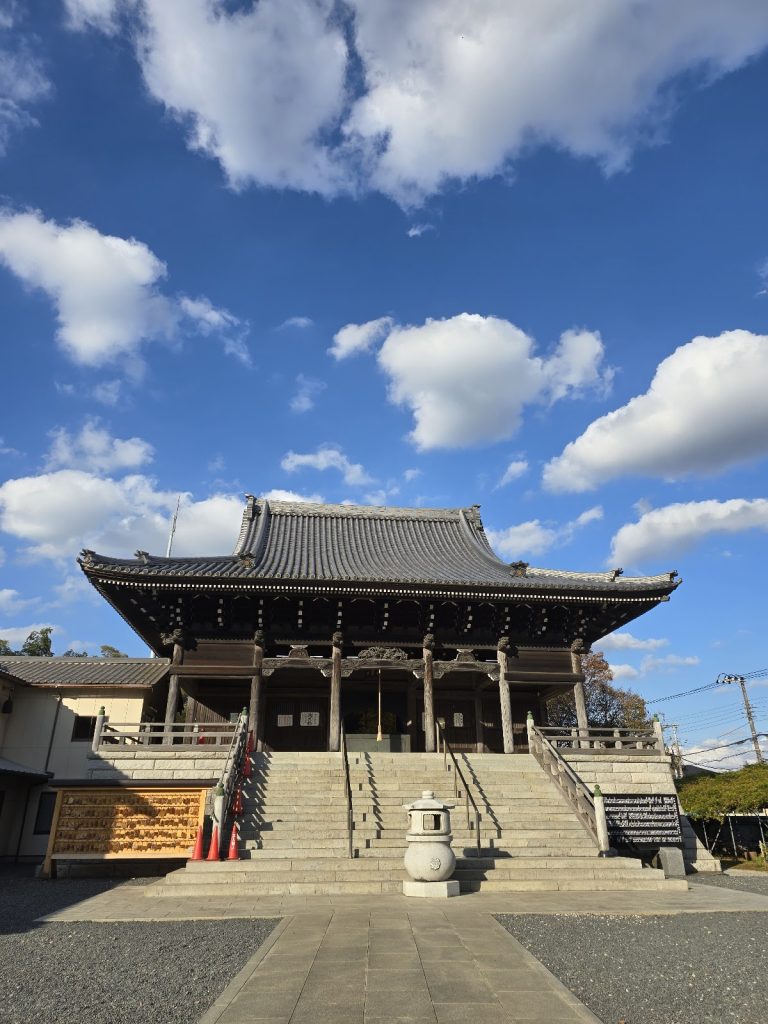
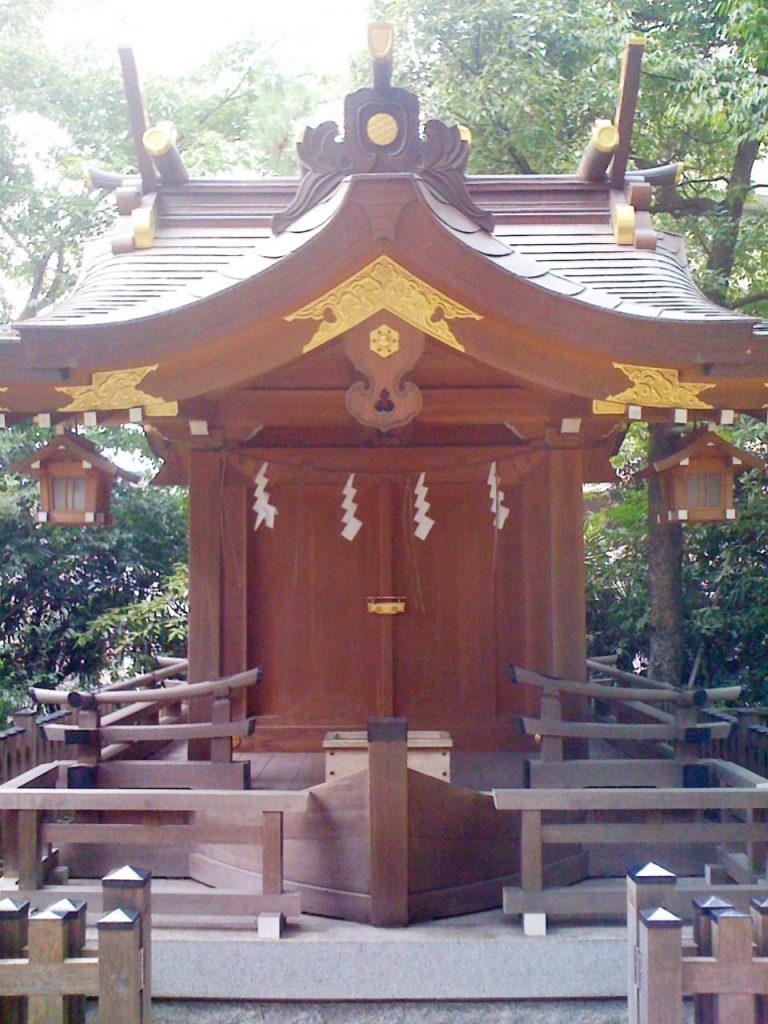
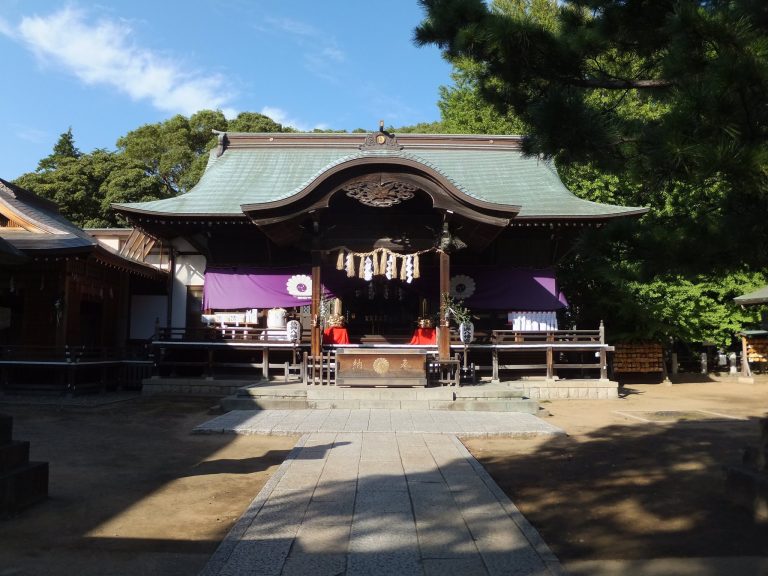
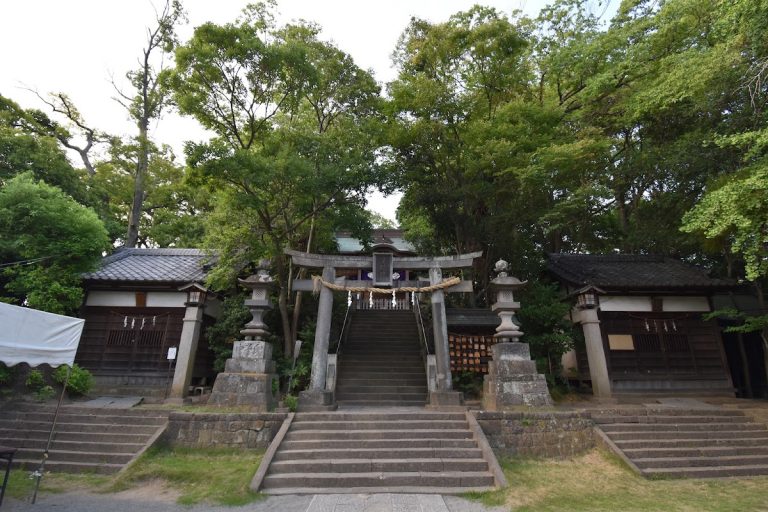
The surviving precinct is organized around shrine buildings rebuilt during the An’ei period, approximately 1772 to 1781, and an approach that crosses a valley before climbing toward the worship hall. The buildings use the Gongen-zukuri plan, in which the worship hall and main sanctuary are joined by an intervening offering hall or connecting space. This arrangement creates a continuous architectural composition, while the approach controls how the principal entrance is revealed.
Shrine buildings
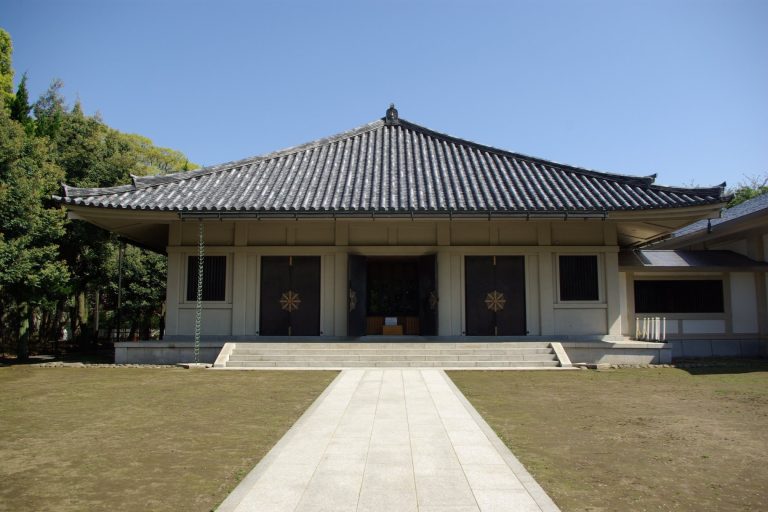
The main sanctuary and worship hall have copper-sheet roofs. The main sanctuary roof was changed from thatch in October 1922, followed by a similar replacement on the worship hall in 1925. Their floor levels were designed to remain equal from the worship hall through the offering hall, an arrangement that contributes to the connected Gongen-zukuri plan. The eaves’ bracket complexes and the waist framing were made according to the formal techniques used by shrine carpenters of the period. The worship hall’s entrance is crowned by a karahafu gable, a curved and sweeping gable whose vigorous carvings form a prominent part of the approach’s designed view.
Valley approach
From the front torii, the approach descends into and crosses a valley. A small stream runs along the valley floor and is traditionally said to connect through its watercourse with a pond in the precincts of Kikuta Shrine in Tsudanuma, Narashino. The route continues in a straight line across the valley before rising by stone steps. As the steps approach their upper end, the curved gable over the worship hall’s entrance gradually comes into view. The approach was deliberately arranged to reveal the sweep of the karahafu and its carvings progressively rather than all at once.
Ginkgo tree
A ginkgo tree stands within the shrine precincts and is designated as a natural monument. It forms part of the protected cultural features associated with Ninomiya Shrine.