Hotsumisaki-ji Temple: A Shingon Buddhist Temple and Pilgrimage Landmark in Japan


Site at a Glance
- Rating
- 4.2
- Popularity
- Low
- Country
- Japan
- Primary era
- Modern
- External website
- Open
- Eras represented
- Medieval, Early Modern, Modern
- Civilizations
- Japanese, Tokugawa
- Site type
- Religious
- Remains
- Temple
On this page21 sections
History
Hotsumisaki-ji Temple is a Shingon Buddhist temple in Japan, located at Muroto in Kochi Prefecture and traditionally founded in 807. Shingon is an esoteric school of Japanese Buddhism centered on ritual, mantra, meditation, and mandala teachings. The temple is formally known as Murotozan Myōjōin Hotsumisaki-ji and is also called Higashi-dera. Its principal deity is a secret image of Ākāśagarbha, a bodhisattva associated with boundless space, wisdom, and the retention of knowledge.
Foundation and early tradition
The temple’s traditional foundation is connected with Kūkai, the early ninth-century monk who founded the Shingon school and is also known as Kōbō Daishi. At the request of Emperor Saga, Kūkai is said to have carved the principal image in 807. Before this, he had undertaken mountain practice for approximately five years from 792 and was associated with a cave near Muroto Cape, where he practiced meditation devoted to Ākāśagarbha.
Tradition places the temple’s original site on the summit of Mount Shijuji. During the Kantoku period in the eleventh century, it was moved to its present location. The temple burned in 1202 and later suffered additional fires, but its religious associations and imperial connections continued. In 1341, Ashikaga Takauji designated it as the Ankokuji temple of Tosa Province. Ankokuji temples were Buddhist institutions established under Ashikaga patronage to pray for peace and protection within the provinces.
Medieval and early modern patronage
Hotsumisaki-ji received the devotion and support of successive emperors after Emperor Saga. It also benefited from Ashikaga support during the Muromachi period, when the Ashikaga shoguns governed Japan, and from the Yamanouchi rulers of Tosa during the Edo period. During the Genna period, from 1615 to 1624, Tadayoshi Yamanouchi, lord of Tosa, supported the rebuilding of the complex. This reconstruction was traditionally said to have created a temple precinct with seven halls.
The temple became the 24th temple of the Shikoku Eighty-Eight Temple Pilgrimage and the first pilgrimage temple in the former province of Tosa. In the sequence of the pilgrimage, it marks the beginning of the stage associated with austerity and discipline. Hotsumisaki-ji is also the fourth temple in the Shikoku Thirteen Buddhas pilgrimage. Its associations are expressed in the pilgrimage hymn beginning “In the direction where the morning star appears, Higashi-dera,” as well as in the mantra of Ākāśagarbha. The pilgrimage stamp identifies both the principal deity and the “Cave Built in One Night.”
Meiji disruption and modern protection
At the beginning of the Meiji period, the separation of Shinto and Buddhism caused Hotsumisaki-ji to deteriorate and suffer damage and destruction. The prohibition on women worshipping at the temple was lifted in 1872. Before that change, women worshipped from a women’s hall beside the trail entrance below the cape.
The temple was reconstructed in 1914, while the Main Hall was rebuilt in 1924. The Daishidō, dedicated to Kūkai, was rebuilt in June 1985, and the Tahōtō treasure pagoda was rebuilt in March 1979. The temple and its associated cultural properties include nationally designated Important Cultural Properties and other protected cultural properties. In 2025, the approximately 600-metre Hotsumisaki-ji section of the Tosa Pilgrimage Route became part of the national historic site known as the Tosa Pilgrimage Route.
Kūkai’s seven wonders
Hotsumisaki-ji’s traditional landscape includes seven features associated with Kūkai’s practice and miracles. They are the supposedly inedible taro, the bell stone, the Kannon Cave or “Cave Built in One Night,” the Myōjō Stone, the ablution pond, the eye-washing pond, and the Twisted Rock. Their stories connect the temple with ritual practice, encounters with dragons, healing, and the protection of Kūkai’s mother.
Remains
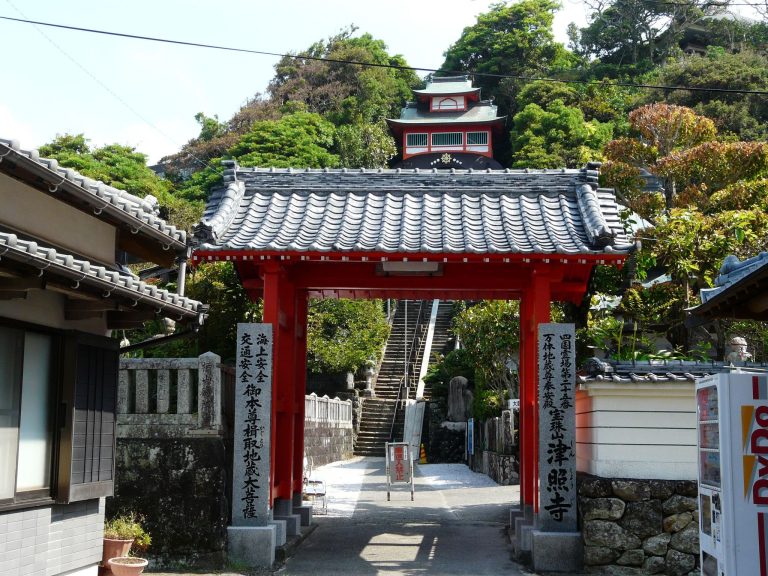
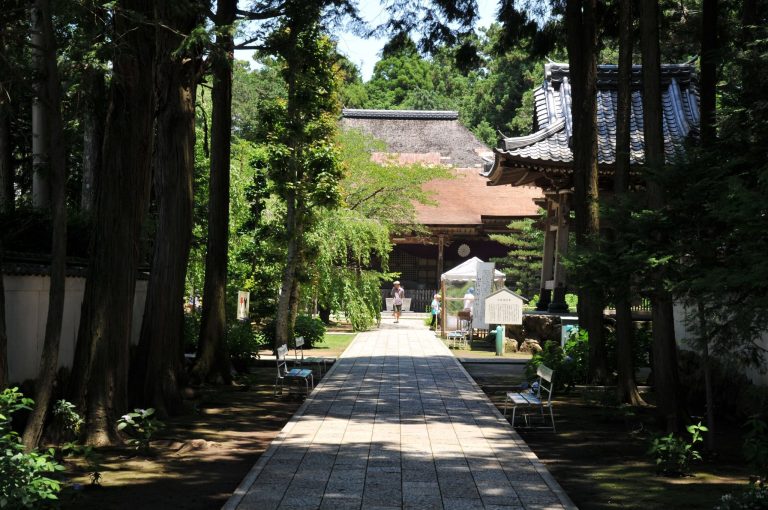
Hotsumisaki-ji stands on elevated ground at Hotsumi Cape in Muroto. The approach from the cape climbs toward the inner precinct, which is entered through a two-story Niōmon gate. Within the precinct, buildings, Buddhist images, sacred stones, ritual facilities, and pilgrimage monuments occupy a sequence of spaces extending from the gate toward and behind the Main Hall.
Gate and central precinct
Niōmon gate
The entrance is formed by a two-story Niōmon, a temple gate guarded by two warrior figures called Niō. During the early Meiji separation of Shinto and Buddhism, guardian statues from the gate of the present Tosa Shrine were installed on the gate’s outer side. The former stone guardian pair, made in 1647, was moved to the inner side. Two pairs of Niō therefore stand on the front and rear sides of the gate. Four Heavenly King statues formerly stood on the second floor.
Buildings around the Main Hall
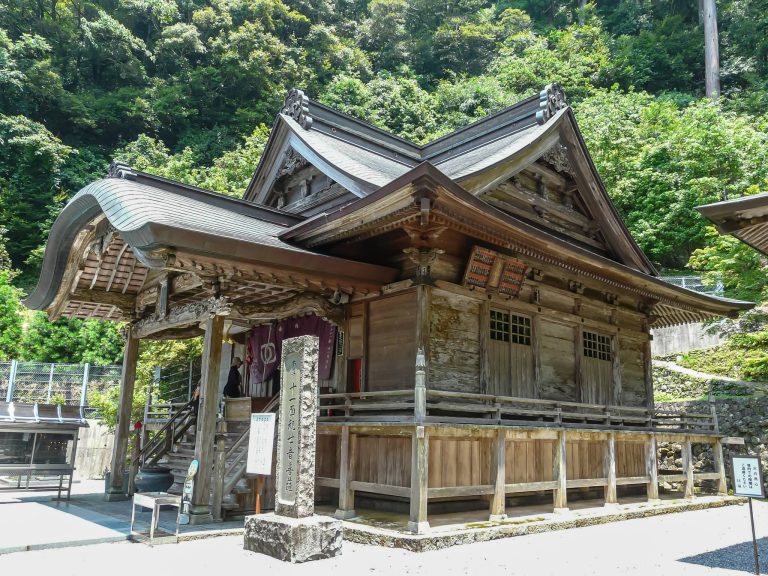
After entering the Niōmon, the bell tower in the flared hakama-goshi style, the stone image of Ākāśagarbha, and the Tahōtō stand to the right. The sumo-wrestling ring and Daishidō are to the left, while the ablution place and temple office lie farther ahead. The Main Hall stands in front. Rebuilt in 1924, it forms the principal focus of the inner precinct.
Daishidō and Tahōtō
The Daishidō was rebuilt in June 1985 and contains an image of Kūkai that worshippers can view. The Tahōtō, a Buddhist treasure pagoda associated especially with esoteric Japanese architecture, was rebuilt in March 1979. Inside it are a seated image of Dainichi Nyorai, the central cosmic Buddha of Shingon teaching, and standing figures of the Four Heavenly Kings.
Bell towers and Reihoden
The older bell tower was built in the hakama-goshi style, with a lower structure that flares outward, and was donated by Tadayoshi Yamanouchi in 1648. The present structure dates from 1984. A second bell tower with open sides also stands in the precinct. Behind the Main Hall are the newer bell tower and the Reihoden treasure hall, which displays important cultural-property treasures during its annual public opening held on one Saturday or Sunday in the first week of November in conjunction with the Lighthouse Festival.
Rear precinct and associated features
Shrines and ritual halls
Behind and to the right of the Main Hall stands Wakamiya Hachimangu, a tutelary shrine associated with the temple precinct. Farther to the rear are the Seitendō and the Gomadō, a hall used for goma fire rituals. The Kannon Hall occupies the uppermost part of the pilgrims’ lodging and houses a replica of the stone Nyoirin Kannon.
Images and pilgrimage monuments
A large stone image of welcoming Kūkai stands beside the parking area, while a large stone statue of Bato Kannon stands at the entrance to the pilgrim center. Inside the precinct are a stone image of Ākāśagarbha, a miniature pilgrimage circuit represented by stone Buddhas, a sumo-wrestling ring, ablution facilities, and inscribed monument stones. Several commemorative poem and song monuments bear inscriptions by named poets. They stand outside the wall near the sumo ring, behind the Daishidō, in front of the Seitendō, and beside a pathway.
Plants and sacred stones
A colony of yakkosō grows on the hill to the right inside the temple gate. Immediately to the right of the Main Hall is a field of kuwazuimo, or inedible taro, associated with a local Kūkai legend. The bell stone, described as andesite, produces a bell-like sound when struck and was traditionally believed to carry its sound to the underworld. It is associated with the area near the water-pouring Jizō.
Sacred cave and legendary landscape
Kannon Cave and the Myōjō Stone
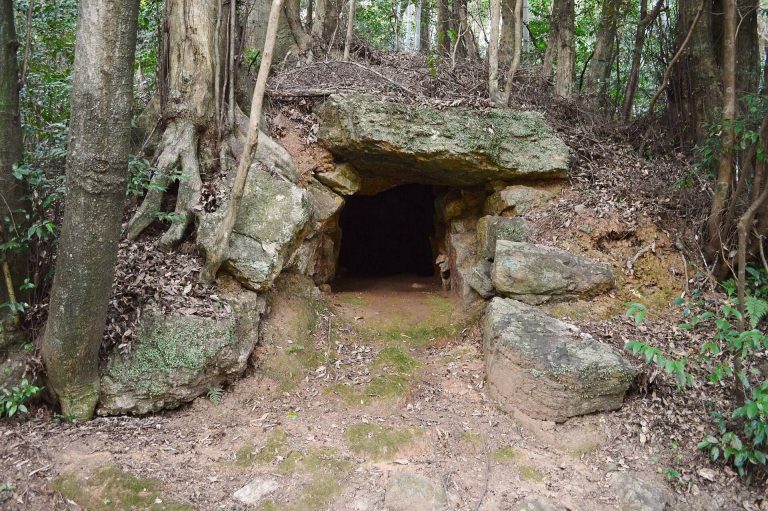
The Kannon Cave, also called the “Cave Built in One Night,” serves as the temple’s inner sanctuary. It is associated with a stone image of Nyoirin Kannon, a form of Kannon shown in a half-lotus position. The Edo-period stone doors of the shrine housing the image are carved with flying celestial figures. The Myōjō Stone is linked to the tradition that it shone when Kūkai spat at poisonous dragons attempting to obstruct his practice.
Ponds and the Twisted Rock
The ablution pond is associated with Kūkai’s ritual bathing, while the eye-washing pond is connected with his reputed healing of eye disease. The Twisted Rock belongs to a tradition in which Kūkai sheltered his mother inside a twisted boulder when flames attacked her as she approached the restricted site while dressed in men’s clothing.
Preserved images and objects
Buddhist images
The stone Nyoirin Kannon is an Important Cultural Property. Approximately 53 centimetres high, it is made of stone described as marble and shows the figure with one knee raised, a gourd, and finely carved clothing. Its unusual marble material is regarded as evidence of an origin on the Asian mainland. Other protected images include a late-Heian-period seated wooden Yakushi Nyorai, the Buddha associated with healing, approximately 86 centimetres high, and a late-Heian-period standing wooden Gakkō image approximately 102 centimetres high. Both are made of wood with lacquered foil.
The holdings also include a Heian-period standing wooden Jizō made of hinoki and approximately 97.8 centimetres high, a wooden incense image of uncertain date, and a Muromachi-period wooden Buddha head. A plaque depicts seated Ākāśagarbha. The precinct also preserves Edo-period stone Kongō Rikishi guardian statues measuring approximately 95 and 100 centimetres, together with fragments of a Kamakura-period wooden Kongō Rikishi traditionally attributed to Tankei. The surviving fragments include part of the Agyō figure’s face and the tip of its right foot.
Ritual and lacquer objects
Two lacquered three-legged trays were donated in 1379. One is red lacquered and the other is black lacquered. Other preserved objects include a lacquered stand for a ritual gong, a cast-metal ritual gong, the upper part of a lantern bearing a chrysanthemum crest, and an Edo-period copper handled incense burner. The incense burner is approximately 31.8 centimetres long and 10.8 centimetres high, and was forged and gilded.