Kōnomine-ji Temple: A Shingon Buddhist Temple on Mount Kōnomine


Site at a Glance
- Rating
- 4.3
- Popularity
- Low
- Country
- Japan
- Primary era
- Early Modern
- External website
- Open
- Eras represented
- Early Modern, Modern
- Civilizations
- Japanese, Tokugawa
- Site type
- Religious
- Remains
- Monastery
On this page15 sections
History
Kōnomine-ji Temple is a Shingon Buddhist temple in Japan, located near Yasuda in Kochi Prefecture. It belongs to the Buzan branch of Shingon, a Japanese Buddhist tradition associated with esoteric ritual and the teachings of Kūkai, and is the 27th temple of the Shikoku Pilgrimage. Its principal image is an eleven-faced Kannon, a compassionate bodhisattva represented in a form with multiple faces expressing different aspects of compassionate response.
Origins and Early Buddhist History
Temple tradition traces the site’s beginning to the reign of Empress Jingū, when a shrine was established for the worship of Amaterasu, the Shinto sun deity, and other deities. In 730, during the Tempyō era, Emperor Shōmu is said to have ordered the priest Gyōki to establish a Buddhist temple here. Gyōki reportedly carved the eleven-faced Kannon that became the principal image, creating a place where Buddhist and Shinto deities were jointly venerated.
Kūkai, also known as Kōbō Daishi, was a ninth-century monk traditionally regarded as the founder of Shingon Buddhism in Japan. He is said to have visited the mountain in the early ninth century and established a hall called Kannon-dō, meaning “Kannon Hall.”
Destruction, Rebuilding, and Pilgrimage
The temple was once associated with numerous halls and pagodas, but these buildings were destroyed by fire during the Genna era, from 1615 to 1624. The main hall, Daishidō, and a guardian shrine were later rebuilt. The eleven-faced Kannon was brought from a former affiliated temple at the foot of the mountain after that institution had fallen into disuse.
The steep mountain approach shaped the temple’s role in the Edo-period pilgrimage. Some pilgrims worshipped from a lower station and completed their pilgrimage registration there instead of climbing to the summit. Kōnomine-ji was regarded as a sekisho, a spiritually important checkpoint where tradition held that a pilgrim’s continuation of the Shikoku Pilgrimage could be determined.
During the final years of the Edo period, the mother of Mitsubishi founder Iwasaki Yatarō is said to have walked barefoot for 21 consecutive days between present-day Aki and the temple. The one-way journey was about 20 kilometers, and she prayed for her son’s good fortune.
Meiji Reorganization and Revival
The Meiji government’s policy of separating Buddhism and Shinto, introduced after 1868, ended the Buddhist institution at the site in the early Meiji period. Kōnomine Shrine remained, while the principal image and pilgrimage station were entrusted to Kongōchō-ji Temple, where pilgrims made their registrations. In 1887, a hall was built on the remains of the former monks’ quarters, and the principal image and pilgrimage station were returned, reviving Kōnomine-ji.
In 1912, the temple rank of a Shingon Buddhist Jizō-in from Asahi Village in Inashiki District, Ibaraki Prefecture, was transferred to Kōnomine-ji. The institution began using the name Kōnomine-ji rather than Kōnomine during the Shōwa period.
Road Construction and Recent Recognition
In 1975, reaching the temple required either an approximately 8-kilometer rough road from the east followed by a 30-minute mountain walk, or the steep pilgrimage path from the foot of the mountain. After becoming chief priest in January of that year, Minami Kangen worked with Komatsu Naomoto to improve the footpath and began developing a road directly from the mountain’s base. A road-construction organization was formed under Komatsu’s direction, and construction began in October with assistance from a construction-company president from Tosashimizu and four workers.
The road reached an initial completion two years later and was improved over several subsequent years. It was donated to the town as a municipal road in 1989. In 2011, a two-lane regional farm road connecting the foothills with the middle of the mountain opened and was linked to it. After the road was completed, Minami Kangen, assisted by a former colleague of Komatsu who was a devoted worshipper of the temple, developed the area around the new Daishidō, the chief priest’s residence, and the hillside garden.
In 2015, Kōnomine-ji and the other 87 temples of the Shikoku Pilgrimage were designated together as Japan Heritage.
Remains
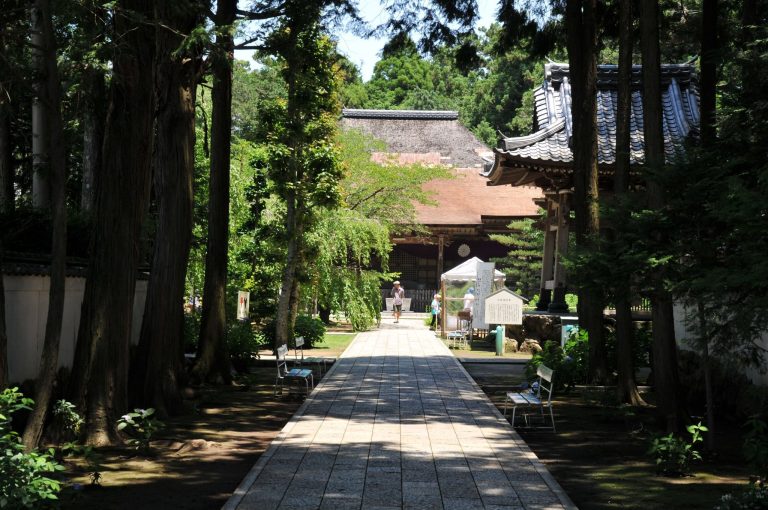
Kōnomine-ji stands near the summit of Mount Kōnomine at an elevation of approximately 424.2 meters. The approach follows the steep mountain path called Mattate. After the Niō Gate, a further climb of approximately 160 stone steps leads through the precinct, where the buildings and garden occupy the mountainside.
Approach and Precinct Buildings
Niō Gate
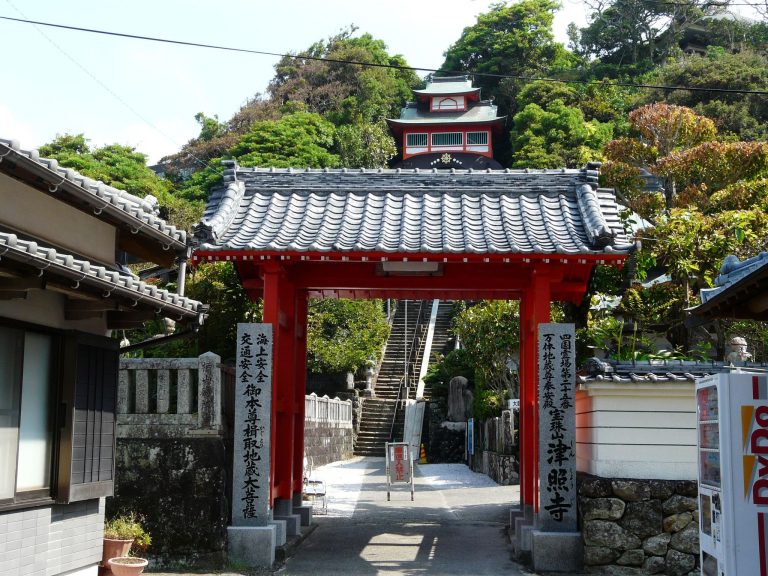
The entrance is marked by a two-story Niō Gate with a hipped-and-gabled roof. Two guardian statues are housed within it. A Buddhist nun raised funds for the gate while traveling throughout Japan, and the building was completed in 1930. Its roof was reroofed and the guardian statues were restored in 2007.
Registration Area and Bell Tower
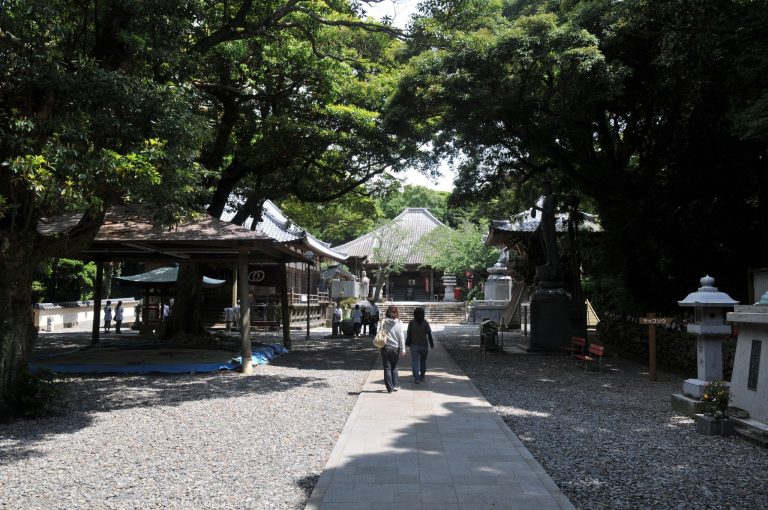
Beyond the gate, a purification basin stands on the left and the bell tower on the right. The living quarters and pilgrimage-registration office lie beside the approach. From this area, a long flight of stone steps rises toward the main hall.
Main Sacred Buildings
Main Hall
The main hall stands beyond the long staircase and contains the hidden principal image of the eleven-faced Kannon. A statue known as the Guiding Daishi is placed along the approach to the hall.
Daishidō
The Daishidō was completed in December 1992 after fourteen years of work that began with cutting into the mountainside. Its principal image is a wooden seated statue of Kūkai described as six shaku in height, made by an artist from Minato Ward, Osaka. A stone image about one shaku in height, found in the mountains during the Meiji period, is enshrined inside the wooden statue.
Hall of Sacred Kannon
The Hall of Sacred Kannon, also called the sutra hall, contains a golden standing statue of Kannon in its Sacred form. Before the present Daishidō was built, this structure served as the Daishidō and was connected with the main hall by a corridor.
Jizō Hall
The Jizō Hall stands to the left of the main hall and contains approximately 50 stone images of Jizō, a Buddhist bodhisattva associated especially with the protection and care of travelers, children, and the dead.
Garden, Spring, and Commemorative Features
A Japanese-style garden extends across the mountainside along the path between the living quarters and the main hall. It contains azaleas, satsuki azaleas, peach trees, magnolias, and autumn foliage. Several trees beside the stone staircase are described as several hundred years old, while plum-blossom season is associated with the sound of nightingales.
The spring called Kōnomine Water is one of 19 springs included among the “40 Notable Waters of Tosa” under the prefectural stream-conservation ordinance of December 19, 1990. A commemorative stone beside the bell tower bears the poem “The warbler begins to sing of spring for the pilgrim.” Another stone, beside the approach between the Niō Gate and the parking area, bears the poem “I climbed the road where chinquapin flowers spill.” A realistic statue of Fudō Myōō stands along the route toward the rear of the Daishidō.