Dōryū-ji Temple: A Shingon Buddhist Temple and Shikoku Pilgrimage Site


Site at a Glance
- Rating
- 4.1
- Popularity
- Low
- Country
- Japan
- Primary era
- Medieval
- External website
- Open
- Eras represented
- Medieval
- Civilizations
- Unclassified
- Site type
- Religious
- Remains
- Monastery
On this page16 sections
History
Dōryū-ji Temple is a major Japanese Buddhist temple in Tadotsu, Japan, traditionally established in the eighth century within the Shingon Buddhist tradition. Formally known as Sōtazan Myōōin Dōryū-ji, it belongs to the Daigo branch of Shingon Buddhism and is traditionally numbered as the 77th temple on the Shikoku pilgrimage, a circuit of 88 Buddhist temples associated with the monk Kūkai. The temple is dedicated to Yakushi Nyorai, the Healing Buddha.
Foundation Traditions
The temple’s origins are placed in the eighth century, with one tradition associating its foundation with Wadō 5 and its stated traditional foundation date belonging to the middle of that century. A foundation story places the earliest events in an area once used as a mulberry plantation. Wake Dōryū, described as a local lord, saw a large mulberry tree shining mysteriously at night. When he shot an arrow toward it, he accidentally killed his nursemaid. In grief, he cut down the tree, carved an image of Yakushi Nyorai from its wood, and enshrined it in a hall.
In 807, Dōryū’s son Tomosuke asked Kūkai, a major Buddhist monk who founded the Shingon school of esoteric Buddhism, to create an image of Yakushi Nyorai about 90 centimetres high. An image of Dōryū was placed inside the new statue, which became the temple’s principal image. Tomosuke received Buddhist precepts from Kūkai, became the second head priest, established a seven-hall temple complex, and named it Dōryū-ji in memory of his father.
Expansion and Religious Development
Kūkai’s younger brother Shinga became the third head priest and founded 23 subsidiary cloisters. The fourth head priest, Enchin, also known as Chishō Daishi, created images of the Five Great Wisdom Kings and built the Gomadō. These figures are powerful Buddhist guardians invoked in esoteric rites, while the Gomadō is a hall used for goma, a ritual fire ceremony in which offerings are burned before sacred images.
During the tenure of the fifth head priest, Shōbō, also known as Rigen Daishi, Dōryū-ji became a place where prayers were offered for the imperial line and prospered greatly. Its religious associations later extended to the Shikoku Seven-Place Pilgrimage and to Jūrōjin, one of the Seven Lucky Gods.
Damage, Continuity, and Memorial Associations
An earthquake between 976 and 978 damaged many of the temple buildings. Warfare brought another destruction in 1060, when the temple was burned. Dōryū-ji has also traditionally been said to have suffered a war-related fire during the Tenshō period, from 1573 to 1592. The temple’s own historical record does not mention such a fire and instead records religious observances continuing during that period.
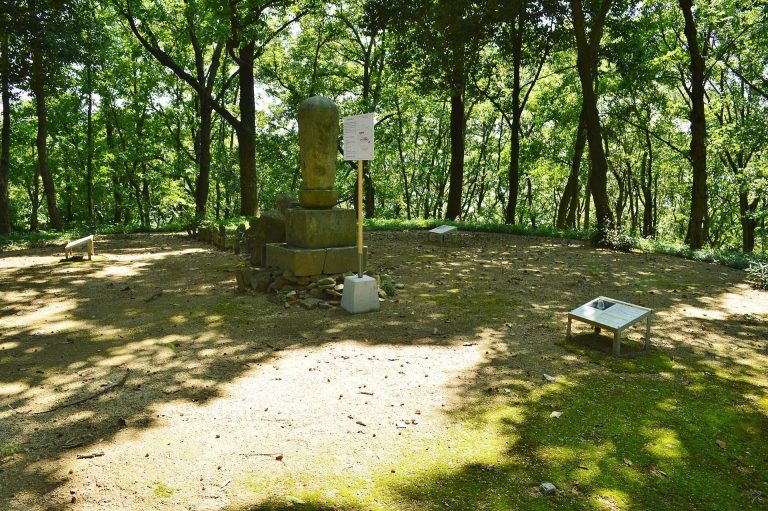
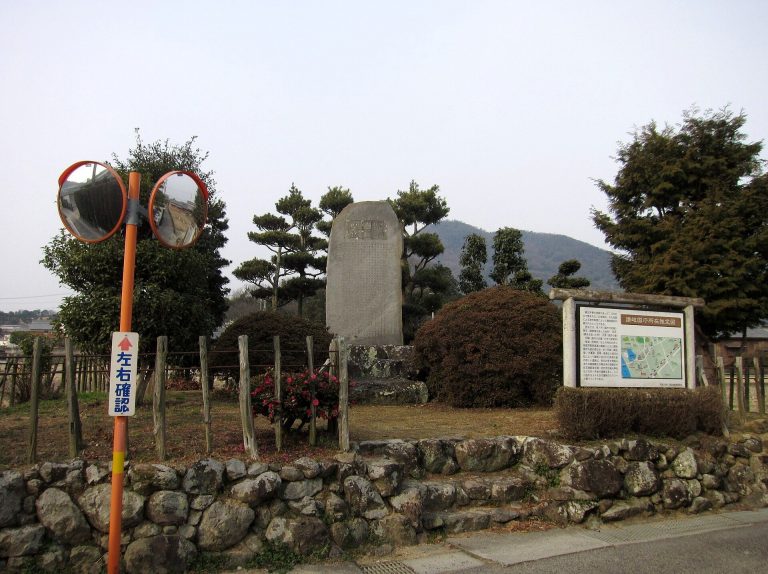
Dōryū-ji remains a grand head temple of the Daigo branch and retains its place as the 77th temple of the Shikoku pilgrimage. A tomb and memorial monument commemorate Mori Nagami and his family. Mori served as an official responsible for miscellaneous revenues in the Tadotsu domain and wrote Kokugaku Wasuregai. The temple is also associated with a star mandala, a sacred diagram representing astral deities in a ritual arrangement, which is registered as an Important Cultural Property of Japan.
Remains
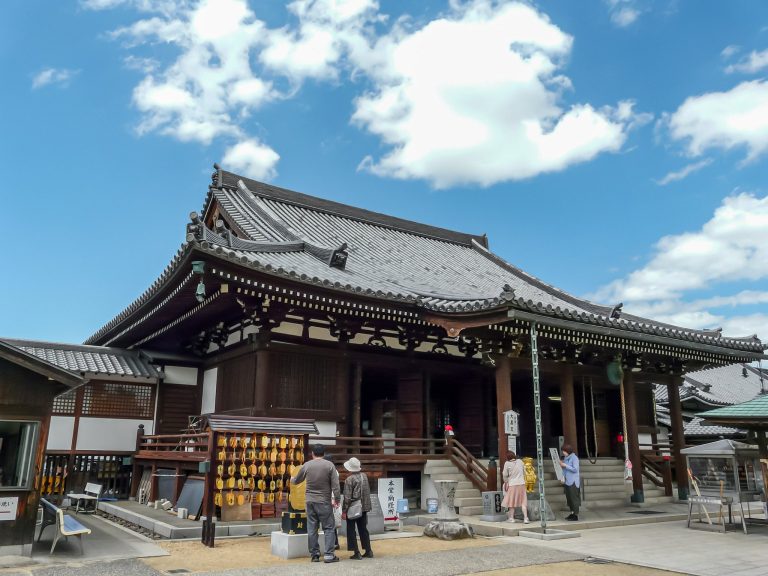
The precinct is organized along a south-to-north approach. A southern entrance leads through the Niō Gate, a gateway guarded by paired temple guardian figures. The approach continues toward the Main Hall, while additional halls, shrines, and a separate residential headquarters occupy the wider temple grounds.
Approach and Central Buildings
Niō Gate and Entrance Precinct
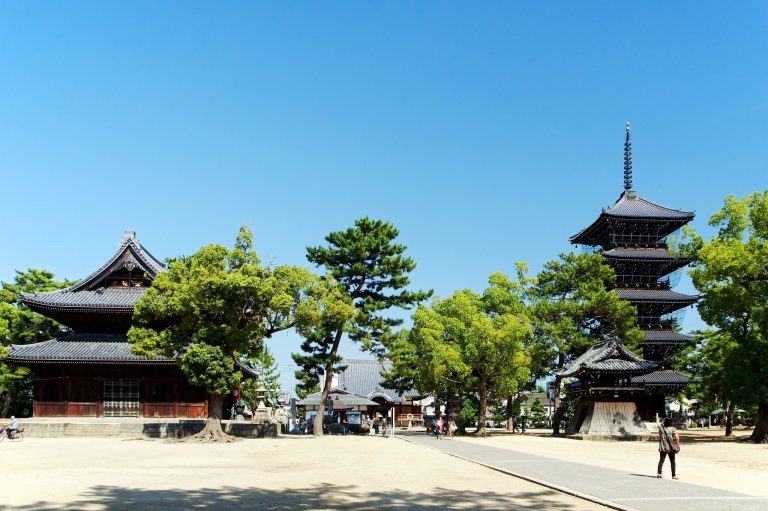
The Niō Gate forms the southern entrance to Dōryū-ji and contains guardian sculptures on its two sides. A bell tower stands to the right of the entrance, and the Awashima Hall stands to the left. A northern gate provides another exit from the precinct, while the temple’s main residential headquarters, or honbō, is located separately from the main enclosure.
Main Hall and Founder’s Hall
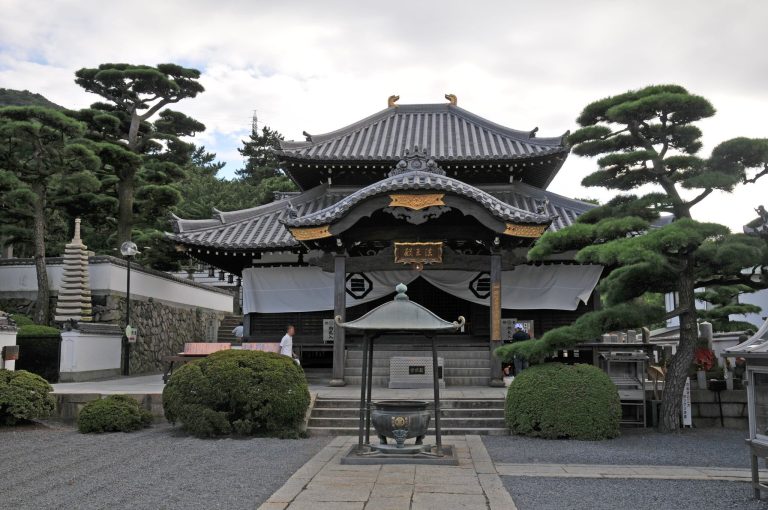
The main approach ends at the Main Hall, with the Founder’s Hall, or Daishidō, positioned to the right. The Main Hall enshrines a standing image of Yakushi Nyorai, the Healing Buddha. This hidden image is traditionally displayed once every fifty years and was opened for public viewing throughout 2023. Standing images of Nikkō and Gakkō Bodhisattvas and the Four Heavenly Kings accompany it.
The Daishidō contains an image of the great Buddhist master associated with the temple. In front of the hall, a sculpture represents Emon Saburō, a legendary figure connected with traditions of the Shikoku pilgrimage, pleading with the master.
Tahōtō
A small Tahōtō stands beside the Main Hall. This pagoda form combines a square lower level with a rounded upper structure and is used in Japanese Buddhist temple architecture.
Religious Halls and Shrines
Mortuary Tablet Hall and Eye-Healing Kannon Hall
The relatively new Mortuary Tablet Hall contains a seated image of Amida Nyorai accompanied by standing images of Kannon and Jizō, important figures in Mahayana Buddhist devotion. The Sentoku-in Hall, also called the Eye-Healing Kannon Hall, distributes protective talismans associated with the eyes.
Gomadō and Supplementary Shrines
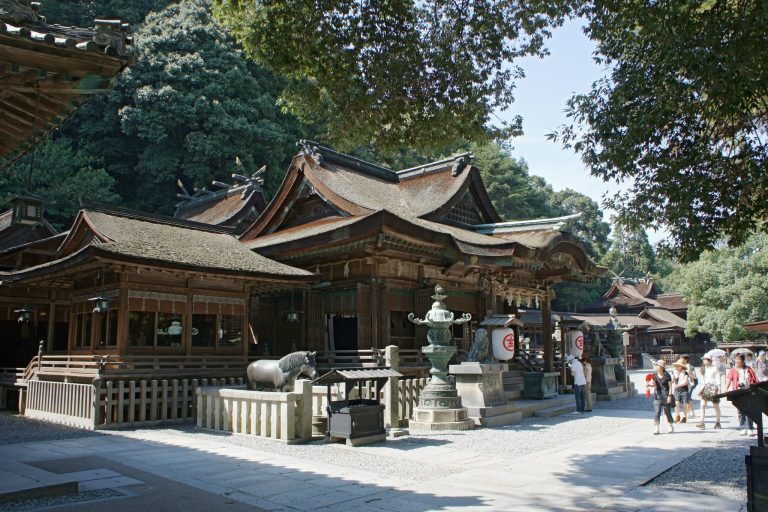
The Gomadō houses the Five Great Wisdom Kings, and a goma fire ritual is performed there several times each year. The grounds also contain Myōkengū Shrine, the Awashima Hall, and various small shrines distributed around the Main Hall.
Kyōgoku Samanosuke’s Burial Site
The burial site of the ophthalmologist Kyōgoku Samanosuke lies west of the Main Hall.
Paintings, Manuscripts, and Sculptures
Mandala and Fudō Paintings
A coloured silk painting of a Lotus Sutra mandala dates from the Northern and Southern Courts period. A mandala is a diagrammatic sacred image representing a Buddhist cosmos or arrangement of deities. This painting served as the principal image for the Lotus Sutra assembly and places Buddhas and bodhisattvas in a circular composition.
A silk painting of a standing Fudō Myōō dates from the Muromachi period. The figure is rendered entirely in red, giving the work its name, the Red Fudō.
Manuscript and Heavenly Deity
The temple’s cultural-property holdings include a manuscript of the Shinshoku Kokin Wakashū, the last imperial anthology of waka poetry. The anthology was completed by imperial order in 1439, and the temple manuscript was copied in 1440.
A wooden standing figure of a heavenly deity was made between the late ninth and early tenth centuries. It is one of the Four Heavenly Kings, Buddhist guardians assigned to the four directions, and is sometimes identified as Zōchōten, the guardian associated with the south, because of the direction in which it faces. The other three figures are not known. After the Second World War, the statue entered the Powers Collection, was later returned to Japan, and is now privately owned there.