Urado Castle: A Maritime Stronghold in Japan


Site at a Glance
- Rating
- 3.4
- Popularity
- Very Low
- Country
- Japan
- Primary era
- Early Modern
- External website
- Open
- Eras represented
- Early Modern
- Civilizations
- Unclassified
- Site type
- Military
- Remains
- Castle
On this page9 sections
History
Urado Castle was a Japanese hill castle at Urado in Kochi, Japan, rebuilt as a major stronghold in 1591 during the late medieval period. It stood on Urado Mountain beside Urado Bay and Tosa Bay, at the entrance to the Kochi Plain. The port at Urado had long served as a center of water transport, and it appears in Tosa Diary by Ki no Tsurayuki.
Early Fortifications and Motoyama Rule
Fortifications are believed to have occupied Urado Mountain from the Kamakura period through the early Muromachi period. The Motoyama clan, one of Tosa’s seven major warrior houses, developed the site more substantially during the Tenbun period, from 1532 to 1554, under Motoyama Kiyoshige, also known as Shigemune.
In 1560, Chosokabe Kunichika defeated the Motoyama clan at the Battle of Nagahama and took control of Urado Castle along with Nagahama Castle. His son, Chosokabe Motochika, moved his main castle from Okoh Castle to Otakasaka Mountain in 1588. Repeated flooding then led him to relocate to Urado Castle in 1591.
The Chosokabe Stronghold
Motochika rebuilt Urado Castle from a fortification primarily focused on defense from the sea into a stronghold designed to control both land and water approaches. During his rule, the castle served as his residence and included a main enclosure, second enclosure, third enclosure, and detached enclosure. A three-tiered keep formed part of the complex.
A castle town grew along the northern shore of Urado Bay. Samurai residences and a facility for mooring boats connected the settlement with the castle’s maritime transport and defensive functions.
The Urado Uprising
Motochika died in 1599 and was succeeded by his fourth son, Chosokabe Morichika. Morichika supported Ishida Mitsunari’s Western Army at the Battle of Sekigahara in 1600, the decisive conflict in which the Eastern Army defeated the Western Army. After that defeat, the Chosokabe house lost its domain.
Yamauchi Kazutoyo became lord of Tosa in 1600, but former Chosokabe retainers resisted his authority. These warrior-landholders, known as the Ichiryo Gusoku, combined agricultural and military roles. On October 19, the shogunate ordered Ii Naomasa to send Suzuki Heibei and Matsui Budayu to receive the castle. Former Chosokabe retainers fired on the two men, beginning a resistance that lasted about 50 days and became known as the Urado Uprising.
The uprising was eventually suppressed through the schemes of Kuwana Yajibei and Sukumo Jinzaemon, former retainers of Morichika. Two hundred and seventy-three retainers who remained inside the castle were killed, and their heads were displayed. Kazutoyo entered Urado Castle in January 1601.
Abandonment and Later Interpretation
Kazutoyo considered Urado Castle too confined and began building Kochi Castle in August 1601. After Kochi Castle was completed in 1603, he moved there, and Urado Castle was abandoned. Materials from the older castle were reused in the construction of Kochi Castle.
Urado Castle is designated as a historic site by Kochi Prefecture. Excavation carried out in 1995 during the rebuilding of Katsurahama-so found roof tiles near the main enclosure that were of lower quality than tiles from Okoh Castle and other sites. This evidence contributed to the theory that Urado was a temporary base prepared for the invasion of Korea, with the main base eventually intended to return to Otakasaka Mountain. Katsurahama-so and the Kochi Prefectural Sakamoto Ryoma Memorial Museum now occupy the former castle area, and their construction, together with later reuse, destroyed much of the earlier castle fabric.
Remains
Urado Castle was a hirayamajo, a castle built on a hill or low mountain while incorporating nearby lowland into its defensive and administrative landscape. The stronghold occupied 59-meter-high Urado Mountain north of Katsurahama and faced Tosa Bay. Its elevated position supported control of the surrounding land and water approaches, while the settlement on the northern shore of Urado Bay provided space for samurai residences and boat mooring.
Enclosures and Keep
The Chosokabe-period castle was arranged through a main enclosure, second enclosure, third enclosure, and detached enclosure. Its keep was three tiers and three stories high, with a plan described as five ken square. A ken was a traditional Japanese unit used to describe building dimensions. The keep no longer survives, while the area occupied by Katsurahama-so and the Sakamoto Ryoma Memorial Museum corresponds approximately to the main castle area.
Surviving Defensive Features
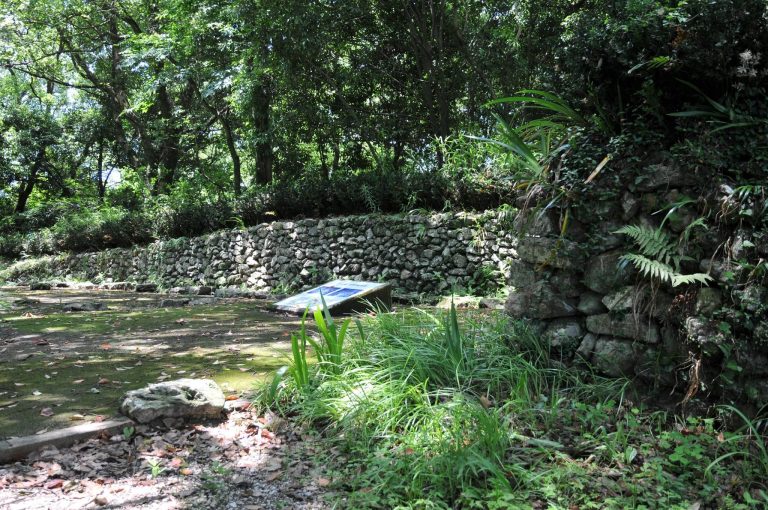
Among the remaining physical features are the platform of the main keep, traces of the enclosures, and part of the main enclosure’s stone wall. Three parallel cut ditches survive near the second enclosure. A cut ditch, or horikiri, is a trench cut across a ridge to obstruct movement along it. Some excavated stonework was relocated and reused in a surviving stone wall, and a stone monument also stands within the site.
Roof Tiles and Excavated Evidence
Excavations near the main enclosure recovered roof tiles whose relatively low quality, compared with tiles from Okoh Castle and other castles, helped shape interpretations of Urado Castle’s construction history and purpose. The surviving evidence therefore includes both defensive earthworks and masonry, as well as archaeological material connected with the castle’s buildings.