Shinomura Hachimangū: A Historic Hachiman Shrine in Kameoka, Japan


Site at a Glance
- Rating
- 4.2
- Popularity
- Low
- Country
- Japan
- Primary era
- Unclassified
- External website
- Open
- Eras represented
- Unclassified
- Civilizations
- Unclassified
- Site type
- Religious
- Remains
- Sanctuary
On this page13 sections
History
Shinomura Hachimangū is a Shinto shrine in Kameoka, Japan, traditionally founded in 1071 by imperial order in the nagare-zukuri style. Minamoto no Yoshiie invited Hachiman, a deity associated with warfare, protection, and the imperial line, from Konda Hachimangū in Habikino, Osaka. A land-donation document issued by Yoshiie on May 13, 1072, survives and is connected with the shrine’s early history.
Origins in the Shinomura estate
The Shinomura estate was first opened by the Fujiwara family and later inherited by the Minamoto family. Shinomura Hachimangū is traditionally understood to have been established within this estate under Minamoto patronage. Its Hachiman tradition reflects the close relationship between warrior families and worship of the deity, who was commonly identified with Emperor Ojin.
Ashikaga Takauji and the Kamakura shogunate
The shrine is especially associated with Ashikaga Takauji, the founder of the Ashikaga, or Muromachi, shogunate. On April 29, 1333, Takauji presented a prayer for victory at Shinomura Hachimangū and remained there for ten days. He then attacked the Rokuhara Tandai, the Kamakura shogunate’s military and administrative office in Kyoto. The victory helped establish the foundations of the Kenmu Restoration, Emperor Go-Daigo’s attempt to restore direct imperial rule after the fall of the Kamakura shogunate.
Takauji later broke with Emperor Go-Daigo and was defeated in the fighting for Kyoto. From January 30 to February 1, 1336, he assembled his remaining troops at Shinomura Hachimangū, donated shrine estates, and prayed for his recovery. He escaped to Kyushu, rebuilt his forces, returned to Kyoto, and founded the Muromachi shogunate. His prayers at the shrine appear in the Baishōron, Taiheiki, and Nantaiheiki. The shrine also preserves his prayer document and an accompanying donation document bearing his seal.
Ashikaga patronage and later changes
After the two crises that preceded his successes, Takauji personally visited the shrine on August 10, 1349, to express his thanks. Later Ashikaga shoguns donated extensive estates, and the shrine’s domain eventually extended across eastern and western Shinomura. During this period, the office of bettō, a senior supervisory position, was held by the monzeki, or high-ranking Buddhist abbot, of Sanbō-in at Daigoji, a major temple complex in Kyoto.
The Ōnin War, a civil conflict that devastated Kyoto and helped begin the Warring States period, caused the shrine to lose much of its records and precinct. Further losses followed Akechi Mitsuhide’s invasion of Tanba in the sixteenth century. During the Kan’ei era, from 1624 to 1643, Suganuma Sadayoshi, lord of Kameyama Castle, repaired the main hall. The shrine was subsequently protected directly by the lords of Kameyama Castle.
Modern recognition
Under the prewar shrine-ranking system, Shinomura Hachimangū held the status of a village shrine. The place associated with Takauji’s troop mobilization became a Kameoka City historic site in 1986. His prayer document and accompanying sealed order were designated Kyoto Prefectural tangible cultural properties in 2006. The main hall, worship hall, and Northwestern Epidemic Shrine were registered as Kyoto Prefectural cultural properties in 2018.
Remains
Main shrine buildings
Main hall
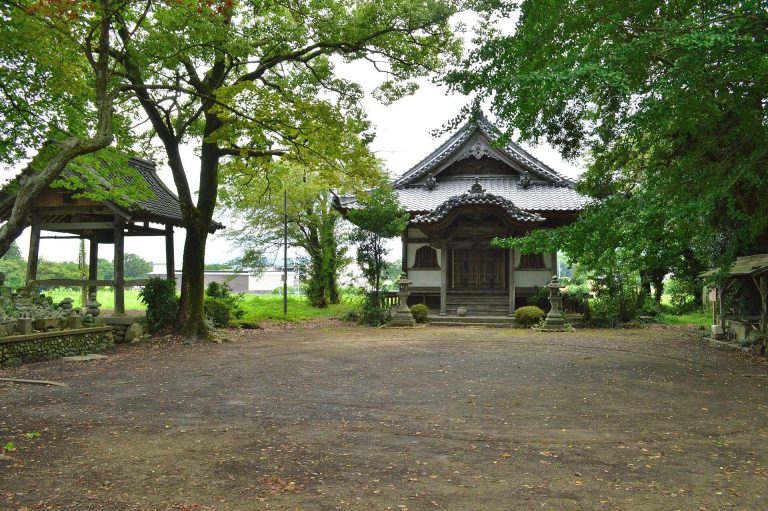
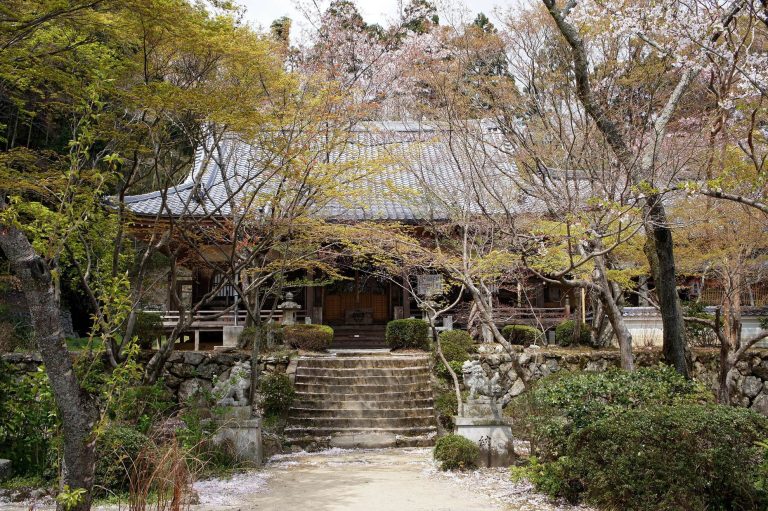
The main hall is a one-bay structure in the nagare-zukuri style. This form has a gabled roof whose front slope projects forward to create a covered space above the entrance. The hall forms the principal building of a precinct that also contains a worship hall and several smaller religious structures.
Northwestern Epidemic Shrine
The Northwestern Epidemic Shrine stands toward the northwest, at the former boundary between Tanba and Yamashiro provinces. It is regarded as older than the Hachiman shrine and is associated with goryō beliefs, which concerned the appeasement of powerful spirits thought capable of causing illness or disaster. These beliefs originated in the Nara period and give the building a religious history distinct from the shrine’s later association with Takauji.
Worship hall and subsidiary shrines
The precinct includes the worship hall, an Inari Shrine, an ancestral spirits shrine, a purification shrine, and four small shrine buildings. The four smaller buildings are said to have been moved from nearby sanctuaries after the Meiji period. Other associated shrines are dedicated to Akiba, Atago, Sumiyoshi, Kasuga, Hiyoshi, the Imperial Grand Shrine, Toyouke, and Tenmangu.
Together, these buildings represent several forms of religious devotion. They include protection against epidemics, worship connected with food and rice, purification, fire protection, mountain worship, sea-related worship, agricultural deities, and Tenjin worship. The ancestral spirits shrine enshrines successive shrine priests and fifty-five people from the surrounding area who died in the Pacific War.
Features associated with Takauji
Arrow mound
A mound known as the arrow mound stands within the precinct. Tradition identifies it as the place where arrows offered during Takauji’s troop mobilization were buried. In the Taiheiki, Takauji offers one whistling arrow together with his prayer document, after which many warriors imitate him and the arrows form a large pile. A shii tree grows on the mound, and the present tree is regarded as the second generation.
Banner tree
North of the precinct stands a poplar called the banner tree. Takauji is said to have displayed a flag bearing his two-bar crest there from April 27 to May 7, 1333, allowing allied warriors to identify his position. The tree is mentioned in the Baishōron. The present specimen was propagated from cuttings in the early Shōwa period and is said to continue a line descended through six or seven generations from the trees associated with Takauji’s time.