Nison-in Temple: A Tendai Buddhist Temple Complex in Kyoto


Site at a Glance
- Rating
- 4.4
- Popularity
- Medium
- Country
- Japan
- Primary era
- Early Modern
- External website
- Open
- Eras represented
- Early Modern
- Civilizations
- Ashikaga shogunate
- Site type
- Religious
- Remains
- Monastery
On this page13 sections
History
Nison-in Temple is a Tendai Buddhist temple complex in Kyoto, Japan, traditionally founded in 834 during the Heian period under the patronage of Emperor Saga. Its formal name is Ogura-yama Nison-kyō-in Keidai-ji, while the name Nison-in refers to its two principal images, Shaka Nyorai and Amitabha. The establishment is associated with the monk Ennin, also known as Jikaku Daishi, and the temple later became part of the Enryaku-ji temple group.
Foundation and early religious history
Nison-in subsequently declined, but it later gained a connection with Hōnen, who resided there and preached Buddhist teachings. In the early Kamakura period, which lasted from 1185 to 1333, the third abbot, Tankū, and other monks revived the institution. Tankū was a prominent disciple of Hōnen and served as preceptor, a senior religious teacher who administers Buddhist ordination or precepts, to the retired Emperor Tsuchimikado and Emperor Go-Saga.
After its revival, Nison-in became a center for the combined study of Tendai, Shingon, Ritsu, and Pure Land Buddhism. Tendai sought to integrate a broad range of Buddhist teachings, Shingon represented esoteric practice, Ritsu emphasized monastic discipline, and Pure Land devotion focused on rebirth in Amitabha’s Western Pure Land. Pure Land teaching became especially influential at Nison-in, which developed into a base for the Saga Pure Land community.
The Karoku Disturbance and imperial connections
During the Karoku Disturbance of 1227, warriors connected with the Rokuhara Tandai escorted Hōnen’s remains from his mausoleum to Nison-in. The Rokuhara Tandai was the Kamakura shogunate’s military and judicial office in Kyoto. The transfer was intended to protect the remains from Tendai warrior-monks, but they were later taken to Nenbutsu Sanmai-in in Nishiyama, where they were cremated.
Nison-in’s religious links with the imperial court continued through its abbots. The fourth abbot, Eikū, served as preceptor to Emperors Go-Fukakusa, Kameyama, Go-Uda, and Fushimi. From the Nanboku-chō period, the fourteenth-century era of rivalry between the Northern and Southern Imperial Courts, until the Meiji Restoration, Nison-in was one of four Kurodo temples. These were imperial-associated Buddhist institutions responsible for rites within the imperial palace. The role is reflected in the graves of court noble families, including the Takatsukasa, Nijo, Sanjo, Shijo, Sanjonishi, and Saga families.
Destruction, rebuilding, and later history
The temple buildings were destroyed by fire during the Onin War of 1467 to 1477, a civil conflict that brought widespread destruction across Japan. About three decades later, in 1521, the main hall and Chinese-style gate were rebuilt. The work took place after Sanjō Sanetaka raised donations, during the tenure of the sixteenth abbot, Eikyō, who had served as preceptor to Emperor Go-Nara.
By the late Edo period, Nison-in belonged to the Tendai school and was counted among the three renowned sites of Saga. In the nineteenth century, the court noble Sanjō Sanetsumu was ordered to retire as a monk at the temple after political disputes over how to respond to newly assertive foreign powers. He died while confined there. Emperor Kōmei subsequently sent imperial envoys to confer on him the posthumous rank of Udaijin, one of the senior offices of the imperial government.
Nison-in is traditionally associated with a villa on Mount Ogura belonging to Fujiwara no Teika, the poet and compiler of One Hundred Poems by One Hundred Poets. It is also traditionally regarded as the birthplace of Ogura bean paste. The temple is the seventeenth pilgrimage site in the Twenty-Five Sacred Places of Hōnen. Its principal Buddhist statues and several paintings and documents are Important Cultural Properties, while seventeen hanging scrolls depicting the Twenty-Five Bodhisattvas welcoming the deceased are designated Important Art Objects. Kyoto City has designated the Main Hall, Tankū Mausoleum, Main Gate, and other features as cultural properties.
Remains
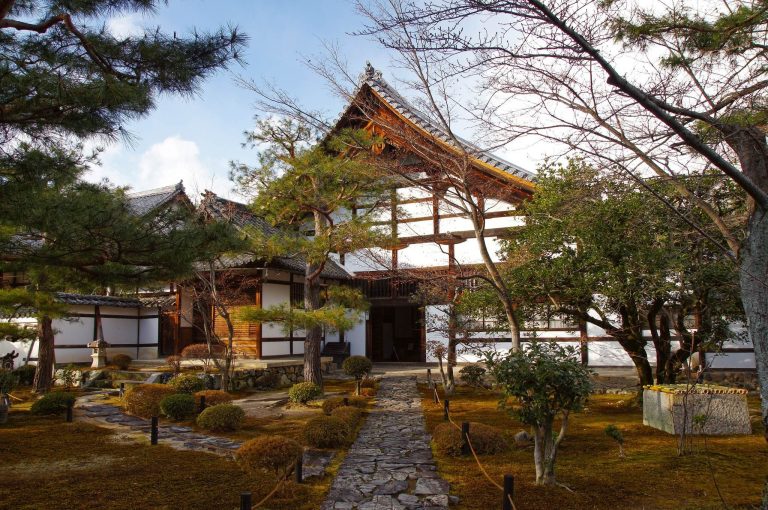
Set on Mount Ogura, Nison-in includes a temple complex, an approach lined with trees, and an old cemetery containing graves of emperors and aristocratic families. The surviving buildings and objects preserve the temple’s connections with Tendai and Pure Land Buddhism, the imperial court, and the religious culture of medieval Kyoto.
Temple grounds and cemetery
Maple Horse Ground
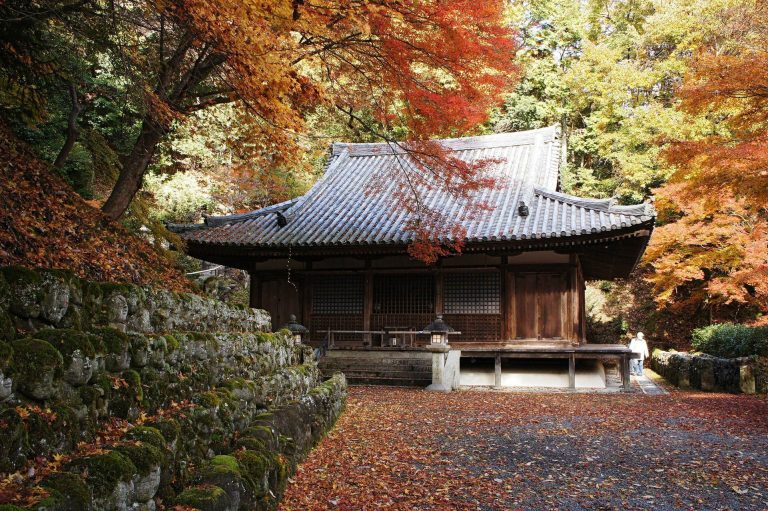
Inside the Main Gate, the approach is known as the Maple Horse Ground. Maple and cherry trees line this part of the complex, forming a defined passage between the gate and the principal temple buildings.
Imperial and aristocratic cemetery
The cemetery on Mount Ogura contains graves of emperors and members of the aristocracy. The father of Sanjō Sanetaka is buried there, adding a courtly connection to the burial landscape associated with the temple.
Shiguretei site
Toward the rear of the grounds lies a place traditionally identified as the remains of Fujiwara no Teika’s Shiguretei villa. The site preserves the temple’s long-standing association with the poet and with the literary traditions connected to Ogura.
Main Hall images
The Main Hall houses standing images of Shaka Nyorai and Amitabha, both attributed to the Kasuga school of Buddhist sculptors and generally dated to the middle of the Kamakura period. Each statue is 78.8 centimeters high. Shaka Nyorai, the Japanese form of Shakyamuni or Gautama Buddha, stands on the viewer’s right with a gesture understood as sending the deceased from this world toward the next. Amitabha, the Buddha associated with the Western Pure Land, stands on the left with a gesture of welcoming the dead to that realm.
The two figures form a symmetrical pair while differing in details of their lower-body drapery and hand positions. Shaka raises his right hand and lowers his left, whereas Amitabha reverses the arrangement. Amitabha’s lowered right hand has all five fingers extended rather than forming the customary finger circle. The statues now appear darkened, although they were originally finished with gold pigment and decorated with geometric patterns made using kirikane, a technique that cuts extremely thin pieces of gold or gold leaf and applies them to the surface.
Painted and literary remains
Portrait of Hōnen
Nison-in preserves a Kamakura-period portrait of Hōnen traditionally titled the “Trailing-Feet Portrait.” Takuma Hōgen painted it on the commission of Kujō Kanezane. Although severely damaged, the work is among the oldest surviving portraits of Hōnen.
Twenty-Five Bodhisattvas paintings
Seventeen hanging scrolls showing the Twenty-Five Bodhisattvas welcoming the deceased are preserved among the temple’s designated art objects. Their subject relates directly to the Pure Land beliefs that became especially influential at Nison-in.