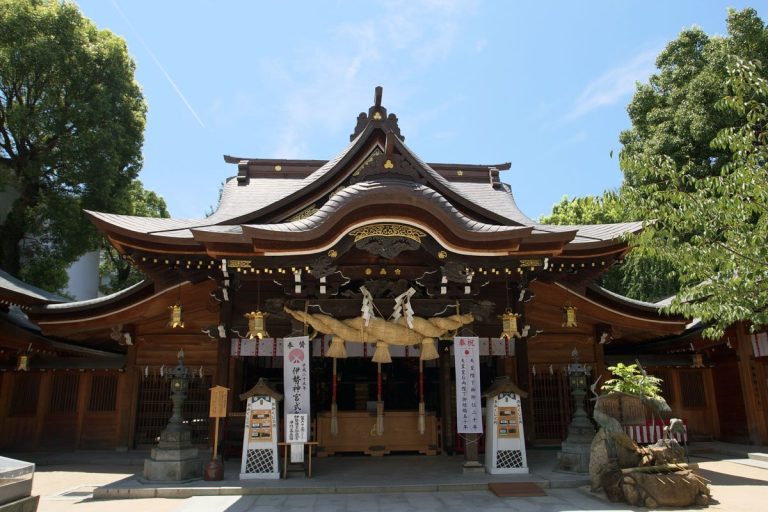
Sōfuku-ji Temple: A Rinzai Buddhist Training Center in Fukuoka


Site at a Glance
- Rating
- 4.1
- Popularity
- Low
- Country
- Japan
- Primary era
- Early Modern
- External website
- Open
- Eras represented
- Early Modern, Modern
- Civilizations
- Japanese
- Site type
- Religious
- Remains
- Monastery
On this page16 sections
History
Sōfuku-ji Temple is a Rinzai Buddhist temple in Fukuoka, Japan, founded in 1240 during the medieval period. It belongs to the Daitoku-ji school, a Rinzai branch centered on Daitoku-ji in Kyoto, and its principal image is Shaka Nyorai, or Shakyamuni Buddha. The temple was one of the Daitoku-ji school’s three training centers and became a leading Zen institution in Kyushu.
Foundation at Dazaifu
The monk Tan’e founded Sōfuku-ji at Dazaifu, a major administrative center for western Japan and the country’s relations with the Asian mainland. The earlier temple site survives as a branch near Chikushidai High School. In 1241, Enni Ben’en, a Japanese Zen monk who had returned from study in China, delivered the inauguration sermon. On that occasion, the temple displayed the eight-character name translated as “Imperially Bestowed, Ten-Thousand-Year Sōfuku Zen Temple,” a name bestowed by the Chinese monk Wuzhun Shifan.
In 1243, Sōfuku-ji and Jōten-ji were placed among the officially recognized temples. Emperor Go-Saga then granted Sōfuku-ji an imperial plaque bearing the words “Dharma Cave of the Western Capital.” The temple was also under the protection of General Mutō Sukeyori, the Kamakura shogunate’s representative at Dazaifu. The Kamakura shogunate was Japan’s military government from 1185 to 1333, and its connection with Sōfuku-ji placed the monastery within the political as well as religious structure of medieval western Japan.
Nanpo Shōmyō and the China connection
In 1272, Nanpo Shōmyō, also known as Daiō Kokushi, became abbot. He was a prominent Japanese Rinzai teacher, and his thirty years at Sōfuku-ji brought the monastery a period of major expansion. Tradition holds that the monastery was built specifically for him. Nanpo attracted numerous disciples and strengthened Zen practice at the temple, while his teachings were later preserved in the Sōfuku-ji goroku, a collection of his recorded sayings and instruction.
Sōfuku-ji also became an important point of exchange between Japan and China. Chinese monks traveling to Japan and Japanese monks traveling to China passed through the temple. In 1308, following Nanpo’s death, Hōō Sōichi became the third abbot. In 1331, Shūhō Myōchō, the leading Zen master later known as Daitō Kokushi and founder of Daitoku-ji in Kyoto, left Daitoku-ji and spent one hundred days at Sōfuku-ji. These associations linked the temple to major developments in Japanese Rinzai Buddhism.
Destruction and relocation
During the Azuchi-Momoyama period, Sōfuku-ji was destroyed by fire in 1586 amid fighting between the Shimazu and Ōtomo clans, including the Battle of Iwaya Castle. Reconstruction followed the establishment of the Fukuoka Domain by Kuroda Nagamasa in 1600. At that time, the temple moved from Dazaifu to its present site in Chiyo, Hakata, and became the family temple of the Kuroda house.
The relocated temple developed close ties with the political and religious formation of the Fukuoka Domain. Nanpo’s teachings at Sōfuku-ji expressed a sense of national responsibility through terms translated as “Great Nation of Japan” or “Great State of Japan.” In 1612, the Hakata merchant and tea master Shimai Sōshitsu paid for the rebuilding of the subtemple Zuiun-an, whose founding abbot was Eggetsu Sōgan. In 1624, Kuroda Nagamasa granted Sōfuku-ji a stipend of 350 koku, a historical measure of agricultural yield used to express stipends and domain income.
Modern decline and rebuilding
The early Meiji period brought the suppression of Buddhism and the separation of Buddhism from Shinto, and Sōfuku-ji entered a period of decline. Reconstruction and reorganization began in 1895 under the abbot Watanabe Gengai. Kuroda Nagashige, then head of the former Fukuoka-domain Kuroda family, wrote the temple name.
A Fukuoka air raid on June 19, 1945, destroyed much of the complex, including the Tankō-an tea room. The room had previously been designated a National Treasure and was associated with Kamiya Sōtan, a merchant and tea master. After the war, the former Kuroda burial grounds were restored and the graves reburied, although the cemetery was reduced to one-fifth of its previous extent. The destroyed tea room was reconstructed in 1963 as Sōtan-an.
On May 9, 2005, arson by a temple trainee destroyed three buildings, including the abbot’s quarters and the study, covering approximately 700 square meters. In 2014, the Kuroda family’s remaining Edo-period graves were donated and transferred to the City of Fukuoka. Road widening also reorganized the approach before the temple gate, added a neighboring automobile road, and moved two shops into the temple precincts.
Remains
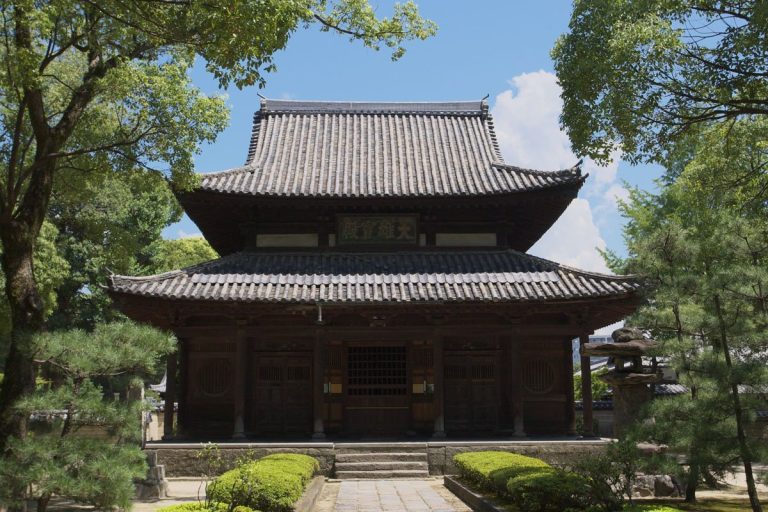
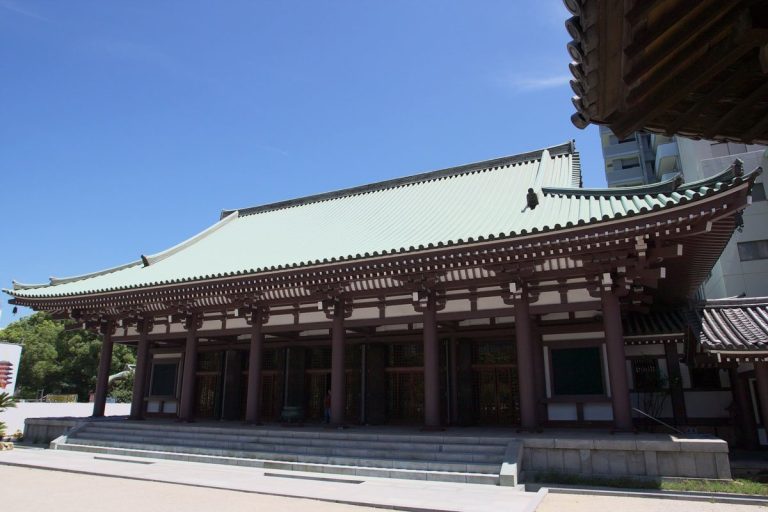
The present precinct in Chiyo combines surviving and reconstructed elements from the temple’s Buddhist, castle, funerary, and memorial history. Its principal features include the former entrance gate of Fukuoka Castle, a gate associated with Najima Castle, the Buddhist Hall, the enclosed Kuroda cemetery, the reconstructed Sōtan-an tea room, and the monument and image of Asahi Jizo. A covered corridor in the publicly accessible front area contains hundreds of Buddhist statues deposited by believers.
Temple gates and principal buildings
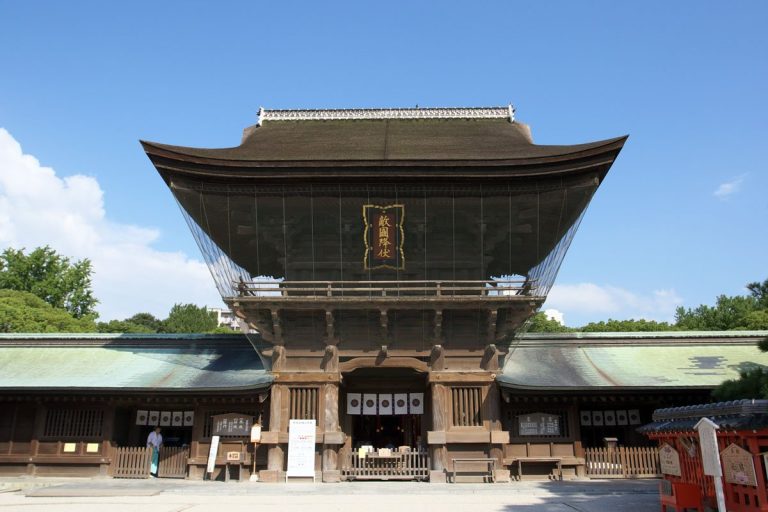
Sanmon
The Sanmon, or mountain gate, was originally the main entrance of Fukuoka Castle. The army released it for relocation, and it was moved to Sōfuku-ji in 1918. The two-story gate has a tiled, gabled roof. A side door on the left survives from the structure’s earlier use as a castle entrance, preserving a physical link between the temple and the former domain headquarters.
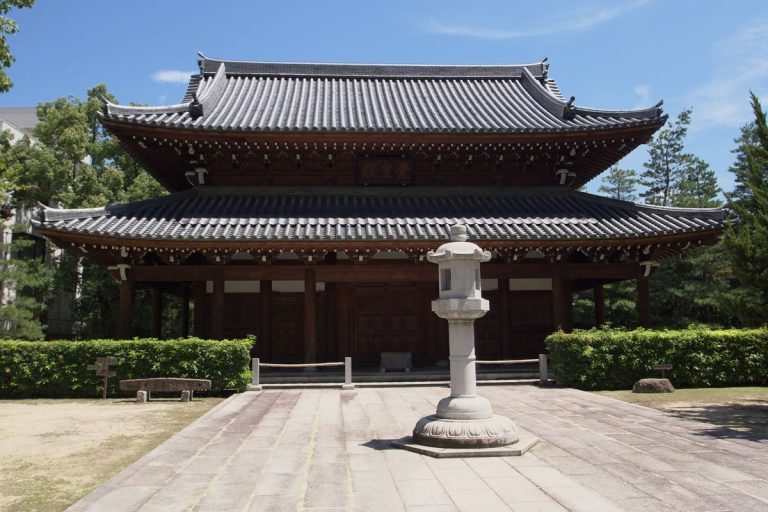
Karamon
The Karamon is believed to have been transferred from Najima Castle. That castle stood on a headland and was demolished in 1601 because its surroundings could not accommodate a larger settlement. The gate was renovated during the Edo period. Its formal gabled roof has curved, Chinese-style roof lines, a form associated with this type of ceremonial entrance.
Buddhist Hall
The Buddhist Hall survives as a designated component of the temple complex. Together with the two relocated castle gates, it forms part of the present temple’s surviving architectural fabric.
Kuroda cemetery
Burial enclosure
The former Kuroda cemetery lies in an enclosed area separated from the rest of the grounds by the Fujisui Gate. It contains monuments to Kuroda Yoshitaka, also known as Jōsui, his wife Kushihashi Teru, Kuroda Nagamasa, and Nagamasa’s younger brother Kuroda Kumanosuke. The enclosure also holds the tombs of the fourth, sixth, seventh, ninth, and tenth lords of the Fukuoka Domain, Tsunamasa, Tsugutaka, Haruyuki, Naritaka, and Narikiyo.
The tombs of the second, third, and eighth domain lords are at Tōchō-ji, while those of the eleventh lord onward are at Aoyama Cemetery in Tokyo. The Sōfuku-ji cemetery also contains the graves of Shimai Sōshitsu, Takaba Ran, and Ōmori Harutoyo, the first president of Fukuoka Medical School. Members of the nationalist organization Gen’yōsha, including Tōyama Mitsuru and Kurushima Tsuneki, are buried there as well.
Rebuilt funerary landscape
The cemetery once included a mausoleum, stone pagodas, lanterns, and more than twenty other tomb structures. Weathering and wartime damage destroyed these elements. After the war, the burial ground was consolidated and rebuilt on a raised earthen platform after being reduced from more than five times its present size. Some monuments, including Nagamasa’s, were newly made. A later reorganization added the Fujisui Gate and an information sign.
Memorials and religious objects
Tan’e monument and Asahi Jizo
A separate monument marks a place associated with Tan’e, the founder of Sōfuku-ji. He is believed to have excavated a cave, lived there in seclusion, and died while seated. A stone monument and, later, a Jizo image were installed at the site.
The image is known as Asahi Jizo and Hikiri Jizo. Jizo is a Buddhist bodhisattva associated with protection, vows, travelers, children, and the dead. Asahi Jizo is revered as a wish-granting figure and is connected with the practice of making one hundred visits. Its festival days fall on the fourth, fourteenth, and twenty-fourth days of each month, when especially large crowds gather. The image was transferred to the present temple when Sōfuku-ji moved from Dazaifu.
Covered corridor and temple furnishings
Inside the outer wall of the publicly accessible front area, a long covered corridor houses hundreds of large and small Buddhist statues from different denominations. Believers deposited the statues there. Other recorded objects include a Korean Korai bell, a votive plaque donated by Emperor Go-Toba, and ceremonial Buddhist furnishings associated with the Kuroda family.
The furnishings were donated by Ichiko, the wife of Kyōgoku Takatoyo, after a memorial service at Sōfuku-ji for her mother Chikuhime. Chikuhime was the wife of Sakai Tadataka and the daughter of Kuroda Mitsuyuki, the third lord of Fukuoka. The furnishings preserve the religious and memorial bond between mother and daughter. The reconstructed Sōtan-an tea room, the former castle gates, the Buddhist Hall, the cemetery, and the memorial to Asahi Jizo together reflect the successive roles that Sōfuku-ji has held since its foundation at Dazaifu.