Tenryū-ji Temple: A Memorial Rinzai Zen Temple in Kyoto


Site at a Glance
- Rating
- 4.5
- Popularity
- High
- Country
- Japan
- Primary era
- Modern
- External website
- Open
- Eras represented
- Medieval, Early Modern, Modern
- Civilizations
- Ashikaga shogunate, Japanese, Tokugawa, Toyotomi regime
- Site type
- Religious
- Remains
- Monastery
On this page19 sections
History
Tenryū-ji Temple is a Rinzai Zen temple in Kyoto, Japan, founded in the early fourteenth century as a memorial to Emperor Go-Daigo. Its foundation is associated with 1339, although 1343 is also recorded as the founding year, and the temple was completed in 1345. Ashikaga Takauji, founder of the Ashikaga shogunate and a leading figure of the Northern Court, acted as founder, while the Zen monk Musō Soseki became its founding abbot. Tenryū-ji is formally known as Reigizan Tenryū Shiseizen-ji and venerates Shakyamuni Buddha as its principal object of worship.
Before the temple
Tenryū-ji occupies the site of Danrin-ji, an early Heian-period temple founded by Tachibana no Kachiko, empress of Emperor Saga. The monk Gikū, associated with the early transmission of Zen teachings in Japan, lived and taught there. Danrin-ji later declined and remained in disrepair for roughly four centuries.
In the mid-thirteenth century, retired Emperor Go-Saga established an imperial residence on the abandoned temple site. His son, Emperor Kameyama, developed it into a detached palace known as Kameyama Palace. The residence later became connected with the Daikakuji imperial line and with Emperor Go-Daigo, whose political struggle to restore direct imperial rule brought him into conflict with Ashikaga Takauji.
Foundation and early development
After Go-Daigo died in Yoshino, Musō Soseki urged Takauji to establish a memorial temple for him. The foundation was intended to support prayers for the deceased emperor and, according to tradition, to appease a spirit that might remain resentful. The former Kameyama Palace was chosen because of its strong connection with the imperial family, and retired Emperor Kōgon authorized its conversion into a temple.
The institution was initially to be called Ryakuō Shiseizen-ji, after the Northern Court era name. It was instead renamed Tenryū Shiseizen-ji, meaning “Heavenly Dragon Temple,” after a tradition that Takauji’s brother Tadayoshi dreamed of a golden dragon rising from the Ōi River, also called the Hozu River, south of the temple.
Takauji and Emperor Kōgon donated estates to support the new temple, but their revenues were insufficient for its construction. In the early 1340s, Tadayoshi obtained permission for trading voyages with Yuan China. The resulting Tenryūji-bune ships were intended to finance the building project. Tenryū-ji was completed in 1345, when a ceremony was held on the seventh anniversary of Go-Daigo’s death.
In 1346, Musō established the Tenryū-ji Ten Views, a group of ten celebrated scenic places associated with the temple and its surroundings. That same year, income from the Shinomiya-shō estate, amounting to 300 kanmon, was assigned to the temple’s memorial-service expenses. These arrangements tied the institution to both religious observance and a wider network of landholding and commercial revenues.
Trade and institutional power
During the 1430s, Tenryū-ji entered a tributary relationship with the Ming imperial court. This arrangement enabled formal trade between Japan and China. In return for Chinese influence over the succession of the temple’s chief abbot, Tenryū-ji and related Zen institutions helped coordinate trade among China, Okinawa, and Japan. That role continued into the nineteenth century.
Under Ashikaga protection, Tenryū-ji became one of Kyoto’s most important Rinzai temples. Its grounds reportedly covered about 330,000 square metres and extended as far as the area of present-day Katabira-no-Tsuji Station. At its height, the institution included approximately 150 sub-temples. In the Kyoto Five Mountain system, a medieval ranking of major Zen temples under the military government, Tenryū-ji stood first among Kyoto’s Five Mountains.
Fire, destruction, and rebuilding
Tenryū-ji suffered six major fires during the fourteenth and fifteenth centuries, in 1358, 1367, 1373, 1380, 1447, and the late 1460s. The final medieval destruction came during the Ōnin War, a late fifteenth-century conflict that caused widespread devastation in Kyoto. Reconstruction proceeded slowly, and none of the original buildings survived these repeated disasters.
Toyotomi Hideyoshi donated land yielding 1,720 koku to the temple in 1585. Buildings collapsed in the Keichō-Fushimi earthquake of 1596 and were later restored. In 1604, Tokugawa Ieyasu confirmed land yielding 7,020 koku to Tenryū-ji, strengthening its resources during the establishment of the Tokugawa shogunate.
A fire in 1815 destroyed the Dharma Hall and the abbey buildings. During the Kinmon Incident of 1864, a political and military confrontation in Kyoto during the final years of the Tokugawa period, Chōshū forces used Tenryū-ji as a base. After they withdrew, Satsuma troops led by Murata Shinhachi entered the temple and looted furnishings. Satsuma artillery then caused a major fire that destroyed most of the complex. Shōgan-ji, Jisai-in, and Kōgen-ji were the surviving sub-temples.
The graves of Emperors Go-Saga and Kameyama were repaired in 1865. The Hokke-dō, or Lotus Hall, associated with Kameyama was rebuilt with financial support from Higashi Hongan-ji. The imperial tombs are now administered by the Imperial Household Agency.
Modern institution and historical legacy
Tenryū-ji became the head temple of the Tenryū-ji branch of Rinzai Zen in 1876. Government land confiscation reduced its former territory, including extensive holdings in Arashiyama, Kameyama, and the Saga plain, to roughly one-tenth of its earlier area. Major rebuilding began with the Dharma Hall, large abbey, and kitchen in 1899 and continued into the early twentieth century.
The temple’s surviving documentary collection, known as the Tenryū-ji Documents, contains more than 2,500 items. Many medieval originals were lost in fires and survive only as copies. Other materials from the related Rinsen-ji were later transferred to Tenryū-ji, giving the collection a substantial Rinsen-ji component as well as later temple diaries. The documents concern landholdings, settlements, buildings, and the institution’s history.
In 1962, Tenryū-ji hosted the first Kyoto Conference of Scientists under the direction of Hideki Yukawa, the first Japanese recipient of the Nobel Prize in Physics. Described as a Japanese counterpart to the Pugwash Conferences, the meeting publicly advocated a treaty banning nuclear weapons.
The temple garden was protected as a nationally designated Historic Site and scenic place in 1923. It received the higher designation of Special Place of Scenic Beauty in 1955. In 1994, Tenryū-ji became part of the UNESCO World Heritage property Historic Monuments of Ancient Kyoto. The temple continues to hold a memorial service for Emperor Go-Daigo on September 15 and one for Musō Soseki on October 30.
Remains
Tenryū-ji stands on the left bank of the Ōi, or Katsura, River, opposite Arashiyama. Its eastern boundary contains the Chokushimon, or Imperial Messenger Gate, and the Middle Gate. From these gates, the approach runs westward toward the central buildings, an arrangement that differs from the usual south-facing, north-south alignment of Zen monasteries. Sub-temples line both sides of the approach, which leads to the Dharma Hall and then to the large abbey, small abbey, kitchen and administrative building, meditation hall, Tahōden, and other structures. Most of the buildings are modern reconstructions.
Gates and central buildings
Chokushimon
The Chokushimon is a one-story gate in the four-legged-gate style and the oldest surviving structure on the grounds. It represents Momoyama-period architecture and is believed to have been transferred from Fushimi Castle.
Dharma Hall
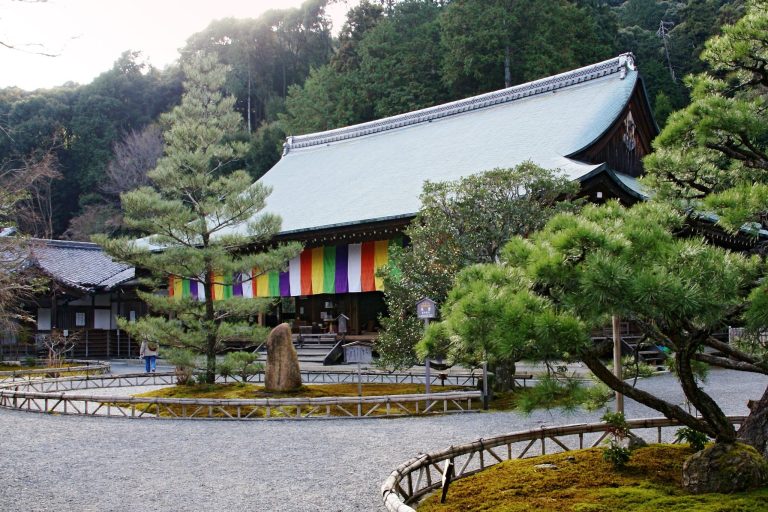
The Dharma Hall occupies an unusual position near the center of the grounds. The present building was reconstructed around 1900, after the late-Edo-period structure had been moved from the sub-temple Ungo-an. It also serves as a Buddha Hall and contains an image of Shakyamuni Buddha flanked by two guardian figures.
The ceiling formerly carried a cloud-dragon painting made by Suzuki Shōnen in 1899. Matazō Kayama later recreated the painting for the 650th memorial observance of Musō Soseki and the centenary of the hall’s transfer.
Large abbey and kitchen
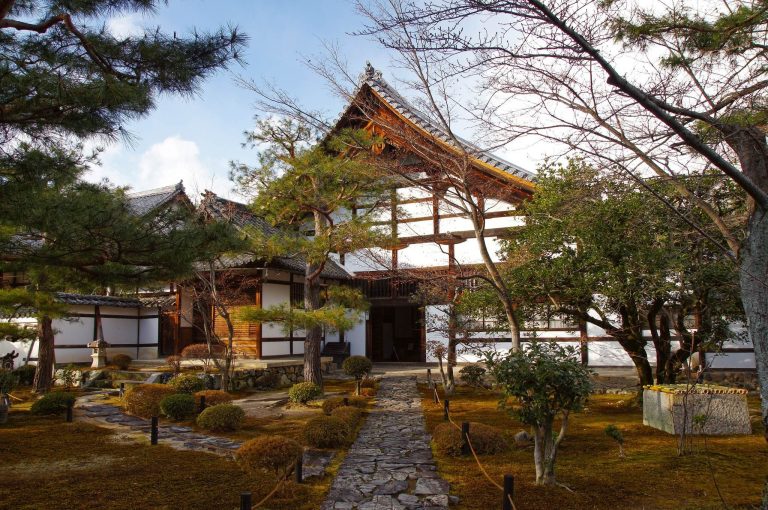
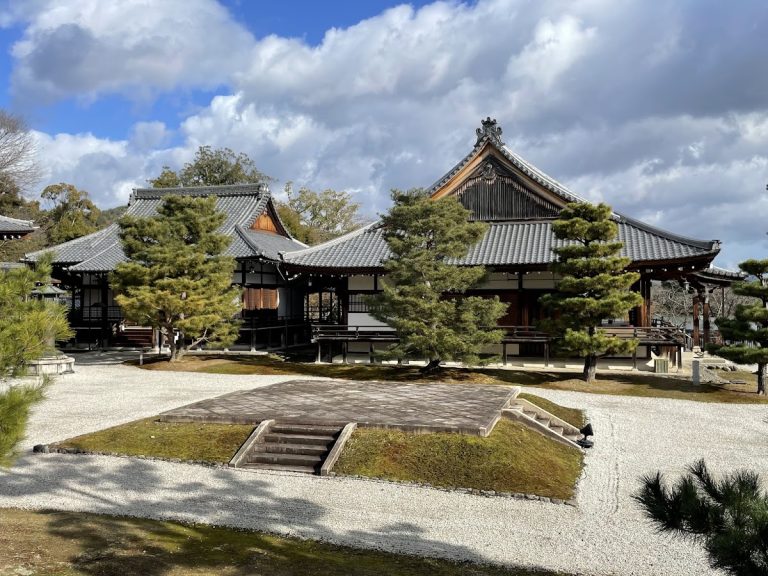
The large abbey, or ōhōjō, was completed in 1899 and is the largest building in the temple. It has a high roof, deep eaves, an eastern front facing the main gate, and a western side bordering the garden and Sōgen Pond. Its interior is divided into six rooms and contains another image of Shakyamuni Buddha. The sliding fusuma doors bear a dragon painted by Motsugai Dōjin in 1957.
Attached to the abbey is the kuri, the Zen temple’s kitchen and administrative building, completed in 1899. Its visible gable is divided by a characteristic timber lattice into panels finished with white plaster.
Small abbey and southern buildings
The small abbey, or kohōjō, was completed in 1924. Also called the shoin, meaning a study, lecture, or writing hall, it is connected to the Tahōden by a covered passage. South of the abbey are the Zen meditation hall, the Ryūmontei pavilion, the Yūun-an Hall used for meditation and lectures, and the Seikōkan research center. The Ryūmontei was recreated in 2000 as part of a memorial project for Musō Soseki and contains the restaurant Shigetsu.
Tahōden and tea rooms
The Tahōden was completed in 1934 in a style modeled on Kamakura-period architecture. It is dedicated to Emperor Go-Daigo and contains a wooden image of the emperor. Its irimoya roof, which combines a central gable with hipped sections, and the surrounding weeping cherry trees were intended to recall the palace Go-Daigo established on Mount Yoshino.
Two tea rooms, Shōunkaku and Kanmeitei, were built beside the Tahōden in 1934. Shōunkaku is a copy of Zangetsutei, a tea room associated with the Omotesenke school of tea. Beyond the Tahōden are the Hyakka-en garden, completed in 1983, and a monks’ training and residential building.
Gardens and scenic places
The designated garden area consists of the front garden and the garden behind the abbey. The front garden extends from the Chokushimon through the Release Pond to the Dharma Hall. The rear garden is a pond-stroll garden centered on Sōgen Pond and traditionally attributed to Musō Soseki. Its surviving form retains elements or traces of his original design.
Sōgen Pond is bordered by projections resembling sandy beaches, with stone arrangements and a stone bridge behind it. The garden uses Arashiyama and Kameyama as borrowed scenery, incorporating these distant landscapes into its composition. It is also understood to have evoked Penglai, the mythical Chinese island or mountain. The garden extends from the Middle Gate east of the large abbey to the northern gate and includes Sōgen Pond, a hill, and Hyakka-en. Kameyama Park lies to its west.
The Tenryū-ji Ten Views comprise Fumyō Pavilion, Zesshō Ravine, Reihi Mausoleum, Sōgen Pond, Nenge Ridge, Togetsukyō Bridge, Sankyūgan Rock, Manshō Cave, Ryūmontei, and Kichō Tower. Ryūmontei stands south of Sōgen Pond, while the other views are named scenic locations associated with the temple grounds and surrounding landscape.
Sub-temples and associated remains
Shōgan-ji and Jisai-in
Shōgan-ji was founded in 1353 by Yotsuji Yoshinari, with Kaikoku Sotan as its founding monk. Its small hall is dedicated to Fukurokuju, one of the Seven Lucky Gods, and its cemetery contains a statue of Sakamoto Ryōma.
Jisai-in was founded in 1363 by the monk Mukyoku Shigen. Its ceiling bears a dragon painting by Satomi Beian.
Sanshū-in and Kōgen-ji
Sanshū-in was founded in 1368 by Fusen Hōjo, a direct disciple of Musō Soseki and the sixteenth abbot of Tenryū-ji. The sub-temple was destroyed during the Ōnin War, restored in 1662 by the monk Tengaijō, destroyed again by fire in 1769, and moved to its present location in 1908. Its east-facing Daikokuten image is a Saga doll made at the imperial command of Emperor Go-Mizunoo and is regarded as one of Japan’s three great Daikokuten images.
Kōgen-ji was founded in 1429 by Hosokawa Mochiyuki, who invited Gyokushū Eishu to serve as its founding monk. The sub-temple was among those that survived the 1864 destruction of the main complex.
Other sub-temples
Eimyō-in was founded in 1413 by Taigaku Shūsū, a third-generation Dharma descendant of Musō Soseki. His preface and first verse appear among the inscriptions contributed by leading Zen monks to the painting known as The Gourd and Catfish.
Kongō-in was reportedly established in 1364 by Shun’ya Myōha as a memorial tower for retired Emperor Kōgon. Hōgon-in was traditionally founded in 1461 by Hosokawa Yoriyuki at a location in present-day Kamigyō Ward. It moved into Kōgen-ji during the Meiji period and was transferred to its present site in 2002. Hōju-in, Kongō-in, and Rinsen-ji stand outside the main temple precinct, while Myōchi-in originally occupied the site later used by Hōgon-in.
Images and documentary heritage
The artistic heritage associated with Tenryū-ji includes a wooden image of Shakyamuni Buddha, a wooden image of Emperor Go-Daigo in the Tahōden, a sculpture of Avalokiteshvara, three portraits of Musō Soseki, and a painting of Seiryō Hōgen, also known as Yunmen Dashi. The Shakyamuni image is believed to date from the late Heian period and is said to have survived the fires that destroyed the temple.
The temple’s archive includes illustrated and written materials concerning historical landholdings, former settlements, buildings, and institutional history. It contains named landholding and cadastral records, a calligraphic work, and writings by Kitabatake Chikafusa. Myōchi-in preserves a portrait of Musō Soseki and documents associated with the monk Sakugen Shūryō.