Schloss Wiesenau: A Late Renaissance Castle in Austria


Site at a Glance
- Rating
- 4.5
- Popularity
- Very Low
- Country
- Austria
- Primary era
- Early Modern
- Eras represented
- Early Modern
- Civilizations
- Habsburg, Holy Roman Empire
- Site type
- Domestic
- Remains
- Castle
On this page7 sections
History
Schloss Wiesenau is a late Renaissance castle in Austria, built around 1579 by the merchant Sigmund von Pain. Its construction was financed by wealth from the surrounding mines, and the new building formed part of an estate in Wiesenau, in the Lavanttal of Carinthia.
The Pain family and the Siegersdorf-Kirchheimegg estate
Sigmund von Pain erected Schloss Wiesenau as a completely new structure. No earlier building on the site is documented. The family’s fortunes later declined, and the Pain line ended with Sigmund’s son, Seyfried-Friedrich, who died in Wolfsberg in 1652. His failed investments had bankrupted him by 1615. From 1648 to 1778, the estate belonged to the Barons von Siegersdorf-Kirchheimegg.
Johann and Elisabeth Soellner
In 1814, Johann Soellner acquired the castle at public auction. He was director of the lead-white factory at Wiesenau in Wolfsberg and undertook the restoration of the increasingly dilapidated building. He also created an agriculturally advanced estate devoted particularly to fruit cultivation. Gardeners from the imperial household in Vienna occasionally visited Wiesenau to extend their knowledge of these practices.
Soellner’s wife, Elisabeth Soellner-Fortschnigg, turned the castle into a meeting place for the Wiesenauer Kreis, a private intellectual circle rather than a formal academic institution. The group discussed contemporary issues and maintained correspondence with philosophers, scientists, poets, and other intellectuals. Its associates included the Enlightenment philosopher Immanuel Kant, the poet, playwright, and historian Friedrich Schiller, and Archduke John of Austria, a Habsburg known for his interests in science, culture, and regional development.
The imperial court astronomer Johann Tobias Bürg became a frequent guest and later a permanent resident at Wiesenau. Bürg was an Austrian astronomer recognized for calculating the Moon’s orbit from approximately 3,000 observations. He shared a prize announced by the Paris National Institute in 1799 with Alexis Bouvard. A private observatory was installed for him in the castle attic, and he remained at Wiesenau until his death in 1834. After Elisabeth Soellner’s suicide in 1826 and Bürg’s death, the Wiesenauer Kreis dissolved.
Later ownership and protection
In 1847, Johann Soellner’s son-in-law sold Schloss Wiesenau to Count Hugo Henckel von Donnersmarck. The Henckel von Donnersmarck family retained the property until the 1920s. During the interwar period, the castle passed to HESPA, the Lucerne-based timber-purchasing office of Swiss paper mills. HESPA adapted the interiors for administrative work before selling its extensive Austrian forests.
The Carinthian timber industrialist Hans Tilly then acquired the estate and castle. The property was subsequently restored and used mainly as a residence. By 2007, it was in the possession of RZ Holzindustrie GmbH. Schloss Wiesenau is protected as a monument of the Republic of Austria under monument number 34177.
Remains
Castle form and exterior
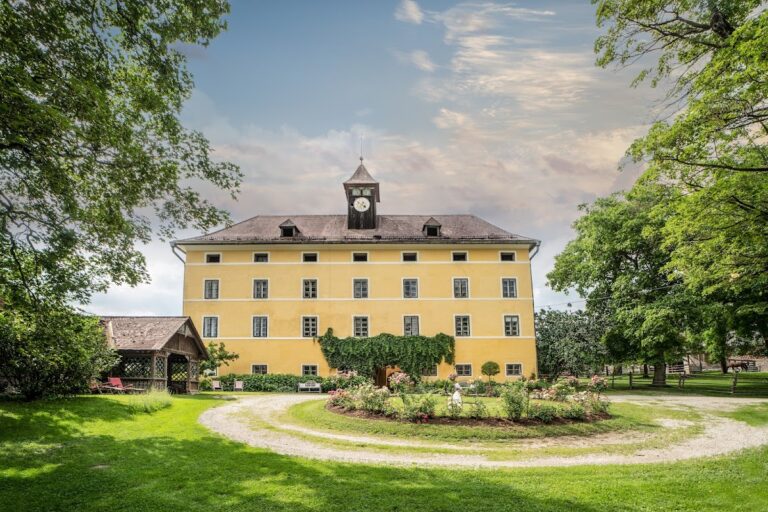
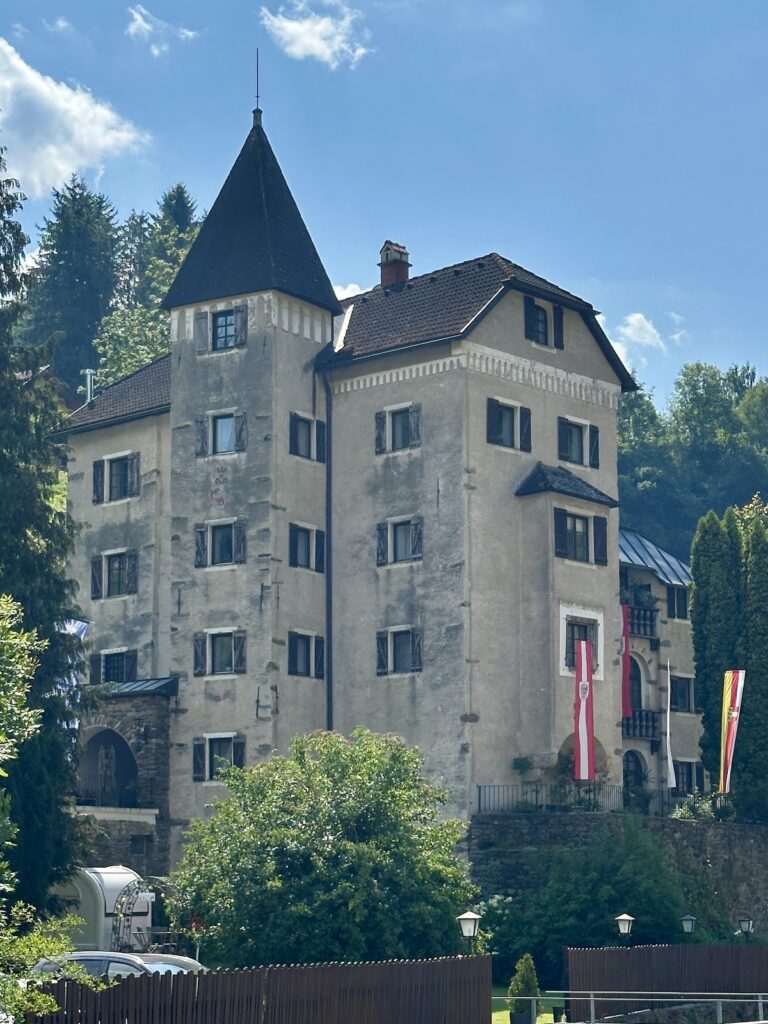
Schloss Wiesenau stands on the right bank of the Lavant in Wiesenau, within the municipality of Bad Sankt Leonhard im Lavanttal. It is a courtyard-less, three-storey building on an approximately square plan. Four corner towers define the structure, with three placed diagonally at the corners. A very high hipped roof, which slopes down on all sides, crowns the building and carries a wooden roof turret. A clock is mounted on the principal facade.
The south facade has a slightly projecting stone portal set off centre. Its round arch has a chamfered, or beveled, edge. Grouped Renaissance biforiate windows, each divided into two openings, accompany the portal on the first floor. The eastern window is a copy. A small oriel, or projecting window structure supported by brackets, stands beside the upper windows.
Interior features and archaeological material
A stove tile bearing Sigmund von Pain’s coat of arms and the date 1579 is built into the southwest tower. The lower entrance hall and staircase contain a small collection of Roman-period funerary monuments. These monuments were recovered during excavations near the castle and came from a settlement probably connected with gold mining at nearby Kliening, where gold was also mined during the Roman period.
A small, carefully maintained park surrounds the castle. Its extent is constrained by a large timber-storage area and a railway line, placing the surviving residence within a setting shaped by both the estate’s later industrial use and modern infrastructure.
Nearby sites