Schloss Schönwörth: A Late-Medieval Residential Tower in Austria


Site at a Glance
- Rating
- 4.1
- Popularity
- Very Low
- Country
- Austria
- Primary era
- Medieval
- Eras represented
- Medieval, Modern
- Civilizations
- Duchy of Bavaria, Habsburg, Holy Roman Empire
- Site type
- Domestic
- Remains
- Castle
On this page9 sections
History
Schloss Schönwörth is a historic aristocratic residence in Niederbreitenbach, Austria, developed around a late-medieval residential tower probably erected about 1360 by the Lords of Freundsberg. The property acquired its present name in the nineteenth century and was later expanded into an estate with additional buildings, richly fitted interiors, and a park.
Medieval territorial setting
On 28 March 1255, Langkampfen was assigned to the Duchy of Upper Bavaria under Duke Ludwig II. The area formed one of three administrative districts within the Bavarian judicial district of Kufstein, a jurisdiction that became part of Austria after the War of the Landshut Succession in 1505. The bishops of Regensburg also held property in Langkampfen, including Schindlberg Castle, which they probably pledged to Konrad and Friedrich von Freuntsperch.
A settlement of 7 February 1266 required the brothers to return their dependent tenants, bailiwick rights, estate, and tithes in Langkampfen to Bishop Leo of Regensburg. These arrangements formed part of the territorial and feudal background in which local fortified residences and estates were held. A fief was property granted under feudal obligations, while freehold ownership meant that the property was held outright.
The tower and changing ownership
The Niederbreitenbach tower first appears in written evidence in 1448, when Duke Heinrich of Bavaria sold it to Hans Ebbser, the custodian of Kufstein, an official responsible for administering the local judicial district and its authority. The tower is sometimes assigned to the twelfth or fourteenth century, but its construction around 1360 by the Lords of Freundsberg is considered probable. The same family also built Mariastein.
The Lords of Ebbs sold the tower to Marquard Breisacher in 1450. Ownership changed repeatedly thereafter. The Praun family held Niederbreitenbach from 1528 until 1564, when Georg Praun sold it to Georg Ilsung. In 1587 Karl Freiherr von Schurff acquired the property, and two years later he converted the former fief into freehold property.
From the Schurffs to peasant ownership
The name Schönwörth became associated with a Schurff aristocratic residence at Volders, which was destroyed by lightning in 1747. The Schurff family retained the title “Barons of Schönwörth” until its extinction in 1688. Through inheritance, the Niederbreitenbach property passed to Hans Friedrich von Stachlburg, who had married the daughter of the last Schurff.
Simon Felix Freiherr von Crosina inherited the property, together with Mariastein, in 1747. He sold it to Martin Anton von Cloz in 1773. In 1834 the Cloz family sold its estates in North Tyrol, and Niederbreitenbach entered peasant ownership on 14 October of that year.
Nineteenth- and twentieth-century owners
The tower was purchased by the Kufstein cement manufacturer Alois Kraft in 1858 and by the physician Georg Widmann in 1879. Alexander Wladimirowitsch Fürst Baratinsky of Saint Petersburg acquired it in 1886, followed by Andreas Baron Dipauli von Treuheim, a member of the Reichstag, the legislative assembly, in 1895.
Baratinsky’s ownership brought major changes to the property. He added a tower and veranda, built carriage sheds, horse stables, servants’ quarters, and guest rooms, and established a park. His alterations included small guest rooms within the large square tower, a new village-facing entrance, and a covered staircase designed as a round tower. His coat of arms was placed on the side facing the village. The park contributed to the later adoption of the name Schönwörth.
In 1906 the property was sold to the Bavarian Count Max zu Löwenstein-Scharfeneck. His son, the politician and writer Hubertus Prinz zu Löwenstein, was born there in the same year. Count Strachwitz later owned the estate, followed by Consul General Eduard Schüssel after his purchase in 1925. Mathilde Gräfin Quadt Isny subsequently held the property until her death on 19 May 1967. The current owner is Margit Cornides, Countess Quadt Isny’s daughter.
Remains
The medieval residential tower
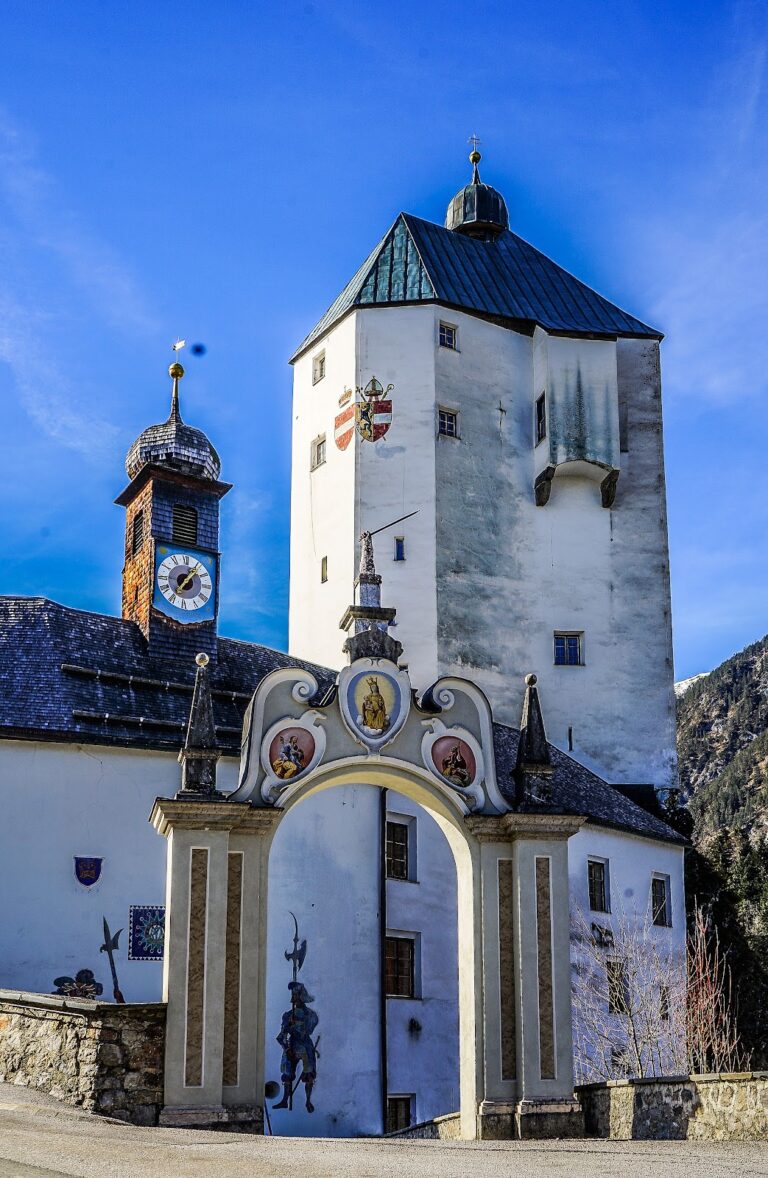
The central structure is a five-storey residential tower dating probably from around 1360. Built of brick, it has walls as much as 1.2 metres thick and is covered by a half-hipped roof. This roof has sloping sections at the ends that stop short of the eaves, combining features of a gabled and hipped roof. The tower forms the late-medieval core around which the later estate developed.
Baratinsky’s additions and estate
Baratinsky’s enlargement added a further tower, a veranda, carriage sheds, horse stables, servants’ dwellings, and guest rooms. Small guest rooms were also fitted into the large square tower. A new entrance and a covered staircase in the form of a round tower altered the approach to the residence, while the village-facing side received Baratinsky’s coat of arms. The interiors were richly fitted out, and a neighbouring farm was incorporated into the property together with a park.
Decorative features
Stone lions stand at the entrance, and several coats of arms appear on the windows. These features commemorate the period when the Löwenstein family owned the residence, adding later aristocratic decoration to the medieval tower and its expanded estate.
Nearby sites