Mariastein Castle and Church: A Medieval Fortress and Pilgrimage Shrine in Austria


Site at a Glance
- Rating
- 4.8
- Popularity
- Low
- Country
- Austria
- Primary era
- Medieval
- Eras represented
- Medieval, Early Modern
- Civilizations
- Habsburg, Holy Roman Empire
- Site type
- Military
- Remains
- Castle
On this page13 sections
History
Mariastein Castle and Church is a medieval fortified complex and Marian pilgrimage shrine in Austria, built around 1361 by the Lords of Freundsberg on the Angerberg terrace above the Inn Valley. Originally known as Stayn or Stain, the castle acquired the name Mariastein after a chapel was built and pilgrimage to Mary began in 1587.
Fortification and noble ownership
The Lords of Freundsberg, a prominent noble family based at Freundsberg Castle near Schwaz, strengthened their possessions during the political instability that followed the marriage of Louis of Brandenburg and Margaret Maultasch in 1356. The fortified tower at Mariastein stood beside the important road to Rosenheim, which then crossed the Angerberg.
The Freundsberg brothers endowed a weekly Mass at the castle on 16 November 1371. In 1379 Hans von Freundsberg sold the “castle on the Stayn” to the Bavarian dukes. Thomas Wurm served as their judicial administrator at Stain in 1445. In 1448 Duke Henry of Lower Bavaria sold the property to his administrator Hans Ebbser, after which it became part of Austria.
The road later moved to the opposite bank of the Inn, while the development of firearms during the fifteenth century reduced the tower’s military value. Its residential role continued, however, as a residential wing was added during the fifteenth and sixteenth centuries. The Lords of Ebbs raised the tower by two storeys and donated the Madonna and Child that became known as the Grace Madonna.
Marquard, Knight of Breisach and an imperial envoy in Venice, held the castle and lordship from 1487 until his death. Around 1540, Christoph, Count of Liechtenstein, converted the storey beneath the chapel into a second worship space to accommodate the growing number of pilgrims. The exact beginning of the pilgrimage remains uncertain.
Growth of the pilgrimage
In 1558 the castle belonged to Georg Ilsung of Augsburg. A local tradition says that angels twice returned a venerated Marian statue to the castle after Ilsung tried to take it to Augsburg. This story helped strengthen Mariastein’s reputation as a pilgrimage destination, especially during the eighteenth century.
Georg Ilsung transferred the castle to Karl Schurff, Baron of Schönwörth, in 1587. Schurff, together with his wife, Baroness Polyxena Closen-Freyberg of Hohenaschau, reorganized the deteriorated estate as a pilgrimage center. During the Thirty Years’ War, a European conflict fought from 1618 to 1648, six priests and two hermits were already caring for pilgrims at Mariastein.
A castle chaplain was appointed in 1606. Over time, as many as four additional priests served the pilgrims and maintained worship. During the first decade of the eighteenth century, these clergy belonged to the institute founded by the blessed Bartholomew Holzhauser, a Catholic priest who promoted communal priestly life and pastoral service. They established the Sacred Heart Confraternity at Mariastein, which Pope Clement XI confirmed on 28 June 1715. An imperial court decree issued on 14 January 1791 confirmed the chapel’s exemption, placing it outside ordinary local ecclesiastical jurisdiction, and recognized its independent pastoral administration.
Decline, preservation, and reconstruction
After Baron Ferdinand Schurff, the last of his line, died on 16 September 1688, the castle passed to the related Counts of Stachelburg. It came to Simon Felix von Crosina in 1747, and he sold it in 1773 to the Counts Klotz of South Tyrol. In 1835 Count Paris von Klotz of Trent, the last of his line, sold the entire property, including its woodland and farmland. The lordship was divided, tenants became owners, and the estate was liquidated.
The castle and pilgrimage church consequently lost their financial support, and some castle buildings began to be demolished. The Archdiocese of Salzburg took over the complex in 1835, preventing its threatened destruction. After the war, the castle and church were partly ruinous. Archbishop Andreas Rohracher directed their reconstruction, which began under his administration in 1956. The principal restoration took place between 1959 and 1966, while the works were substantially completed by 1994.
Pilgrims, the Archdiocese of Salzburg, and the Province of Tyrol support the site’s preservation. The castle is administered directly under the archdiocese, and its historic land-register designation identifies “Our Lady of Mariastein” as the owner. Approximately 200 older votive panels, devotional images offered in fulfilment or remembrance of a vow, preserve evidence of the former pilgrimage. The oldest surviving depiction of a miraculous healing dates from 1608 and was made by the Kufstein painter Hilarius Duvivier together with five other panels. The panels were moved from the lower stairwell to the Knights’ Hall to protect them from theft and damage. A surviving volume of the pilgrimage miracle book records answered prayers associated with the Grace Madonna between 1678 and 1742; two other volumes disappeared during the 1930s.
Remains
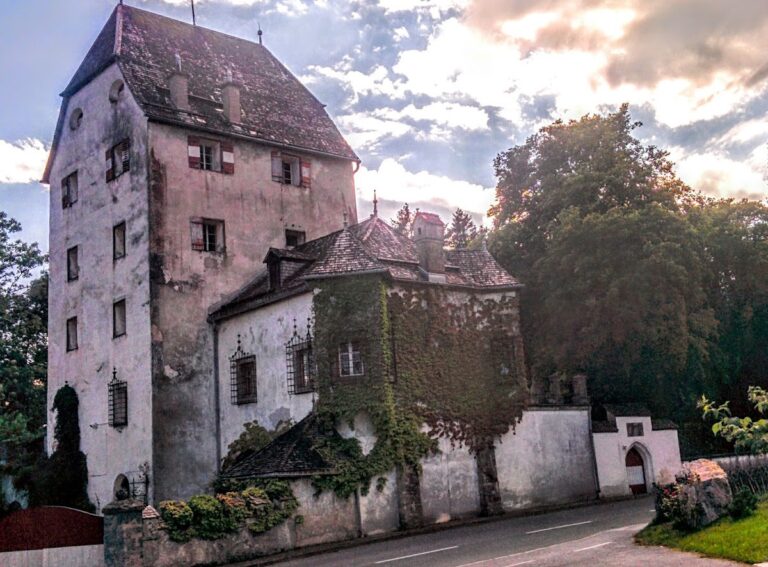
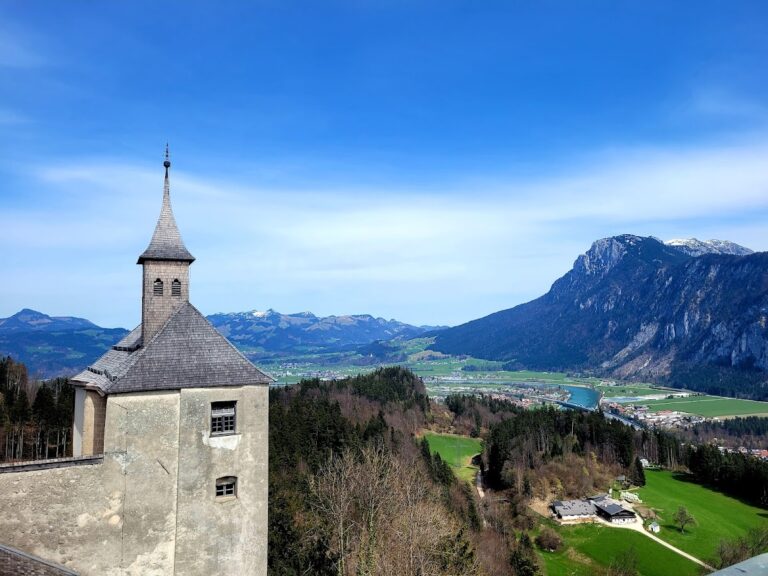
Mariastein occupies an exposed rock on the Angerberg terrace, approximately 150 metres above the Inn Valley. A wooded ridge shields the tower from the valley. The complex is dominated by a 42-metre fortified residential tower with walls 1.75 metres thick and a stairway of more than 150 steps. A residential wing and stair tower are attached to it, while a courtyard entered through an archway is bordered by the chaplaincy building. A free-standing altar erected in 1956 is used for summer pilgrimage services and Sunday late Masses.
Fortified tower and chapels
Upper Grace Chapel
The upper chapel, known as the Chapel of Our Lady of Mariastein or the Grace Chapel, was originally Gothic and was built between 1682 and 1685. It contains the Grace Madonna, a Madonna and Child dating from around 1450 and made by an unknown master from the Salzburg-Bavarian region. An eighteenth-century Rococo altar completes the chapel’s present interior.
Chapel of the Holy Cross
The lower chapel is dedicated to the Holy Cross and contains an image of the Prague Child Jesus. The two chapels are arranged one above the other within the tower, forming the central religious spaces of the complex.
Rock-cut chapel and Candle Chapel
The lowest storey is carved entirely from natural rock and may have been the original chapel. Its pointed-vaulted room is entered through an iron door and contains a feature resembling a sacrament house, probably recalling its earlier ecclesiastical use. No consecration document survives, but the chapel’s dedication is celebrated on 8 September, the Feast of the Nativity of Mary.
The tower basement now serves as the Candle Chapel. It has a late Gothic net-rib vault, a Pieta set in a niche, and an early Baroque Madonna altar. Above it, the former armoury occupies an intermediate storey. Two dioramas present a Tyrolean Nativity scene and a historical representation of Mariastein’s pilgrimage history. The same space contains a Holy Sepulchre originally made for the parish church of Angath.
Halls, treasury, and collections
Knights’ Halls
The former Knights’ Hall lies above the Candle Chapel and armoury. It now houses surviving art treasures from the castle. Mariastein also contains a large Knights’ Hall and a smaller hall known as the Princes’ Hall, both with beam or coffered ceilings. Only four helmets and four suits of armour remain from the former armoury collection, with the surviving pieces distributed among museums and exhibitions.
Treasury and historic artworks
The treasury contains objects and sculptures from the sixteenth and seventeenth centuries. Its holdings include two Renaissance silver candlesticks donated in 1599 and a richly illuminated Gospel book painted in 1602. Life-size portraits of former castle lords also survive, rescued from deterioration by the provincial monument-conservation authority.
Entrance and manuscript
The entrance portal bears the coats of arms of the Freundsberg and Schurff families. Two knightly figures were painted in the outer entrance area in the late 1950s. The castle once preserved a twelve-sided parchment manuscript thought to be a work of Saint Jerome. An examination commissioned by Count Paris von Klotz identified it as a codex written in Glagolitic ecclesiastical script, a medieval Slavic alphabet, and it was published in 1834 under the title Glagolitia Clozianus.
The castle museum preserves the Tyrolean state regalia, including an archducal hat, a ceremonial insignia of an archduke, and a sceptre donated by the territorial prince Maximilian III. The castle remains inhabited by clergy, while the museum and pilgrimage church preserve the complex’s religious, artistic, and historical functions.
Nearby sites