Thierberg Castle: A Medieval Hilltop Fortress and Pilgrimage Site in Austria


Site at a Glance
- Rating
- 4.8
- Popularity
- Low
- Country
- Austria
- Primary era
- Medieval
- Eras represented
- Medieval, Early Modern, Modern
- Civilizations
- Holy Roman Empire
- Site type
- Military
- Remains
- Castle
On this page16 sections
History
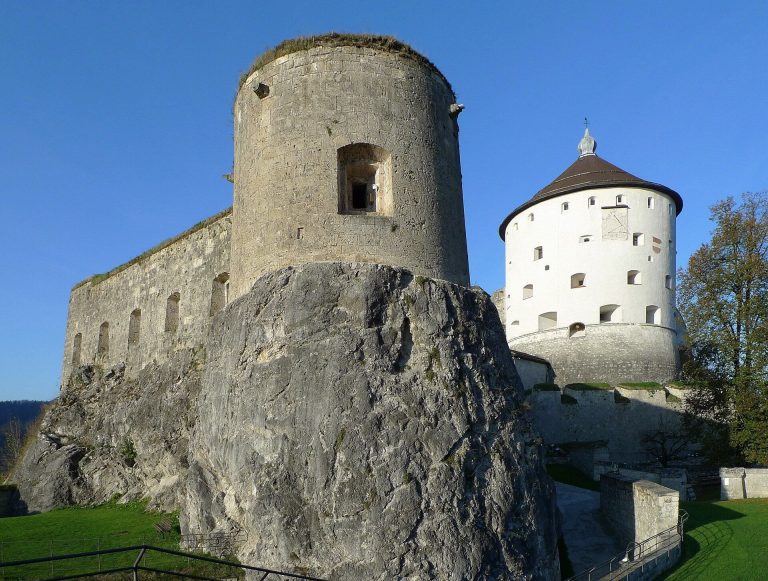
Thierberg Castle is a medieval hilltop fortress in Austria, north of Kufstein in Tyrol, built in 1285 by the noble Freundsberg family as an eastern stronghold for its possessions in the Lower Inn Valley. Konrad von Freundsberg was associated with the castle by 1290. Its position on Thierberg gave it an observation point over the valley, opposite Kufstein Fortress.
Freundsberg and Habsburg rule
In 1379, the Freundsberg family sold Thierberg Castle to the dukes of Bavaria. After the eastern Lower Inn Valley passed to the Duchy of Austria, the castle became Habsburg property. The Habsburgs were the dynasty that ruled Austria and held extensive territories in Central Europe.
The expansion of the fortresses at Kufstein and Rattenberg reduced Thierberg’s strategic importance. From the second half of the fifteenth century, the castle was allowed to decay. After the siege and capture of Kufstein in 1504, Maximilian I gave Thierberg to his chamberlain. Maximilian I was a Habsburg ruler who later became Holy Roman Emperor and expanded Habsburg power in the Alpine region.
From castle to pilgrimage site
Thierberg’s chapel, dedicated to Saint John the Baptist, was first recorded in 1315 in the Konradinische Matrikel, a diocesan register of the Diocese of Freising. It later became a pilgrimage chapel, and in the second half of the sixteenth century it received its own chaplain. Pilgrimage practices remain associated with the site.
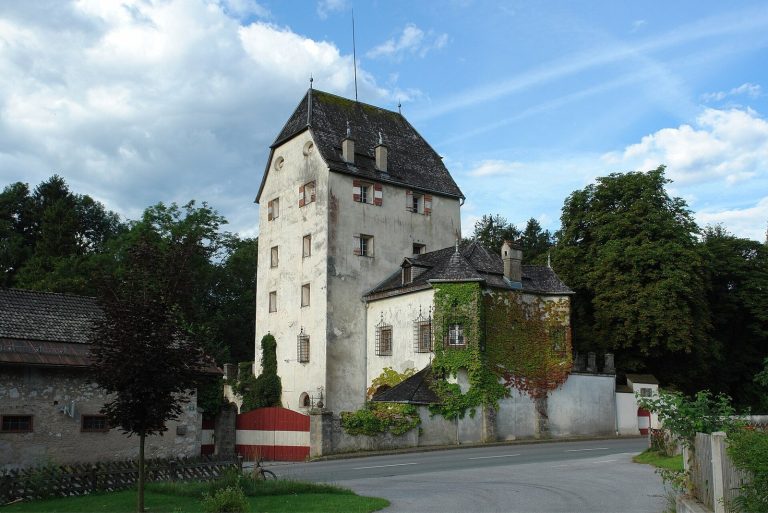
After several changes of ownership, Georg Voglmayer acquired the complex in 1584. He partly rebuilt and altered the former residential building, moving the chapel into it after the original castle had been partly demolished. In the last quarter of the seventeenth century, a hermitage was established at Thierberg. An extension was added to the former residential building to provide space for this purpose. The complex includes the last inhabited hermitage in Tyrol.
Fire, repair, and conservation
A major fire destroyed the residential building down to its exterior walls in 1700. The building and chapel were subsequently repaired, their furnishings were renewed in the Late Baroque style, and further additions were made during the nineteenth century. A Way of the Cross was established in the nineteenth century on the ascent from the Neuhaus inn, creating a historically documented approach to the ruin.
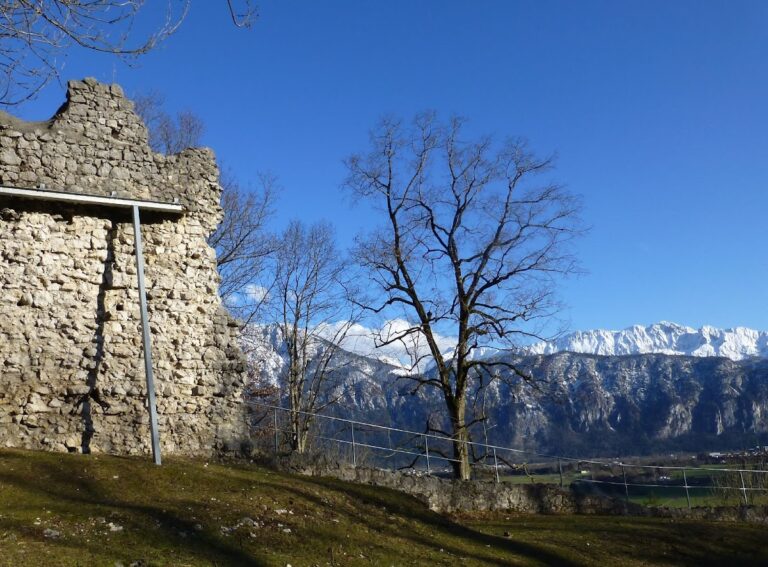
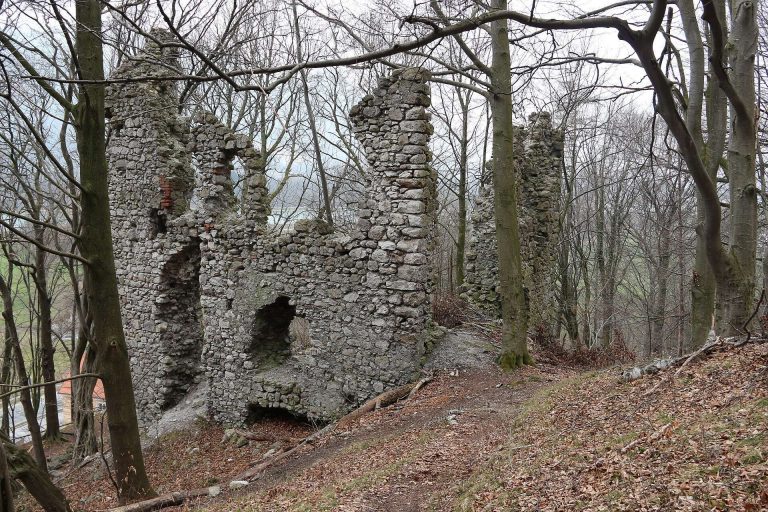
The castle, its surviving defensive walls, and its bergfried were extensively conserved in 2001. A bergfried is a fortified medieval tower intended mainly for defense and refuge rather than permanent residence. Thierberg Castle is protected as a monument.
Remains
The surviving complex stands at approximately 721 metres above sea level on Thierberg, a relatively low mountain north of Kufstein. It includes the bergfried, the former palas with the chapel on its ground floor, an upper chapel arranged as a hall-like room, and the inhabited hermitage beside it. A palas is the principal residential and representative building of a medieval castle. The remains also include parts of the inner defenses, the outer enclosure, and the zwinger, an outer defensive space between successive fortification lines.
Fortifications and tower
Bergfried
The bergfried survives to approximately 70 percent of its original height. It forms one of the principal surviving elements of the castle and underwent extensive conservation in 2001. The tower’s preserved fabric belongs to the defensive core of the complex rather than to the later residential and religious spaces.
Defensive walls and outer enclosure
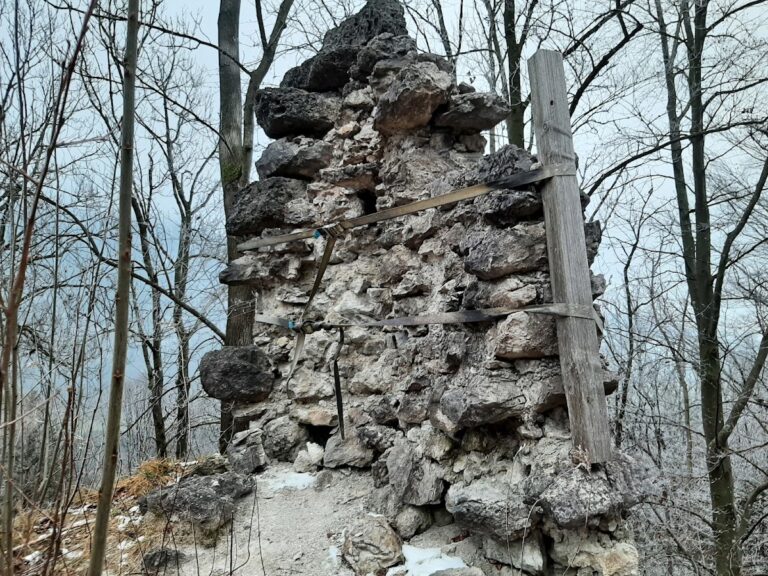
Significant remains of the inner castle’s defensive walls survive together with sections of the outer enceinte and zwinger. Wall and tower fragments preserve parts of the successive defensive lines that surrounded the castle. A separate fortification called Schlangenburg was built near Thierberg but was dismantled shortly after its construction.
Palas, chapels, and hermitage
Former palas and lower chapel
The former palas now contains the chapel on its ground floor. Its plan forms an irregular rectangle because a spiral staircase inserted to reach the upper floor projects into the room. The chapel runs from north to south as a result of the building’s form and has a gallery on its northern side. Its east windows have elaborate stucco surrounds.
Upper chapel
An upper chapel is arranged as a hall-like room within the surviving complex. It functions as a display room for ecclesiastical vestments, a Christmas crib, and relics. The upper chapel forms part of the later religious use of the castle buildings.
Inhabited hermitage
The hermitage stands beside the former palas and occupies the extension added for the solitary religious resident in the last quarter of the seventeenth century. A hermitage is a residence for someone living apart for prayer and contemplation. It remains inhabited and forms part of the present complex.
Chapel furnishings and devotional features
Altar and apostle figures
The chapel’s high altar dates from 1780 and bears Franz Stirz’s painting of the beheading of Saint John the Baptist. Half-length busts of the Twelve Apostles stand along the side walls of the choir. On the southwest side altar is a reproduction of the Madonna of Montserrat, a Marian image associated with the shrine at Montserrat, which was brought into the chapel in 1811.
Paintings and votive offerings
A Baroque crucifix showing Jesus within a halo of rays is mounted between the windows. A wall painting in a niche on the western wall presents four episodes from the life of Saint John the Baptist. Almost all the remaining wall surfaces are covered with votive tablets and popular wax votive offerings. Votive offerings are objects or images given in fulfillment of a vow or as thanks, often after a hoped-for or believed healing.
Historic approaches
The Way of the Cross forms the documented approach from the Neuhaus inn to the ruin. Another route reaches the chapel from the direction of Kiefersfelden or Hechtsee through Aigen and Aschau. These routes are associated with the castle’s continuing religious use and its pilgrimage tradition.