Palacio de Francisco de los Cobos: A Renaissance Palace in Úbeda

Site at a Glance
- Rating
- 4.2
- Popularity
- Very Low
- Country
- Spain
- Primary era
- Early Modern
- Eras represented
- Early Modern
- Civilizations
- Crown of Castile, Spanish
- Site type
- Domestic
- Remains
- Palace
On this page7 sections
History
Palacio de Francisco de los Cobos is a Renaissance palace in Úbeda, Spain, built for Francisco de los Cobos, secretary to Charles V, the Habsburg ruler who was king of Spain and Holy Roman Emperor in the sixteenth century. The palace formed part of an ambitious artistic and institutional programme that also included the Sacra Capilla del Salvador, designed as Cobos’s church and funerary chapel, the unfinished University of Úbeda, and the Hospital de los Honrados y Venerables Viejos del Salvador.
Creation of the Úbeda palace
The palace occupied the site of Cobos’s father’s former residence in the Santo Tomás district. From 1506, Francisco de los Cobos acquired adjoining houses to enlarge the property. In spring 1531, he purchased two further plots, and shortly afterward commissioned Luis de Vega, a Spanish Renaissance architect associated with courtly and aristocratic projects, to design the palace.
The building belonged to a wider effort to elevate the Cobos family through architecture, patronage, and historical imagery. Its programme reflected the ambitions of high Spanish nobles during the Renaissance, including their interest in claims and ideals of medieval ancestry. The nearby Sacra Capilla del Salvador gave this ambition a funerary focus, helping to present the family as an established lineage.
Artistic patronage and later fate
Francisco de los Cobos also commissioned works for his residences through the ambassador Micer Mai. A stone fountain was made for the Úbeda palace, while in December 1531 Micer Mai announced the arrival at Alicante of a bust of Apollo, described as a fine work from Italy. Much of this artistic material was intended for Cobos’s palace in Valladolid. Cobos may also have owned a small Renaissance cabinet of curiosities, a collection of rare natural and artistic objects assembled for study, display, and prestige. An Aztec manuscript or codex bound in jaguar skin, possibly a gift from Hernán Cortés, was among the objects possibly linked to this collection; Cobos gave it to the historian Paolo Giovio for his museum in Naples.
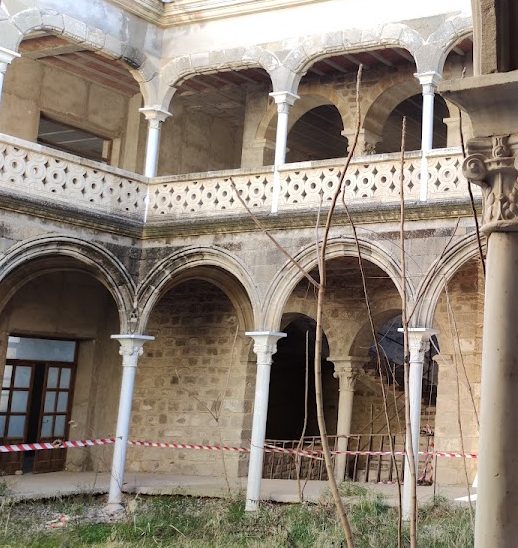
The Úbeda palace was burned and looted during the nineteenth century, destroying its paintings and other works of art. Two further fires in the twentieth century, when the building had become a tenement house, caused its collapse. It is being reconstructed for use as the headquarters of the National Distance Education University, a Spanish university whose teaching is primarily conducted through distance education. A dispute between the municipal government and the House of Medinaceli, a prominent Spanish aristocratic house, ended with ownership awarded to the latter. The palace is designated an Asset of Cultural Interest and stands within an area designated as a World Heritage site.
The Valladolid palace
A second Palacio de Francisco de los Cobos stood in Valladolid. It was initially built for Cobos in 1524, although 1526 and 1531 are also associated with its construction. Luis de Vega designed it near the Palace of the Counts of Rivadavia, whose owners were Cobos’s parents-in-law. The building later became the Royal Palace of Valladolid.
Remains
Úbeda palace and monumental setting
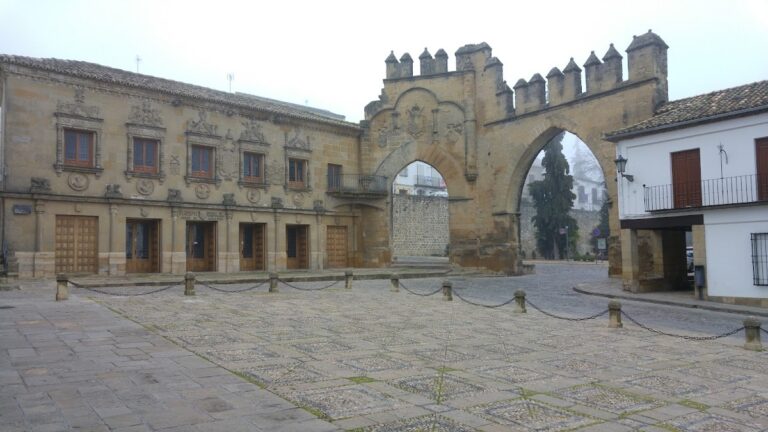
The Úbeda palace was integrated into a larger monumental ensemble, with the Sacra Capilla del Salvador nearby. Its layout was shaped by the buildings already occupying the site of the former family palace. A broad facade of ashlar stone gave the palace a restrained appearance that contrasted with the chapel’s rich decoration. The front included a plain entablature, a Cross of Santiago placed between two scallop shells, and a large window aligned with the doorway. The window did not develop into a balcony. The emblems of the Order of Santiago, a major military-religious order whose signs could express religious affiliation and aristocratic status, were used prominently to convey the owners’ lineage and ambitions.
The palace also contained a courtyard and a garden laid out over the site of an earlier Jewish cemetery. The stone fountain commissioned through Micer Mai was still preserved when the arrival of the Apollo bust at Alicante was announced in December 1531. The former residence’s paintings and other artworks belonged to its historic interior collection, while the later fires and collapse shaped the building’s present condition and reconstruction.
Valladolid palace
The Valladolid palace stood near the Palace of the Counts of Rivadavia and was designed by Luis de Vega. Its later transformation into the Royal Palace of Valladolid altered its institutional role while retaining its place in the history of Francisco de los Cobos’s architectural patronage.
Nearby sites