Auerburg: A Medieval Border Fortress in Bavaria


Site at a Glance
- Rating
- 4.6
- Popularity
- Low
- Country
- Germany
- Primary era
- Medieval
- External website
- Open
- Eras represented
- Medieval, Early Modern
- Civilizations
- Duchy of Bavaria, Holy Roman Empire
- Site type
- Military
- Remains
- Castle
On this page9 sections
History
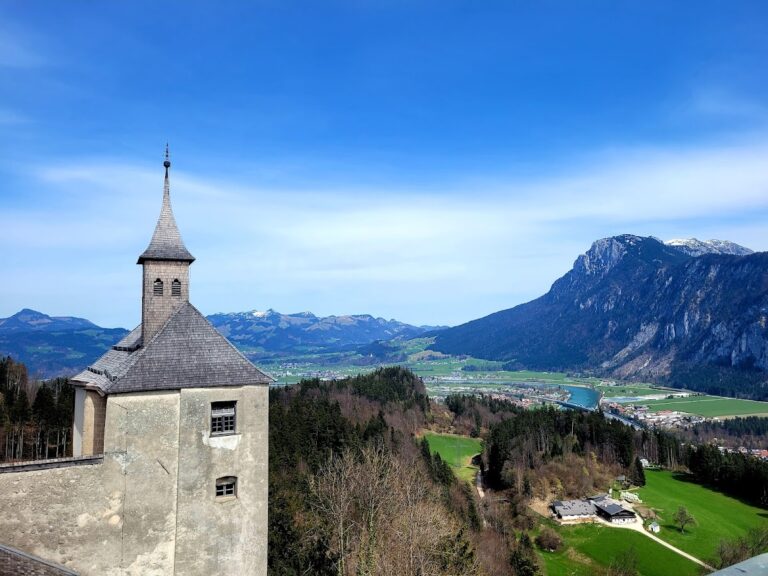
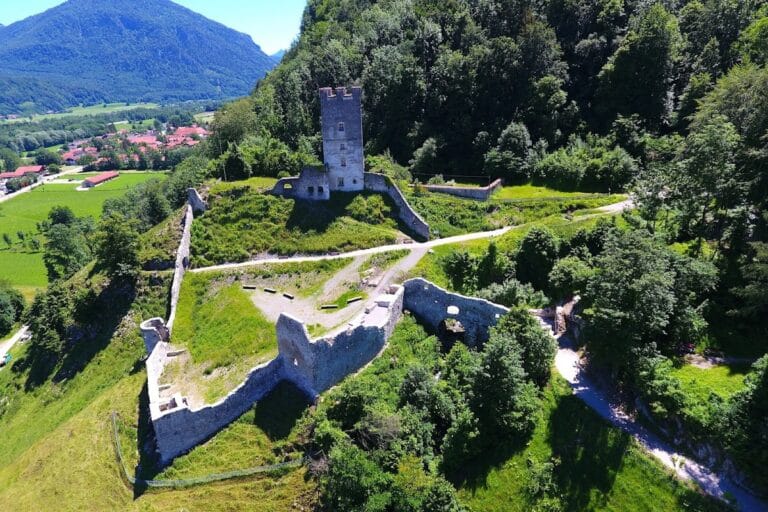
Auerburg is a ruined medieval rock castle in Germany above Oberaudorf in the Upper Bavarian Inn Valley. An initial castle belonging to local nobles stood on the site in the twelfth century, although its origins are also described as predating 1100. Archaeological finds show that the castle rock had already been inhabited during the Bronze Age.
From Noble Castle to Wittelsbach Stronghold
The castle was first held by the Counts of Falkenstein, a medieval noble family, and later passed to the Wittelsbachs, the dynasty that ruled Bavaria for many centuries. The date of this transfer is uncertain. Auerburg first appears in written history in the Wittelsbach family treaty of Pavia in 1329.
Its position between the castles of Kufstein, Thierberg, and Kirnstein gave Auerburg strategic value. The Bavarian dukes used it to help secure the Inn Valley. Around 1350, the castle is recorded as a court and as the seat of a Pfleger, a ducal official with judicial and governmental authority in a defined district. From the fifteenth century, its judicial district was divided among the captaincies of Kiefersfelden, Niederaudorf, Oberaudorf, and Fischbach.
Border Fortress and Destruction
A barbican, an advanced defensive structure protecting an entrance, was added at the end of the fifteenth century. After the War of the Bavarian Succession in 1503–1505, Kufstein, Kitzbühel, and Rattenberg were lost to the Habsburgs. Auerburg then became a border fortress facing Tyrol and was strengthened again.
By around 1700, Auerburg was one of the most imposing castle palaces in the Inn Valley, as shown in Michael Wening’s 1701 engraving. Wening was a Bavarian engraver known for detailed views of towns, castles, and other buildings.
Austrian troops captured Auerburg on 4 May 1743 during the War of the Austrian Succession, a wider eighteenth-century conflict involving Austria and opposing European powers. After the Peace of Füssen in 1745, miners from Kitzbühel demolished the fortress in 1747.
Archaeology and Tradition
Between 1992 and 1998, archaeology students from the University of Bamberg, working with the Dr. Zeune Office for Castle Research, investigated the complex and exposed buried masonry. Auerburg is protected in Bavaria as an architectural monument, while its medieval and early-modern underground remains and the Bronze Age hilltop settlement are protected as an archaeological monument. The cave castle of Luegstein is probably an earlier predecessor.
A local legend called “The Three Pagan Maidens of Auerburg” tells of three sisters, two of whom deceived their blind sister. When she discovered the deception, she pronounced a terrible curse, and the castle was said to have sunk until only the ring walls remained.
Remains
Auerburg occupies a rocky summit at 543 metres above sea level above Oberaudorf. The ruined castle survives mainly through slight visible traces and buried masonry exposed by excavation. The historical entrance was fitted with a wooden bridge in 1994, linking the surviving remains with the former approach to the complex.
Castle Rock and Excavated Walls
Buried Masonry
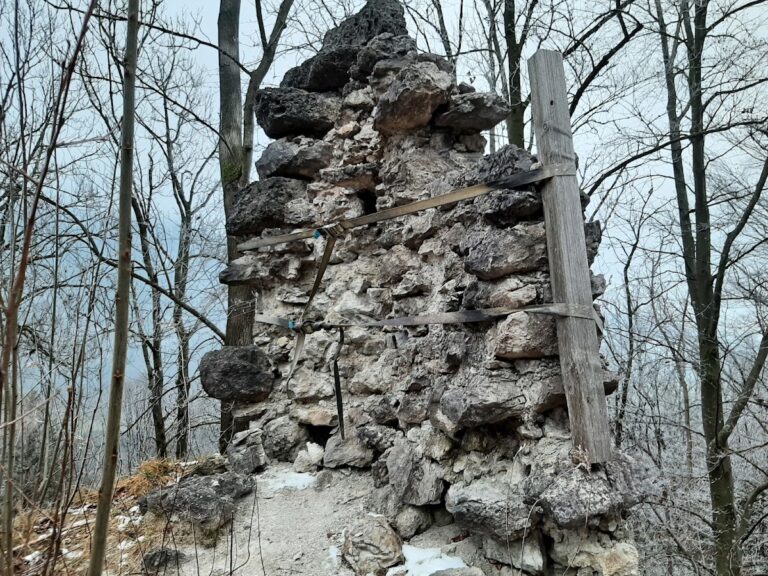
Excavations within the castle complex revealed wall remains beneath the surface. These medieval and early-modern structures form the principal surviving physical evidence of the fortress, whose ruined condition followed its demolition in 1747.
Gate and Approach
Late-Medieval Castle Gate
The late-medieval castle gate stands on the road toward Kiefersfelden, where it creates a narrow passage between rocky slopes. It controlled an important trade route to Italy. The gate bears the coat of arms of Oberaudorf and the inscription “HIE FALK FRUMB SICHT GUET ZIEL UNS RICHT.” Since 1991, it has housed the Auerburg Museum, whose main subject is the history of the castle.
Nearby sites