Schloss Greillenstein: A Renaissance Castle and Museum in Austria


Site at a Glance
- Rating
- 4.6
- Popularity
- Low
- Country
- Austria
- Primary era
- Early Modern
- External website
- Open
- Eras represented
- Early Modern
- Civilizations
- Habsburg, Holy Roman Empire
- Site type
- Domestic
- Remains
- Castle
On this page13 sections
History
Schloss Greillenstein is a Renaissance castle in Greillenstein, Austria, built for the Kuefstein family and completed in 1604. Its history is rooted in the changing lordships of the Waldviertel, a historical region in northwestern Lower Austria, and its later life has preserved evidence of aristocratic residence, territorial government, military conflict, and legal history.
From fortified castle to Kuefstein residence
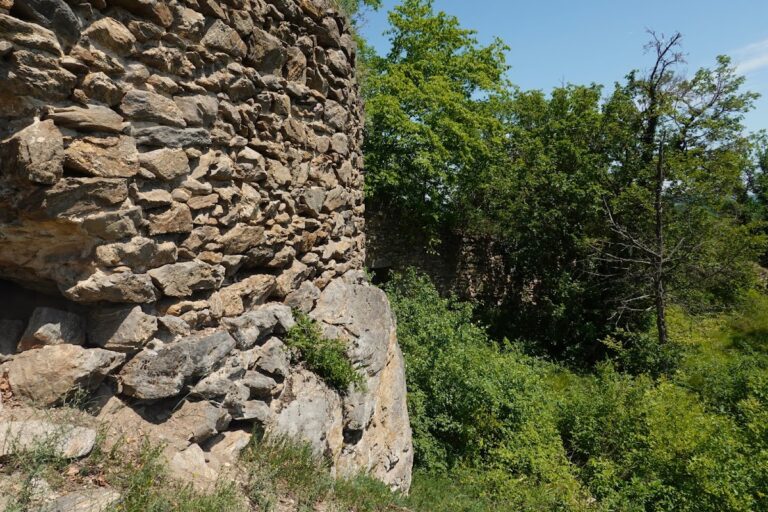
A small fortified castle held by the Greillen family was first reported in 1313, the last year in which that family can be documented. The castle appears again in a document from 1371, when it passed to the Lords of Dachpeck. The Dachpeck family held the lordship until 1499, after which it belonged first to the Grabner of Rosenburg and later to the Lords of Volkra.
Johann Lorenz von Kuefstein purchased the lordship in 1534. His son, Hans Georg III von Kuefstein, ordered the old fortified castle to be demolished between 1570 and 1590. Tradition attributes the construction of the present building to an Italian master builder. The castle, its interior furnishings, and its equipment were completed in 1604.
The new residence became the administrative seat of the three large lordships of Feinfeld, Schauenstein, and Greillenstein. It also served as a representative home and summer residence for the Kuefstein family, whose members were later elevated from barons to counts. The family was Protestant but remained loyal to the emperor. Hans Georg III required a suitable base for his duties as Vicedom of Lower Austria, a senior territorial administrator exercising governmental authority on behalf of the ruler.
Religious conflict and the Thirty Years’ War
The family’s position brought it into repeated military conflict with nearby Altenburg Abbey, a Benedictine monastery in Lower Austria. Greillenstein escaped devastation during the Thirty Years’ War, the European conflict of 1618 to 1648 that combined religious, dynastic, and political struggles. In 1620, however, Hans Jacob Baron von Kuefstein had to leave after the castle was occupied by Maximilian, Elector of Bavaria and leader of the Catholic League, a military and political alliance of Catholic imperial territories.
For several days, Greillenstein served as a Catholic headquarters. Maximilian, Count Tilly, and Field Marshal Count Bucquoy met there to plan their strategy before the Battle of White Mountain, fought near Prague in 1620. Swedish troops occupied the castle without resistance near the end of the war, but the occupation caused no damage. In 1623, Hans Jacob von Kuefstein converted to Catholicism, allowing his family to retain the lordship.
Lordship administration and later changes
In 1634, Emperor Ferdinand II granted the lordship high jurisdiction, the authority to hear major criminal cases and impose severe judicial penalties. The associated district court remains at Greillenstein with a substantial collection of medieval court records. This judicial role strengthened the castle’s importance as an administrative centre as well as a family residence.
During the War of the Fifth Coalition in 1809, more than 1,000 French soldiers and 1,400 horses were quartered at Greillenstein. Their departure left the furnishings severely damaged and the finances of the lordship in disorder. Johann Ferdinand III, Count Kuefstein, offered to sell the castle to the emperor, but the offer was rejected. The debts were reduced and the damage repaired by 1815.
The abolition of the manorial system in 1848 ended the castle’s function as an administrative building. Greillenstein nevertheless remained part of the cultural life of the region. During the nineteenth century, artists stayed there, and Franz Grillparzer was inspired to write his play The Ancestress. Countess Maria Magda von Kuefstein discovered and supported the painter Anton Romako.
War, museum formation, and preservation
Greillenstein survived the First World War and the Soviet occupation after the Second World War without damage. After 1945, a cultivated Soviet officer arranged for the castle to be guarded, preventing looting. After the war, Johann Ferdinand IV Kuefstein and his family moved to Greillenstein, and a museum was established in 1959.
In 1960, Karl II Kuefstein and his family moved from the castle into an outbuilding. Since the 1960s, the castle has no longer been inhabited and has functioned as a museum. It was among the earliest castles opened to the public as a museum. The Museum of Legal History was founded there in 1967 and moved to Schloss Pöggstall in 1988, while the former district court remained at Greillenstein.
The permanent exhibitions include the diplomatic relations between the Habsburg emperors and the Ottoman Empire, the Islamic imperial state that ruled much of southeastern Europe, western Asia, and the eastern Mediterranean, as well as Franz Grillparzer’s visits to Greillenstein. In 1992, Karl Kuefstein founded the Association of Friends and Patrons of Schloss Greillenstein. Extensive renovation took place during the first years of the twenty-first century. The castle, its service buildings, and its park are protected as historic monuments. In 2019, the owners were Andreas Kuefstein and his wife Elisabeth Kuefstein.
Remains
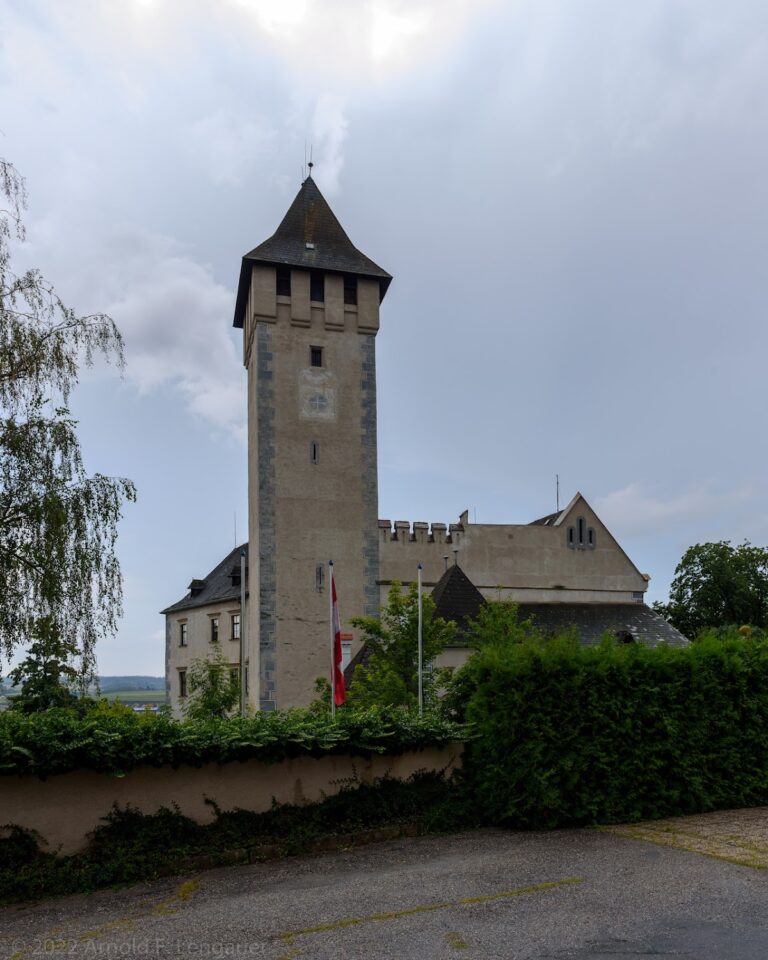
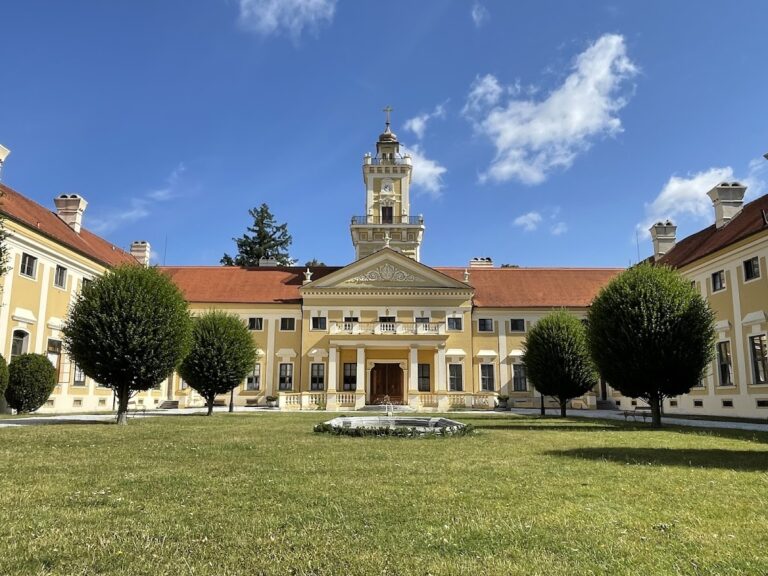
Schloss Greillenstein is a four-wing Renaissance complex arranged around a square inner courtyard. It has two main floors, with a large gate tower on the south side. A bridge crosses the surrounding moat and carries Baroque stone figures. Several Baroque vases designed by Johann Bernhard Fischer von Erlach stand in the courtyard, linking the earlier Renaissance building with later architectural and decorative changes.
Gardens and grounds
An English landscape garden lies in front of the castle. The grounds were laid out during the seventeenth and eighteenth centuries and expanded between 1700 and 1720 with a 47-hectare game park, a Baroque water feature designed for theatrical movement and display, and a new access road. The water installation includes a sculpture of a dragon spouting water. In 1720, Hans Leopold Count Kuefstein had the castle carefully remodeled in the Baroque style, including the present main entrance in the central tower of the south facade.
Interior spaces and collections
Chapel
The chapel in the south tower retains a unified Renaissance interior from the period when the castle was built. This complete interior ensemble is described as unique in the Waldviertel.
Banqueting hall and Turkish Hall
The banqueting hall occupies the west wing. The north wing contains the Turkish Hall, whose portraits include Sultan Murad IV. Together, these rooms preserve parts of the representative and diplomatic setting associated with the residence.
Libraries
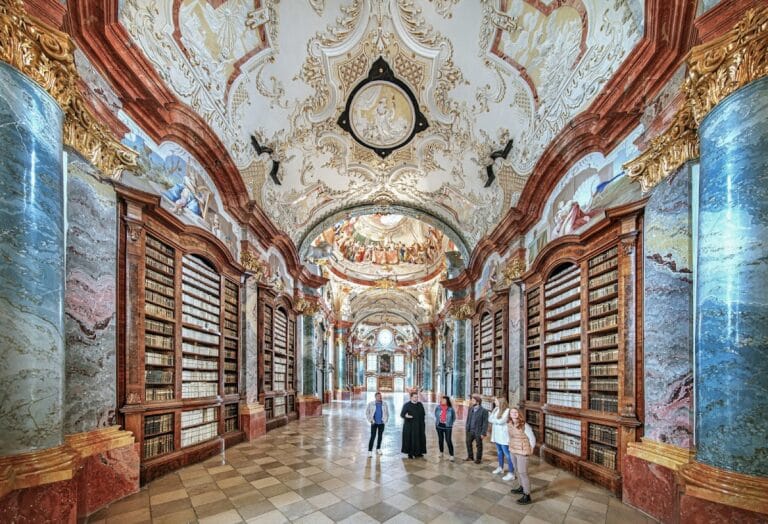
The seventeenth-century Great Library retains part of its furnishings, while its coffered ceiling, formed from recessed ornamental panels, is now in Schloss Laxenburg. The sixteenth-century furnishings of the Small Library are completely preserved. Other interior elements include sixteenth-century fireplaces and doors, Rococo stoves with the lighter and more delicate ornament of that eighteenth-century style, and paintings dating from the seventeenth to the nineteenth centuries.
Former district court
The former district court contains Austria’s only surviving courtroom barrier and a substantial collection of medieval court records. The surviving room and records preserve the physical and documentary sides of the castle’s judicial role after the lordship received high jurisdiction in 1634.
Figures, service buildings, and nearby chapel
The castle houses a collection of garden gnomes and a sandstone dragon, both dating from around 1700. Nine surviving garden figures depict ordinary people in everyday situations. The number of figures is traditionally given as 24, but that total is not documented. Service buildings from the castle’s construction period survive around the complex; some remain in use, while others are ruinous.
The Kuefstein crypt chapel stands near the castle in Röhrenbach. Its domed fresco was painted by Paul Troger, adding a related Kuefstein memorial building to the physical remains associated with Greillenstein.