Schloss Rosenburg: A Renaissance Castle in Austria

Site at a Glance
- Rating
- 4.6
- Popularity
- Medium
- Country
- Austria
- Primary era
- Early Modern
- External website
- Open
- Eras represented
- Medieval, Early Modern
- Civilizations
- Habsburg, Holy Roman Empire
- Site type
- Military
- Remains
- Castle
On this page15 sections
History
Schloss Rosenburg is a Renaissance castle in Austria, located at Rosenburg in Lower Austria’s Kamptal. It developed from a Romanesque castle erected around 1150, with its first documented mention dating to 1175. Built to control trade routes from Bohemia toward Vienna, it later served as a refuge and stronghold during conflicts with Hungarian forces.
Medieval fortress and Gothic enlargement
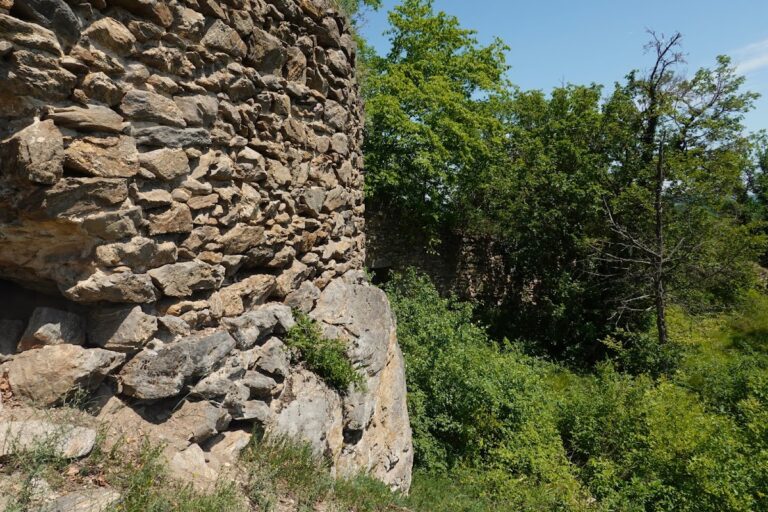
The earliest castle may have replaced simpler defensive structures on the site. Its foundations survive in the base of the present keep, the principal fortified tower of a medieval castle. These remains are associated with the small castle of Goczwin of Rosenberg.
In 1433 Hussite forces captured and devastated Rosenburg, although the castle survived the attack. Kaspar von Rogendorf, chamberlain of Emperor Frederick III, acquired the property in 1476 and enlarged it. The complex then passed in 1487 to the brothers Jakob and Christoph Grabner, whose work and later development transformed it into a Gothic castle.
Rosenburg and the Reformation
The Grabner family and their descendants adopted Protestantism during the sixteenth century. Under Leopold Grabner zu Rosenburg and his son Sebastian II Grabner zu Rosenburg, Rosenburg became a centre of the Reformation, the sixteenth-century movement that divided Western Christianity and produced Protestant churches, in Lower Austria.
Leopold established a printing press at the castle for Protestant literature. In 1555 he appointed Christoph Reuter as household and castle preacher, reinforcing Rosenburg’s religious role. The site thus served not only as a residence and fortified lordship but also as a centre for Protestant religious activity.
Renaissance reconstruction and the Counter-Reformation
Between 1593 and 1597, Sebastian II Grabner ordered the demolition of most of the Gothic castle and rebuilt it as a Renaissance residence. Renaissance architecture drew on classical proportions and symmetry. The expensive project contributed to the debts that led to the castle’s sale in 1604 to his relative Hans Jörger zu Tollet.
During the Counter-Reformation, the Catholic response to Protestant expansion, Cardinal Franz von Dietrichstein gained control of Rosenburg in 1611. The property was sold in 1614 to the Catholic Vinzenz Muschinger, who continued its expansion. On 9 July 1620, Protestant troops associated with the Horner Bund, a political and military alliance centred on Horn in Lower Austria, stormed and captured the castle.
A later tradition claims that 300 men, women, and children died during the attack, but the event is not otherwise historically documented. The assault later linked Rosenburg with the folk ballad Es liegt ein Schloss in Österreich. The castle’s military importance declined after the Habsburg conquest of Hungary moved the frontier and the immediate threat farther south.
Seventeenth-century owners and the Hoyos-Sprinzenstein family
Ownership changed several times during the seventeenth century. Johann Joachim Enzmilner, Count of Windhag, acquired Rosenburg and its lordship in 1659 and continued its expansion. His Topographia Windhagiana, published in 1673, included numerous engravings of Rosenburg by Clemens Beutler.
After Enzmilner’s death in 1678, the property briefly belonged to Ferdinand Max von Sprinzenstein. Rosenburg entered the Hoyos-Sprinzenstein family in 1681 through the marriage of Leopold Karl, Count Hoyos, to Maria Regina, Countess of Sprinzenstein. The marriage brought Rosenburg, Horn, Raan, Kamegg, and Mold into the combined family holdings. The Hoyos-Sprinzenstein family remains the owner, and Markus Hoyos has held the property since 2010.
Fires, restoration, and modern use
A lightning strike destroyed the estate farm in 1721. In 1751, a fire that began in the inner courtyard damaged parts of the castle, including the chapel. Repairs between 1752 and 1755 renewed the roof structures and slowed the building’s deterioration. Another fire in 1800 left the castle increasingly threatened by decay.
Count Ernst Karl von Hoyos-Sprinzenstein directed a comprehensive restoration from 1859 to 1875. The work used the 1673 representations in the Topographia Windhagiana as a guide, restoring the castle and making it one of the first castles in Austria to open publicly.
Further extensive restoration took place between 1984 and 1990 in connection with the 1990 Lower Austrian State Exhibition. The exhibition, Adel im Wandel: Politik, Kultur, Konfession 1500–1700, examined changes in aristocratic politics, culture, and religious affiliation between 1500 and 1700, and attracted approximately 360,000 visitors.
Remains
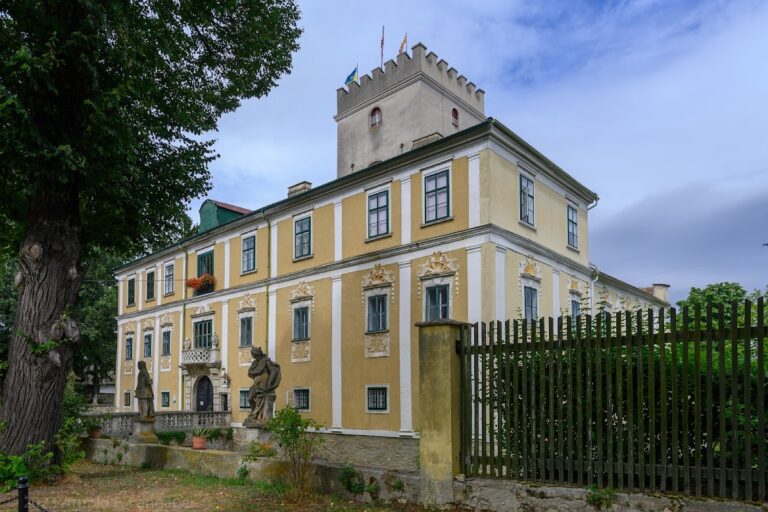
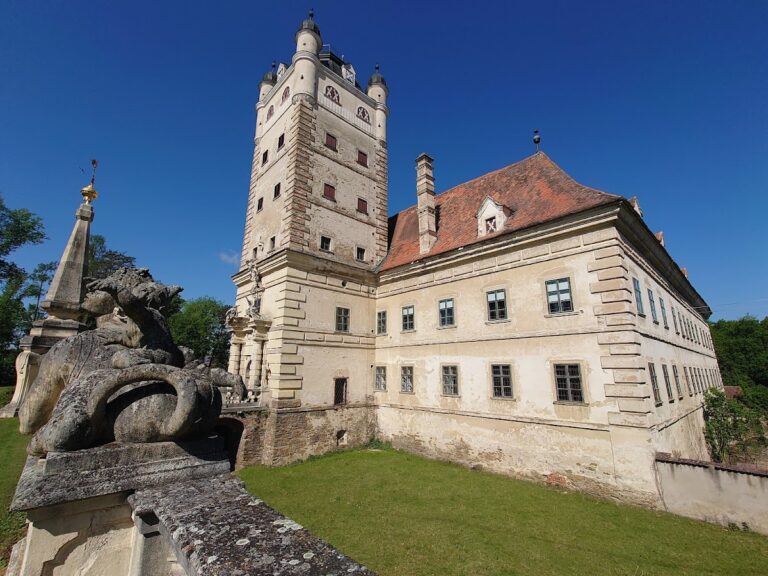
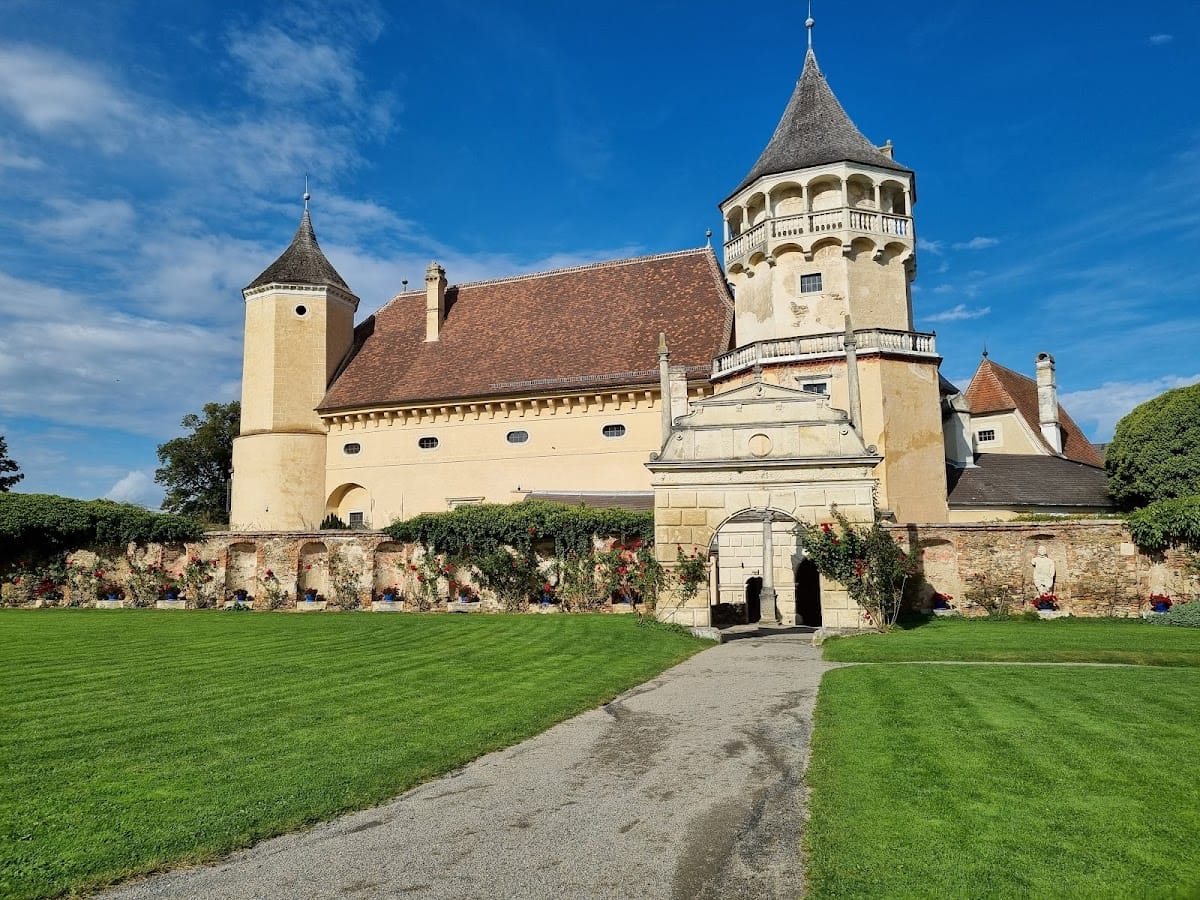
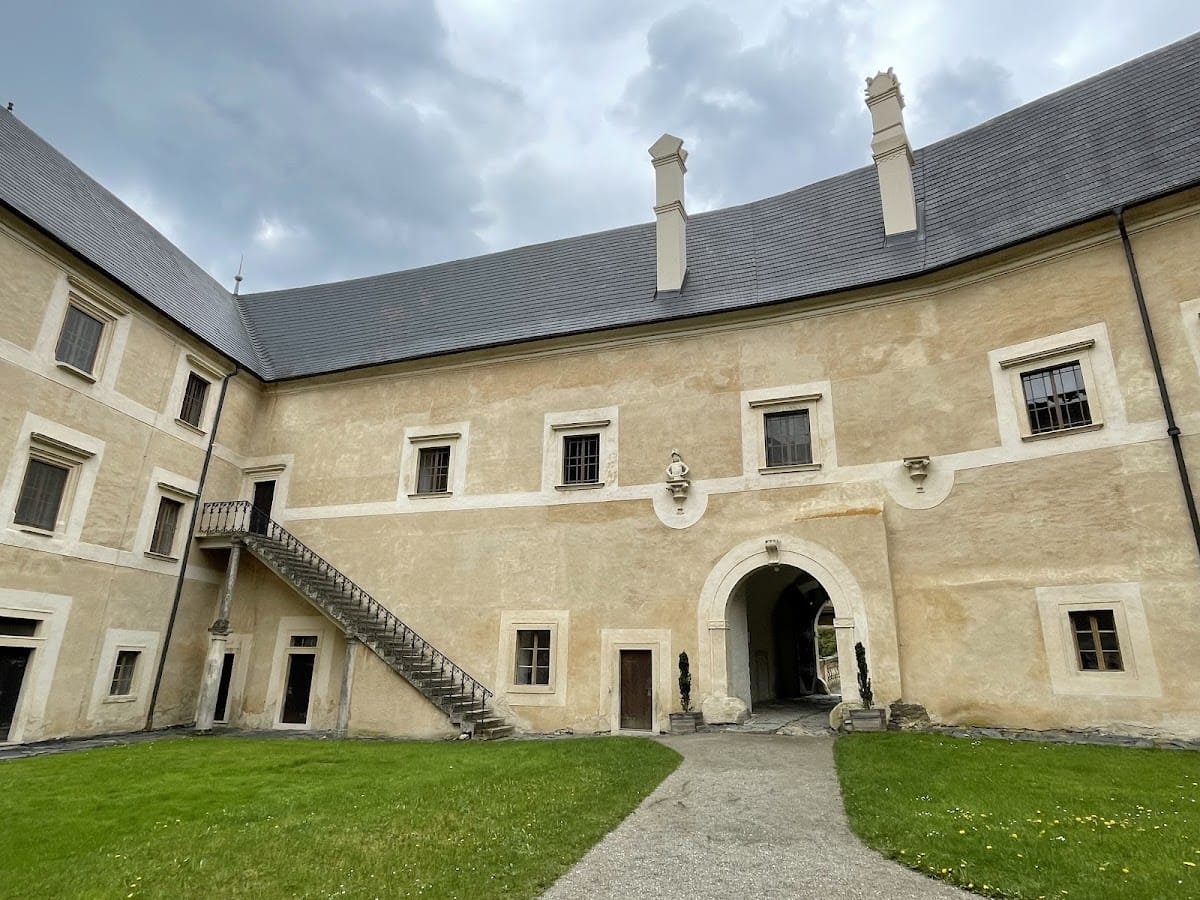
Schloss Rosenburg stands on a cliff above the Kamp valley at approximately 345 metres elevation, within the Kamptal Nature Park. The complex developed around a central keep and a pentagonal inner courtyard. Its surviving fabric combines Romanesque foundations, Gothic defensive elements, and the large-scale Renaissance residence created between 1593 and 1597.
Medieval and Gothic structures
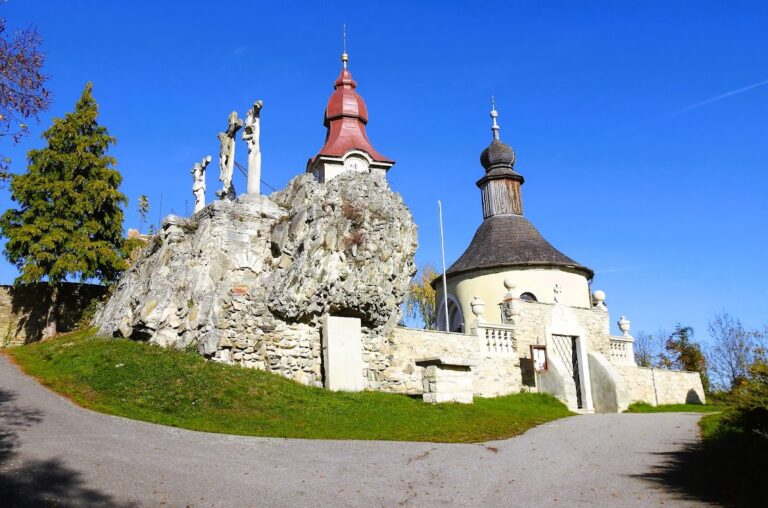
The earliest surviving fabric consists of foundations at the base of the present keep. They belong to the Romanesque phase associated with Goczwin of Rosenberg. The fifteenth-century enlargement created the Gothic castle, whose principal surviving elements include the chapel and most of the outer walls. These structures preserve the defensive character of the medieval complex within the later residence.
Renaissance courtyard and residence
Towers, arcades, and tournament ground
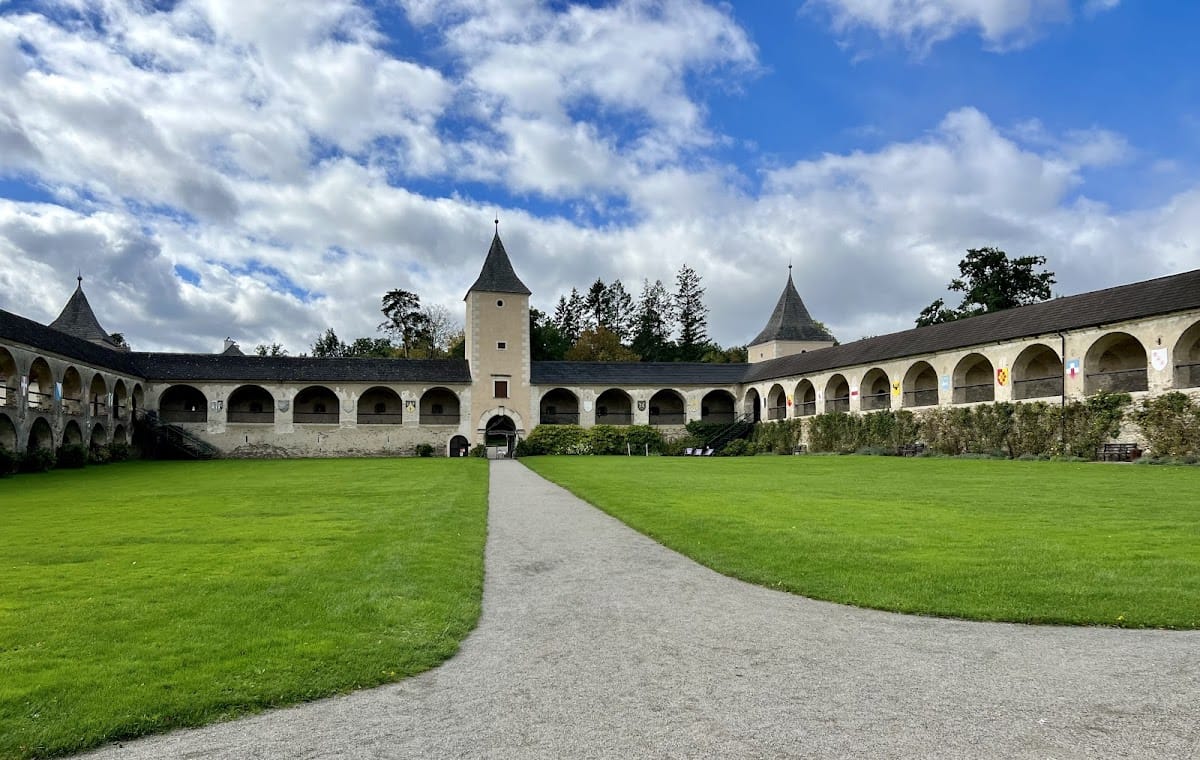
The Renaissance reconstruction gave the castle 13 towers and organized the complex around its pentagonal inner courtyard. The enlarged residence also included 46 arcades, passages or galleries formed by rows of arches, which were documented around 1614. The former tournament ground survives at approximately 67 by 46 metres and is also used for staged tournaments in historical costume.
Interiors and furnishings
Historical interiors survive with historic and historically styled furnishings and inventories. The restored rooms form part of the castle’s interior presentation and preserve the appearance created through the building’s later phases and restoration.
Museum collections and falconry displays
Castle museum and armory
The castle museum contains paintings, furniture, works of art, weapons, and other historical objects. Its armory presents weapons dating from the fifteenth to the eighteenth century, providing material evidence of the periods represented in the castle’s history.
Prehistoric collection
A prehistoric and early-historic collection assembled by Candidus Ponz, Imperial Knight von Engelshofen, contains finds from the Stone Age and Bronze Age. Anton Hrodegh and Angela Stifft-Gottlieb arranged the material as a museum display.
Falconry centre
The Renaissance Falconry Centre Rosenburg presents birds of prey and flight demonstrations. Falconry is the trained use of birds of prey for hunting, and the centre connects this practice with the castle’s surviving tournament ground and its historical presentation.