Fürstenberg Castle: Medieval Fortress and Porcelain Manufactory in Germany


Site at a Glance
- Rating
- 4.5
- Popularity
- Low
- Country
- Germany
- Primary era
- Early Modern
- External website
- Open
- Eras represented
- Medieval, Early Modern
- Civilizations
- Holy Roman Empire
- Site type
- Domestic
- Remains
- Castle
On this page14 sections
History
Fürstenberg Castle is a spur castle in Germany, built on the Kathagenberg above the Weser and largely transformed around 1600 from a medieval fortification into a hunting lodge. Its first construction date is unknown, but the rocky ridge was recorded in 1130 as “Vorstenberch” or Forstinberg. The castle helped secure a military road and the Weser frontier opposite the Brunsburg and Höxter.
Medieval lordship
Around 1300, Fürstenberg passed as a fief of Corvey Abbey to the Principality of Brunswick-Wolfenbüttel. Corvey Abbey was a major Benedictine institution whose territories could be granted as fiefs. The castle was first documented in 1355, and by 1382 its tower castle belonged to Duke Otto I of Brunswick-Göttingen as part of the Principality of Göttingen.
A tradition recorded by Johannes Letzner states that the castle had belonged to the County of Dassel in the Early Middle Ages. This tradition belongs to the castle’s later historical memory, while the surviving evidence places its documented medieval development in the political sphere of Corvey and the Brunswick territories.
Destruction and princely transformation
Hessian troops captured Fürstenberg in 1545 during the Schmalkaldic War, a conflict between Emperor Charles V and the Protestant Schmalkaldic League, and largely destroyed the fortification.
Around 1600, Duke Henry Julius of Brunswick-Wolfenbüttel converted the damaged stronghold into a hunting lodge. It also became the seat of the Fürstenberg administrative office, which managed princely lands and forests. By the middle of the eighteenth century, the castle was being used only partly as a hunting lodge.
Porcelain production and later history
Duke Charles I of Brunswick-Wolfenbüttel then commissioned his court master of the hunt, Johann Georg von Langen, to establish the Fürstenberg Porcelain Manufactory. Founded on 11 January 1747, the manufactory had its seat in the castle from about 1750. Former administrative buildings were moved outside the castle, while production buildings and kilns were added within the complex.
From 1807 to 1813, the castle and manufactory belonged to the Napoleonic Kingdom of Westphalia, a client kingdom created in central Germany under Napoleon. After the Congress of Vienna, they became part of the Duchy of Brunswick. Annette von Droste-Hülshoff is said to have called the manufactory the “Smoking Castle.” Between 1818 and 1843, she made several journeys to relatives at Wehrden Castle on the opposite bank of the Weser, where she lived and worked in a polygonal tower in the park with an unobstructed view of Fürstenberg Castle.
A museum of the porcelain manufactory has occupied the protected historic castle since 1957. Production moved to new buildings beside the castle in 1972, and later additions to the original castle were removed. Extensive modernization closed the castle from October 2015 to March 2017. The redesigned museum reopened with a permanent exhibition, a visitor workshop, and themed temporary exhibitions. The castle remains the seat of the Fürstenberg Porcelain Manufactory, whose museum presents its production from the Rococo period to the present.
Remains
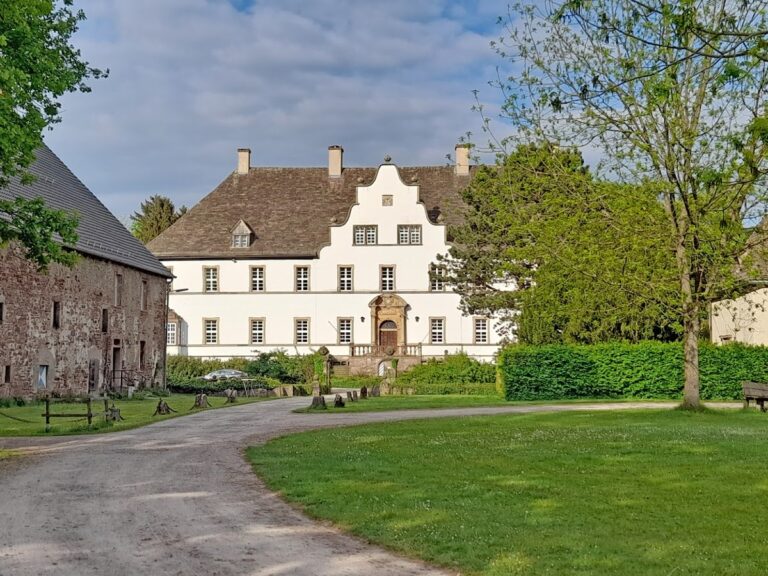
Fürstenberg Castle occupies a prominent rocky ridge above the Weser at approximately 201 metres above sea level. As a spur castle, it uses the projecting terrain for defensive advantage. The present complex largely dates from around 1600 but incorporates parts of the medieval fortification. Its surviving buildings are organized around north and south wings, with a gate building projecting toward the forecourt between them.
Medieval fortifications
Residential tower and south-west defense
The south wing contains a rectangular residential tower at its core, probably built in the mid-fourteenth century. Its ground floor formerly held the castle chapel, which was deconsecrated in 1899. At the south-west corner, the projecting structure called the Schwalbennest contains loopholes. It may originally have been a zwinger, an outer defensive enclosure between fortifications that hindered attackers approaching a gate. The roof visible today was not yet present in 1749.
Early curtain wall and moat
Excavations in 1985 exposed part of the oldest known fortification. It consisted of a one-metre-wide curtain wall, a surrounding defensive wall connecting fortified structures, built from mortared sandstone slabs. Outside it lay a moat two metres deep, together with the remains of a semicircular tower.
Castle enclosure
Outer bailey and entrance defenses
The castle area was separated from a three-winged outer bailey by a moat and drawbridge. The outer bailey was fortified in the same manner. A description by Merian from 1654 referred to two houses with two drawbridges, as well as a rear courtyard enclosed by high walls and a parapet walk. Its accompanying engraving showed half-timbered gables that have since been infilled.
North and south wings
The surviving castle building comprises north and south wings. A gate building projects toward the forecourt between them, and a staircase on its rear side gives access to the individual wings. The former castle courtyard, once enclosed by a curtain wall with a half-timbered parapet walk, now forms the site adjoining the castle on the west.
Porcelain manufactory buildings
Production area
The former porcelain production area occupies the western side of the castle complex and covers the site of the former castle courtyard. Production buildings and kilns were installed there when the castle housed the Fürstenberg Porcelain Manufactory. Production later moved to new buildings beside the castle in 1972.
Former cavalier house
The former cavalier house, an ancillary residence or service building associated with a princely complex, now contains the castle café and Bistro CARL. Food served there is presented on Fürstenberg porcelain.