Schloss Allentsteig: A Medieval Castle Transformed into a Renaissance Palace

Site at a Glance
- Rating
- 4.3
- Popularity
- Very Low
- Country
- Austria
- Primary era
- Early Modern
- Eras represented
- Medieval, Early Modern, Modern
- Civilizations
- Habsburg, Holy Roman Empire
- Site type
- Domestic
- Remains
- Castle
On this page12 sections
History
Schloss Allentsteig is a palace in Allentsteig, Austria, founded by the Kuenringer around 1000 and transformed from a medieval castle into a Renaissance residence between 1544 and 1570. The Kuenringer were a medieval noble dynasty associated with the Waldviertel and other parts of Lower Austria. The site later became a military headquarters and remains a protected listed monument in Austria.
Medieval lordship
The castle was held by the Lords of Kamegg-Kaya until about 1390. The Sonnberg family followed during the fourteenth century and transferred the lordship in 1332 to Eberhard V of Walsee, Captain of Upper Austria. The Kuenringer regained control in 1367, and the property passed to the Lords of Maissau in 1380.
In 1409, Otto IV of Maissau leased Allentsteig to his follower Hans Hager. After Otto fell from favor because of accusations of treason, the territorial prince took direct control of the lordship. It was granted as a fief, a jurisdiction held in return for allegiance or service, to the Lords of Puchheim in 1440.
In 1486, the mercenary commander Spanowsky occupied Allentsteig and Zwettl for Matthias Corvinus, the king of Hungary from 1458 to 1490, who conducted military campaigns in the Austrian lands.
Hager and Sonderndorf rule
The Hager family received Allentsteig as a fief around 1500. From 1544 to 1570, they reshaped the medieval castle as a Renaissance palace, using the architectural language that revived classical forms in Europe from the fifteenth century onward. Several members of the family became diplomats, military commanders, and senior officials.
Sigmund Hager was one of Lower Austria’s leading Protestants and travelled to Martin Luther in Wittenberg. Luther was the German theologian and reformer whose teaching became central to the Protestant Reformation. Paris von Sonderndorf, who purchased the Allentsteig lordship in 1599, was also a militant Protestant and an opponent of the emperor.
These religious and political tensions contributed to repeated plundering of the town during the Thirty Years’ War, the European conflict fought from 1618 to 1648 through overlapping religious, dynastic, and territorial struggles. Imperial troops eventually occupied Allentsteig. Hans Friedrich von Sonderndorf lost the property through confiscation in 1629.
Later ownership and military use
The Barons of Rappach owned the palace and lordship until 1694. Through marriage, they then passed to Count Ernst August of Falkenhayn. Fires severely damaged the palace in 1682 and 1752. Baron Leopold von Hahn acquired the property in 1804, and it passed to the Pereira-Arnstein family in 1816. After 1884, it belonged to the Princes of Liechtenstein, while Baroness Maria von Preuschen inherited the estate in 1918.
In 1938, when the German Reich established the Allentsteig military training area, the palace became the headquarters of its command. The training area temporarily accommodated as many as 60,000 soldiers. Schloss Allentsteig retained this command function after the Russian occupation of Austria from 1945 to 1955 and after control passed to the Republic of Austria. In 2016, it housed the command of the training area and the 4th Reconnaissance and Artillery Battalion.
Remains
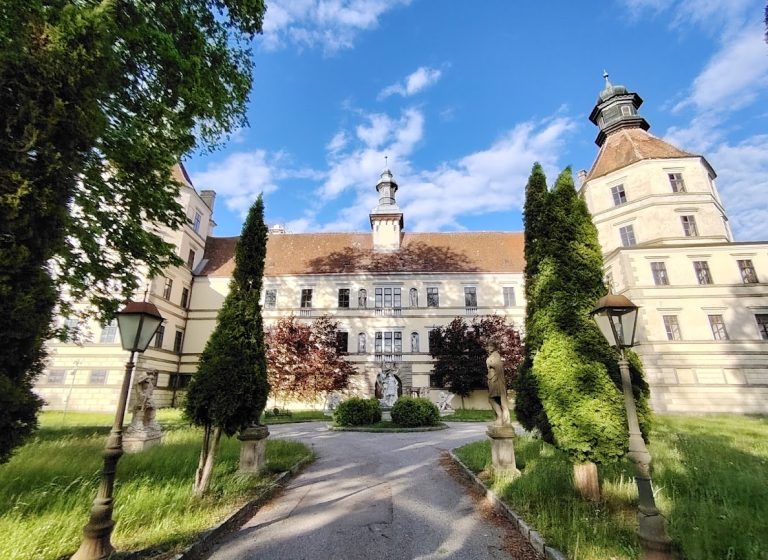
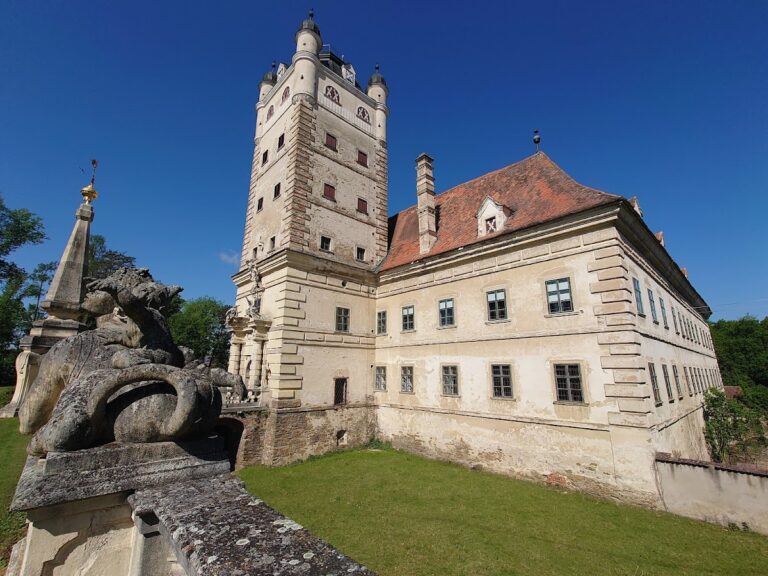
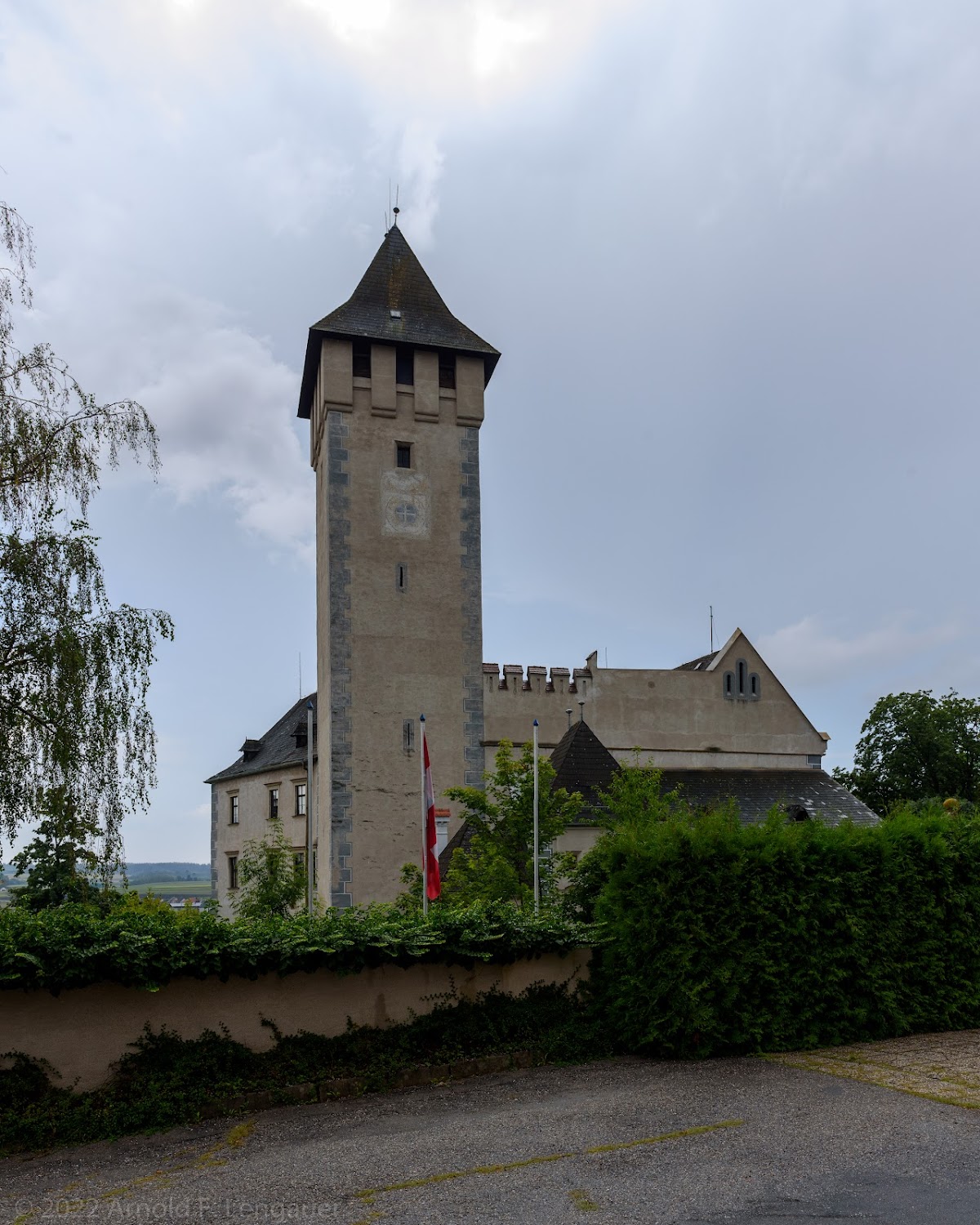
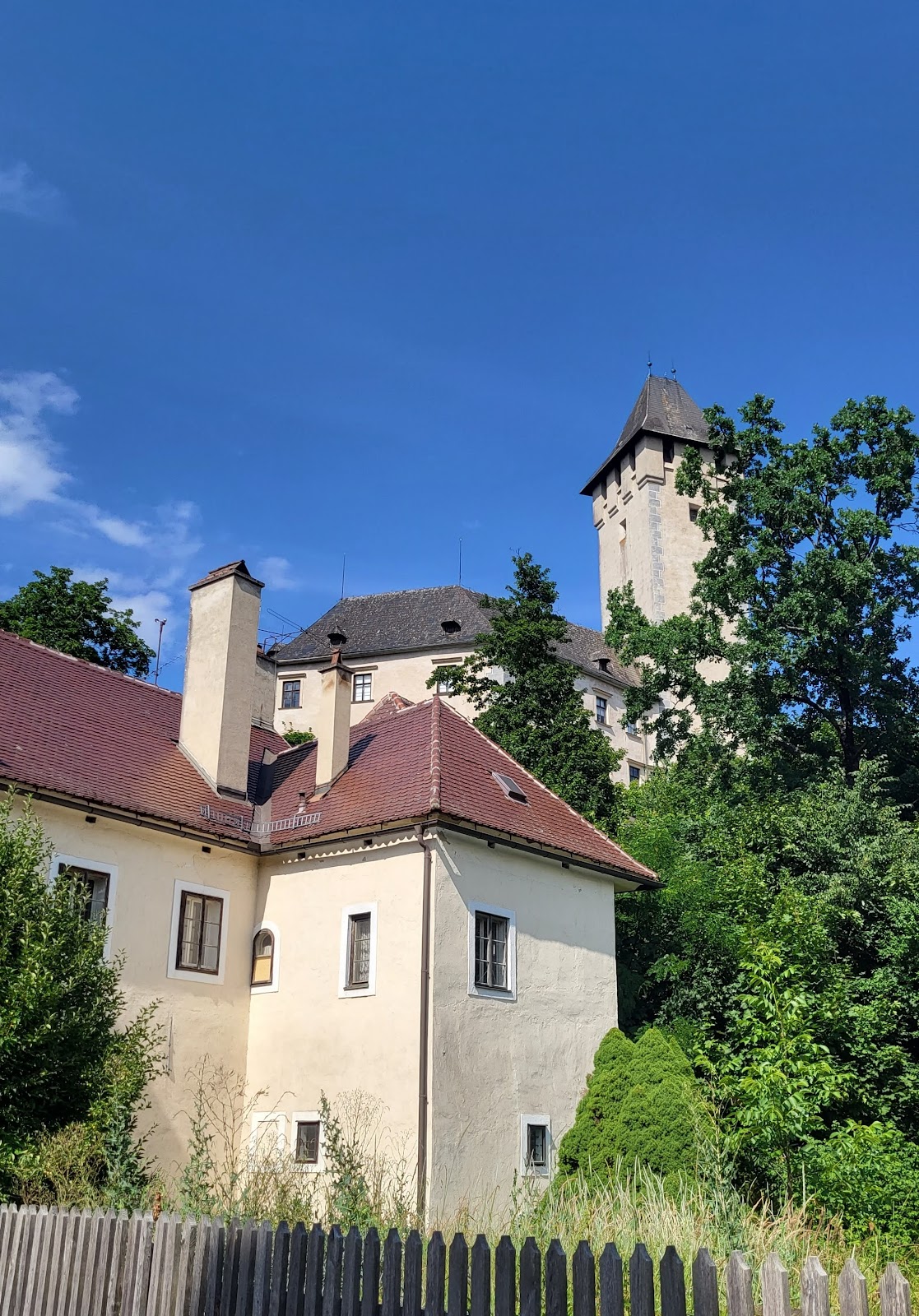
Schloss Allentsteig stands on a rock in the northern part of Allentsteig, beside the former castle moat on its eastern side. Its five-sided Renaissance layout incorporates an outer wall that largely derives from the medieval castle. The surviving complex brings together a fortified tower, medieval and Renaissance entrances, an arcaded courtyard, and later interior alterations.
Fortified core and entrances
Keep
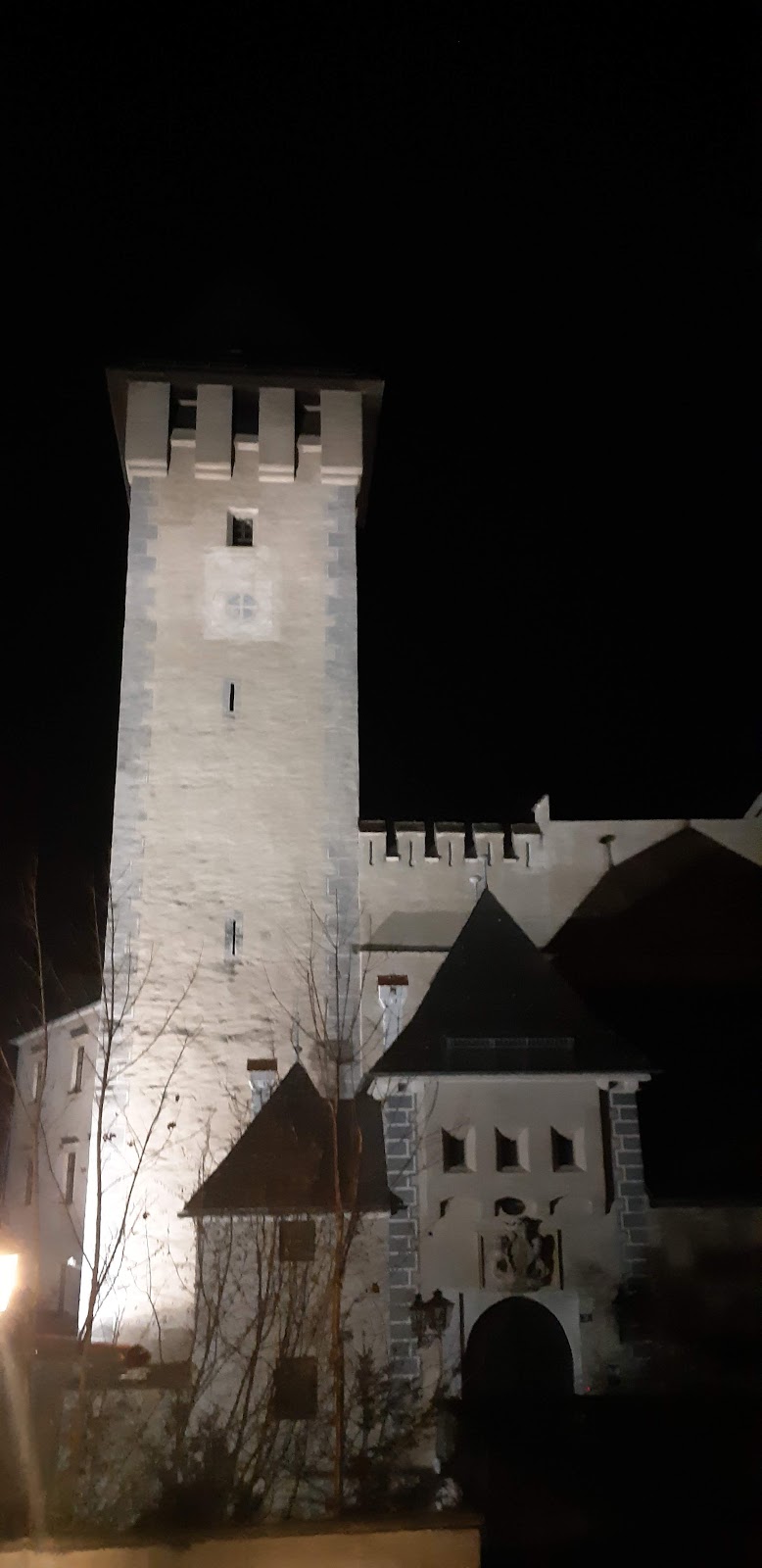
The keep, the principal fortified tower of a medieval castle, is among the oldest surviving parts of Schloss Allentsteig. It dates from the second half of the twelfth century and stands beside an eastern wall built of ashlar, meaning regularly cut stone blocks. A Romanesque portal opens from the keep toward the courtyard. Its upper storey, battlements, and tent roof have their present form from 1904.
Eastern gate hall
Entry from the east passes through a two-storey gate hall constructed in the sixteenth century. Above its rusticated Renaissance gate, whose masonry has emphasized joints and faces to create a deliberately rugged surface, is a broad bay window. The arrangement reflects the palace’s transformation from a medieval stronghold into a Renaissance complex.
Inner gate wall
The inner gate wall dates from around 1300. It contains a Gothic pointed-arch gate from the first half of the fourteenth century, preserving a visible element of the castle’s medieval defensive organization within the later palace.
Courtyard and interiors
Arcade courtyard
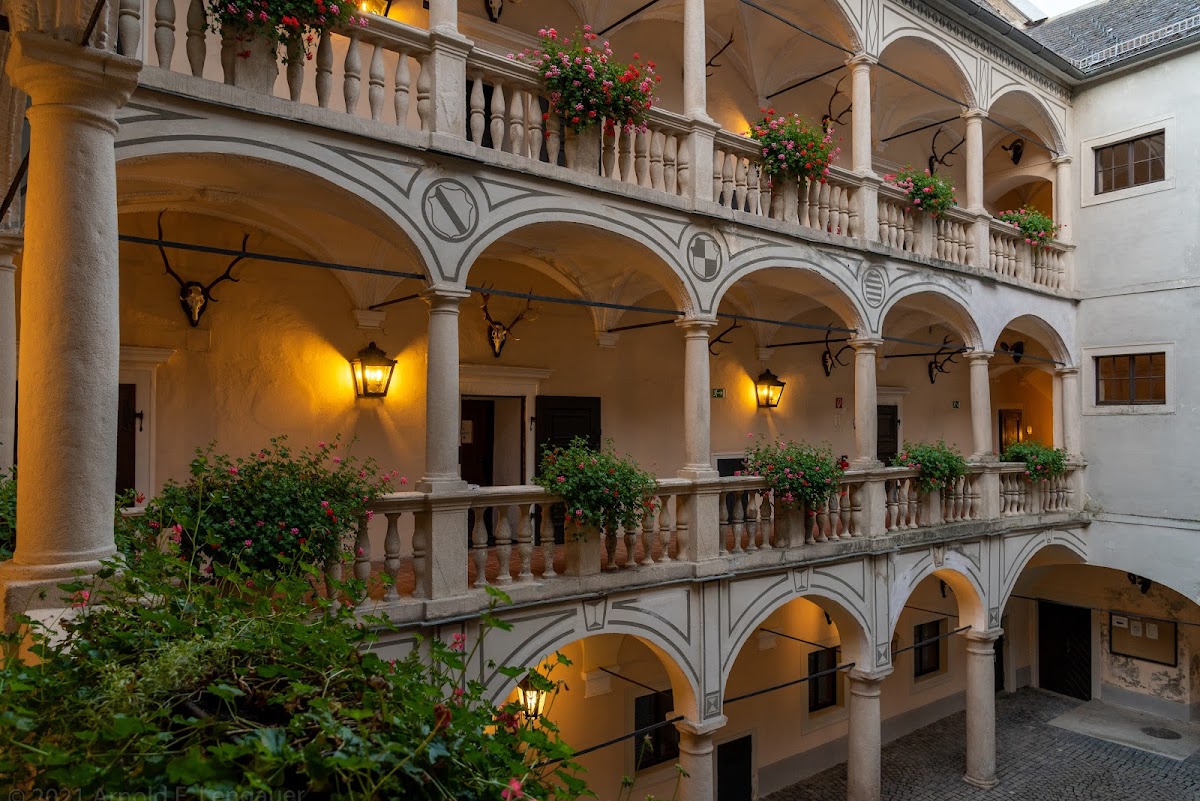
The elongated rectangular courtyard rises three storeys and has flat-arched arcades on three sides. An arcade is a sequence of arches carried by columns or piers. Here, the arcades rest on Tuscan columns, a simplified classical type with plain shafts and simple capitals. The courtyard bears the date 1576, linking its present arrangement to the Hager family’s Renaissance rebuilding.
Historicist interiors
Much of the palace interior was remodeled toward the end of the nineteenth century. The historicist tiled stoves belong to this phase, when historicist architecture revived or imitated earlier styles. The palace is preserved and retains substantial parts of its historic fabric, allowing medieval, Renaissance, nineteenth-century, and twentieth-century phases to remain legible within the complex.