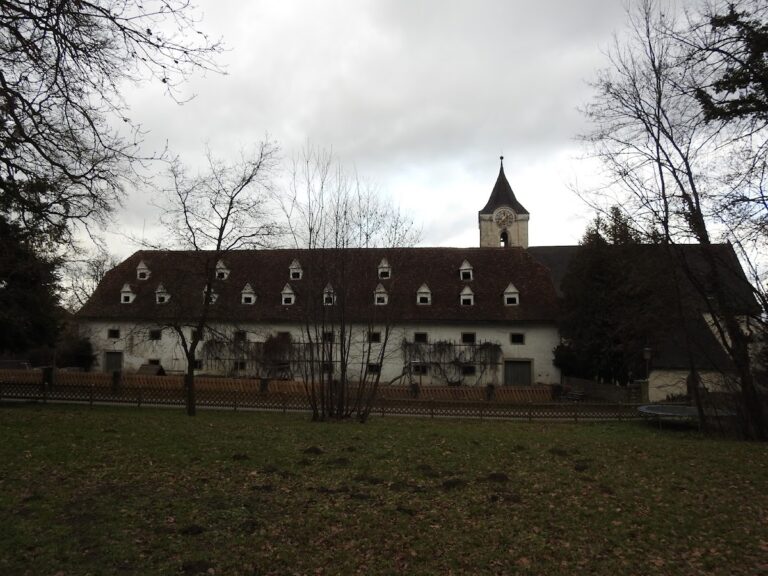
Schloss Ennsegg: A Historic Castle and Cultural Centre in Enns


Site at a Glance
- Rating
- 4.5
- Popularity
- Low
- Country
- Austria
- Primary era
- Early Modern
- External website
- Open
- Eras represented
- Early Modern, Modern
- Civilizations
- Habsburg, Holy Roman Empire
- Site type
- Military
- Remains
- Castle
On this page14 sections
History
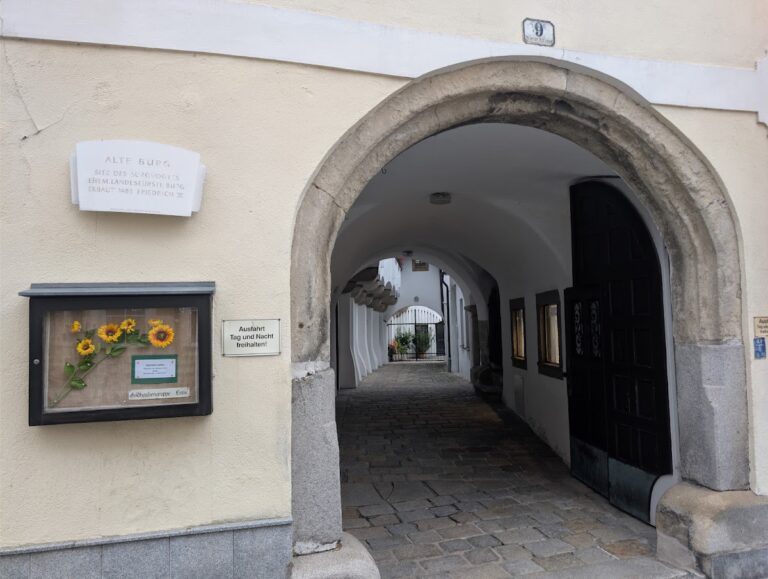
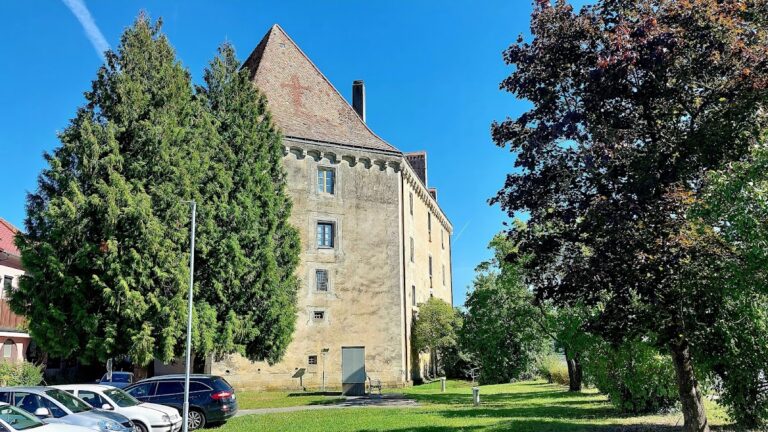
Schloss Ennsegg is a historic castle in Enns, Austria, rebuilt between 1565 and 1570 for the imperial councillor Georg Gienger. It developed from the earlier sovereign-owned Ennsburg, a residence and stronghold belonging directly to the territorial ruler, and later became the centre of the Free Lordship of Enns.
From Ennsburg to the New Ennsburg
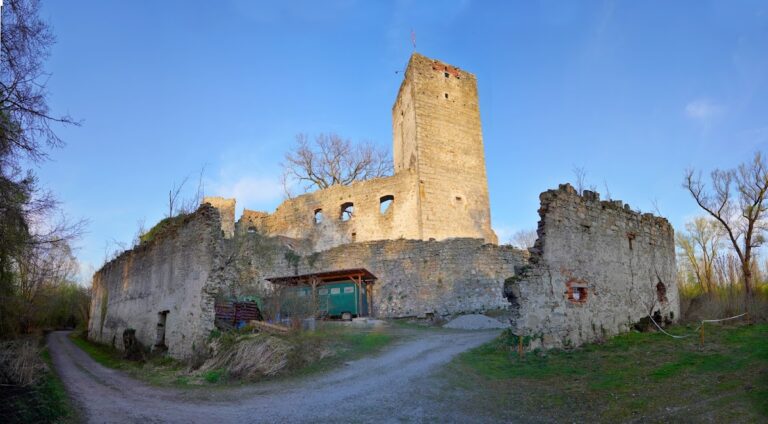
The first Ennsburg stood on the Georgenberg, where it formed part of the town’s defensive system. By the late fifteenth century it had fallen into disrepair. In 1483, Emperor Frederick III ordered the judge and council of Enns to construct a replacement. Four town houses on the Ennsberg were demolished for the project, which became known as the New Ennsburg.
About a century later, the imperial residence was again in such poor condition that a further rebuilding was considered. The old castle occupied the weakest point in Enns’s defensive circuit, so its reconstruction had to be planned together with repairs to the adjoining town wall. In three petitions submitted in 1565, the town council asked for the castle to be transferred to the town. It argued that a noble owner would place the occupants beyond the town’s jurisdiction, while also stressing the high cost of a new building and the town’s need for an arsenal to store military equipment.
Emperor Maximilian II instead granted the property to Georg Gienger (1500–1577). Gienger was court vice-chancellor, an imperial councillor, governor in Swabia, and castle governor of Enns. Maximilian allowed him to rebuild the deteriorated castle on the condition that it be returned to good condition, and protected him from interference by the bailiffs of Enns. The resulting noble free seat was an aristocratic residence with special legal privileges, including exemption from some local jurisdiction. The first sixteenth-century building was considerably smaller than the complex seen today.
Seventeenth-century enlargement and ownership
After Gienger’s death in 1577, Ennsegg passed to his daughter Ursula, the wife of Ferdinand Helfried von Meggau. It later came to David Ungnad von Weissenwolff and then to his son Andreas Ungnad, who called himself lord of Ennsegg in 1601.
Andreas Ungnad took part in the uprising of the Protestant estates against the territorial ruler. As a Protestant participant, he lost the property in 1623. The confiscated castle was transferred to the Bavarian councillor Ott Josef von Kirchberg. After his death it passed to his son, also named Ott Josef, and then to his widow Regina, born Baroness von Hoyos.
David Ungnad had returned to Catholicism and was raised to the rank of count by Emperor Ferdinand III. In 1656 he bought Ennsegg back and enlarged it with the two wings that enclose the large courtyard. The chapel’s later decoration also reflects his commitment to the Counter-Reformation, the Catholic renewal and institutional response to the spread of Protestantism.
Aristocratic inheritance and imperial visits
In 1722 Ennsegg, together with Schloss Roith and Schloss Köppach, became part of the marriage portion of Maria Anna Josepha von Weissenwolff when she married Prince Johann Wilhelm Trautson. In 1744 it passed through the marriage of their daughter Maria Josepha to Prince Karl Josef von Auersperg. Vinzenz Fürst Auersperg succeeded him in 1794, and the property passed to his son of the same name in 1838.
Ennsegg stood on an important transportation route and repeatedly accommodated prominent travellers. Emperor Franz Stephan of Lorraine used it as an overnight stop in spring 1764 while travelling to Frankfurt with two archdukes. Marie Antoinette stayed in Enns in 1770 during her journey to France after marrying the French dauphin, travelling with a large retinue of 57 carriages and a six-horse coach.
After the Battle of Ebelsberg on 3 May 1809, Napoleon took quarters at Ennsegg. In 1810 Archduchess Marie Louise and her father, Emperor Francis I, stayed there while she travelled to join Napoleon. Caroline Augusta of Bavaria, wife of Emperor Francis of Austria, arrived at the castle on 7 November 1816. Archduke Franz Ferdinand was a frequent guest as a young dragoon officer between 1884 and 1888, while Archduchess Marie Valerie spent the summer months there with her family from 1900 to 1902.
Park, wartime damage, and present use
Vinzenz Fürst Auersperg laid out the castle park as an English garden in 1841 and redesigned the interiors. The park was intended from the beginning as a public recreational space. Ownership remained within aristocratic families during the late nineteenth and early twentieth centuries. In 1888 the owners were Mathilde Fürstin von Auersperg and her sister Caroline, the widowed countess of Fürstenberg. Caroline Fürstenberg and Eduard Egon, Count of Fürstenberg, were recorded as owners in 1890, and Eduard Egon held the property alone in 1904.
In 1928 Ennsegg was donated to Marie Caroline Johanna, Countess Walderdorff-Fürstenberg. From 1940 it belonged to her daughters Marie Julie, Countess Colloredo-Mannsfeld, and Therese, Countess von Walderdorff, followed by Franz Eugen, Count von Walderdorff.
The castle’s interior furnishings suffered extensive damage during the Second World War and the postwar period. Until 1955, the demarcation line ran directly below the castle, beyond which the Soviet occupation zone of Austria began. In 2000 the real-estate company Dr. Georg Spiegelfeld-Schneeburg & Co KG took over the property and began renovating the complex, while the city of Enns acquired the park.
Schloss Ennsegg has since been restored. Since 2001 its wings have housed the Ennser Landesmusikschule, and the complex also serves as a cultural centre and registry office, with parts divided into apartments and offices. The Museum Enns 1212, devoted to the history of the city, opened in the castle in 2023. Its design was created by Peter Hans Felzmann.
Remains
Schloss Ennsegg forms part of the historic fortifications of Enns. Its northeast wing stands on a high wall and blocks the city to the north and east. The present complex is arranged around two courtyards separated by a longitudinal wing. The larger courtyard has a covered, loggia-like arcade and opens toward the southwest, while the smaller courtyard is bordered by arcades and opens toward the southeast.
Fortifications and courtyards
Defensive wall and corner tower
At the northeastern corner, a square tower projects from the wall as a flanking element of the fortification. Instead of a roof, it is topped by a crenellated defensive platform. This tower and the high wall beneath the northeast wing preserve the castle’s relationship to the town’s defensive circuit.
Original castle and arcaded courts
The original sixteenth-century Old Castle stood at the northeastern end of the high terrace. It consisted of a two-storey courtyard bordered by arcades, a stair tower, and a connecting wing leading to the town wall. The larger present courtyard retains a loggia-like arcade, an open gallery supported by arches or columns. The smaller court has its own arcaded arrangement and is open toward the southeast.
Chapel tower and entrances
A chapel tower is attached to the western side of the arcaded wing and is crowned by a Baroque onion dome, a bulbous curved dome form associated with Baroque architecture. Roman finds from Lauriacum, the Roman settlement associated with present-day Lorch near Enns, are displayed in the arcade passage. The eastern and western entrances carry the coats of arms of the Auersperg family.
Chapel and historic interiors
Castle chapel
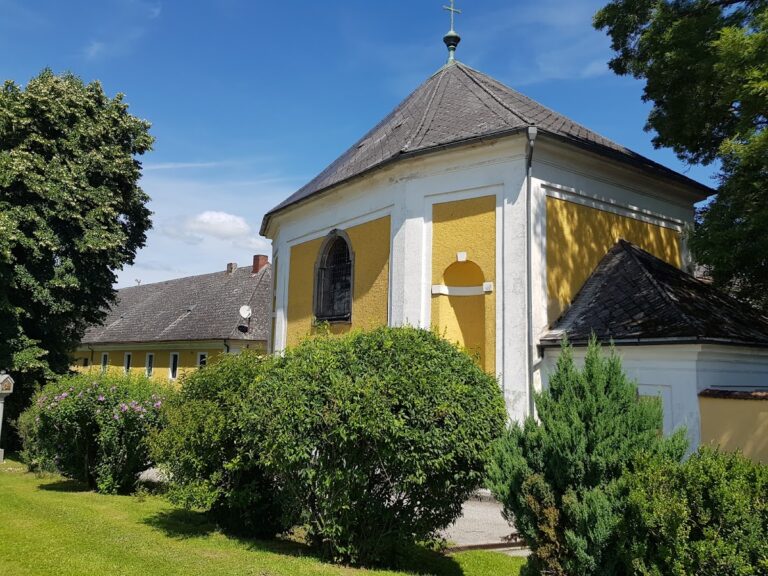
The castle chapel occupies a former defensive tower and dates from the second half of the seventeenth century. Its interior is formed around an octagonal central space with a dome and extensive stucco decoration. The wall paintings were probably created by Carpoforo Tencalla, a seventeenth-century painter active in Central Europe, and depict episodes from the life of the Virgin Mary.
The paintings also express David Ungnad von Weissenwolff’s commitment to the Counter-Reformation. Four fully three-dimensional stucco figures represent the Evangelists, Matthew, Mark, Luke, and John, who are traditionally associated with the four canonical Gospels. The chapel altar was installed around 1800, while its altarpiece was looted by American occupation troops in 1945.
Rococo picture hall
The eastern part of the castle contains a Rococo picture hall. Its paintings are recessed into the walls, and the room is now used as a marriage room.
Renaissance-style ceramic stove
Another hall contains an elaborate Renaissance-style ceramic stove bearing the coat of arms of the Jörger family. The stove was brought from Schloss Köppach and forms part of the castle’s surviving historic interior furnishings.
Nearby sites