Schloss Marbach: A Medieval Castle Complex in Austria


Site at a Glance
- Rating
- 3.8
- Popularity
- Very Low
- Country
- Austria
- Primary era
- Early Modern
- Eras represented
- Medieval, Early Modern
- Civilizations
- Habsburg, Holy Roman Empire
- Site type
- Domestic
- Remains
- Castle
On this page8 sections
History
Schloss Marbach is a medieval castle complex in Marbach, Austria, within the municipality of Ried in der Riedmark. Its history reaches back to around 1145, when Eberhardus de Marpach, a local nobleman, appeared as a witness to a charter alongside Dietmar von Aist. The site is one of two medieval castle complexes in the municipality, the other being Schloss Grünau.
From noble residence to territorial fief
Ulrich de Marpach, the last member of the Marpach family, failed to return from a crusade in 1217. The castle then passed to the territorial ruler and was granted as a fief to several holders. These included Ulrich Lichtenegger, Otto Feuchter from 1382, Rudolf I von Walsee, and Sighart Panhalm from 1398.
Hussite incursions, military campaigns connected with the Hussite movement in fifteenth-century Central Europe, reached the Mühlviertel, a historic region of northern Upper Austria, in 1424. The castle was burned during these campaigns. From 1484, Wolfgang von Rohrbach owned Marbach and rebuilt it as a fortified water stronghold.
Abbey ownership and later uses
After the Rohrbach family died out in 1619, Emperor Ferdinand II granted the lordship of Marbach to Johann Engelhofer, a member of the Imperial Aulic Council, the Holy Roman Empire’s central judicial and advisory institution. Members of the Engelhofer family were buried at Sankt Florian Abbey, an Augustinian monastery in Upper Austria, where three metal coffins remain in one of the crypt chapels.
Engelhofer’s heirs sold the castle to Sankt Florian Abbey in 1623. The abbey retained ownership for 250 years, until 1873. A major remodelling between 1706 and 1710 established the complex’s present overall form. After 1873, Marbach changed hands several times. It returned to Sankt Florian Abbey in 1937 but was expropriated soon afterward.
During the Second World War, the building was used as a horse farm for about 100 horses. Shortly after the war, it became a field hospital, treating mainly survivors of the Mauthausen and Gusen concentration camps in Austria from 17 May 1945. A prison facility belonging to the Garsten penal institution operated at the castle until 1956. The complex entered private ownership shortly after the war, was thoroughly renovated in the 1970s, and remains privately owned and inhabited. The castle, chapel, and service building are separately protected as historic monuments.
Remains
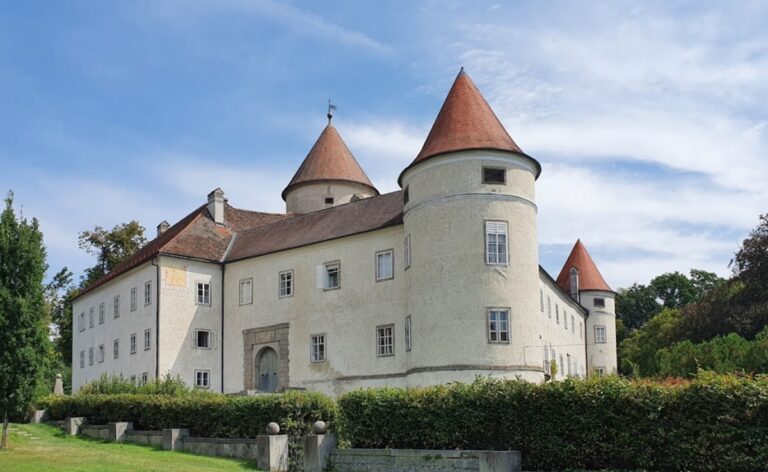
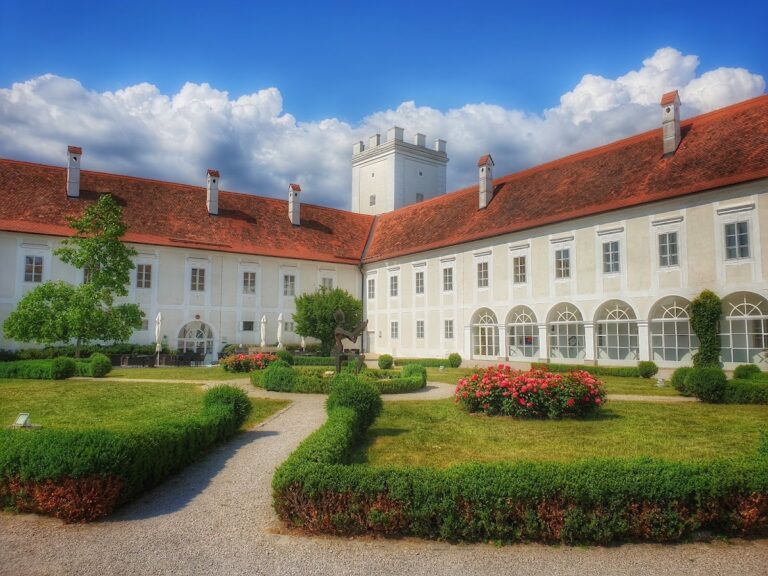
Schloss Marbach is a three-storey country manor castle arranged on a rectangular ground plan. The main buildings and a wall along the eastern side enclose an inner courtyard. Within it, an ornamental garden occupies maintained lawns, with two fountains forming part of the courtyard arrangement.
Castle buildings and courtyard
Main building and arcade wing
The principal castle building forms the core of the rectangular complex. On its western side, a two-storey arcade wing extends northward beyond the main building and chapel. The building also carries a sundial, while the courtyard provides the central enclosed space of the estate.
Castle chapel
The castle chapel stands at the south-west corner and connects directly with the main building. Carlo Antonio Carlone and Giovanni Battista Carlone, architects and builders of the Carlone family active in Central European Baroque architecture, constructed it between 1686 and 1689. Inside the chapel, a 1704 painting by Johann Michael Rottmayr depicts the beheading of Saint Catherine. The chapel was included in the renovation of the 1970s.
Service buildings
At the north side, the western arcade wing joins a transverse service building. A former service building also faces west. The estate grounds are leased, and the former farmyard is no longer in agricultural use.