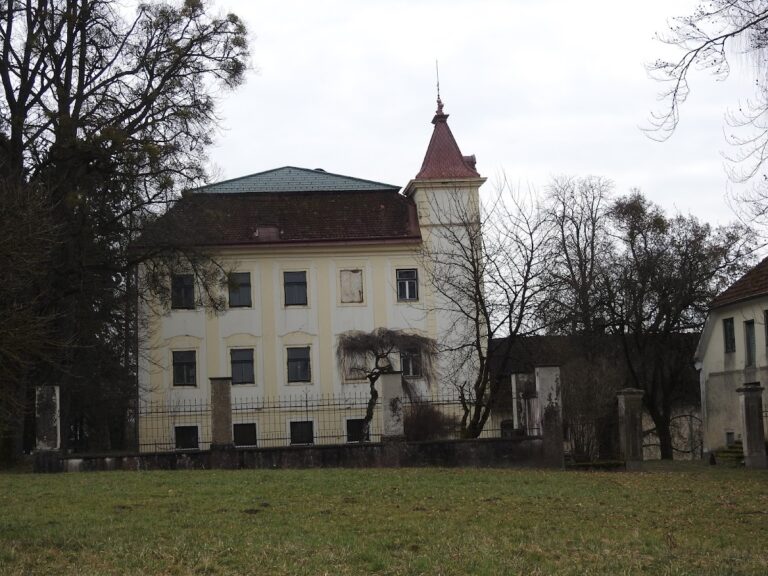
Pragstein Castle: A Danube Water Castle in Austria


Site at a Glance
- Rating
- 4.5
- Popularity
- Very Low
- Country
- Austria
- Primary era
- Medieval
- External website
- Open
- Eras represented
- Medieval, Early Modern
- Civilizations
- Habsburg, Holy Roman Empire
- Site type
- Military
- Remains
- Castle
On this page6 sections
History
Pragstein Castle is a late medieval water castle in Mauthausen, Austria, built between 1491 and 1506 on the Danube with the permission of Emperor Frederick III. Ladislaus Prager, who controlled the Mauthausen lordship as security for a financial claim, commissioned the castle, which took its name from him. He was also known as Laßla von Prag.
Habsburg Rule and Military Use
After Frederick III died, his successor, the Roman-German King Maximilian I, redeemed the pledged lordship. Members of the Prager family were nevertheless permitted to remain at Pragstein for several more years. By 1530, the complex was regarded as deserted. The castle was later renovated in response to the Ottoman threat, the military and political pressure exerted by the Ottoman Empire on Habsburg lands, and was occupied by mercenaries. It was pledged several more times before standing unoccupied again in 1599.
Georg Erasmus von Tschernembl modernized Pragstein in 1603. In 1612, Emperor Ferdinand II transferred the property to Veit Spindler, an imperial salt official responsible for the politically important salt trade and its revenues. Ferdinand II sold it to Leonhard Helfried von Meggau in 1633, and it passed by inheritance to the Cavriani family in 1644. The Cavriani renewed many of the windows, doors, and floors.
Emperor Leopold I stayed briefly at Pragstein in 1680, indicating that the castle was probably in good condition at that time. During the War of the Austrian Succession, an eighteenth-century European conflict fought largely over Maria Theresa’s inheritance of the Habsburg territories, 66 French soldiers occupied the castle. They were taken prisoner on 5 January 1742. Josef Gundaker, Count of Thürheim, acquired the lordship in 1770.
Municipal Ownership and Public Uses
Leopold Heindl, mayor of Mauthausen, acquired Pragstein in 1894 and sold it to the market municipality in 1901. A local history museum has occupied the castle since 1910. A regional music school was added in 1984, and the Mauthausen Pharmacy Museum was established in 2007, largely from holdings assembled by the Mauthausen pharmacist Norbert Aichberger. Extensive renovation took place toward the end of the twentieth century.
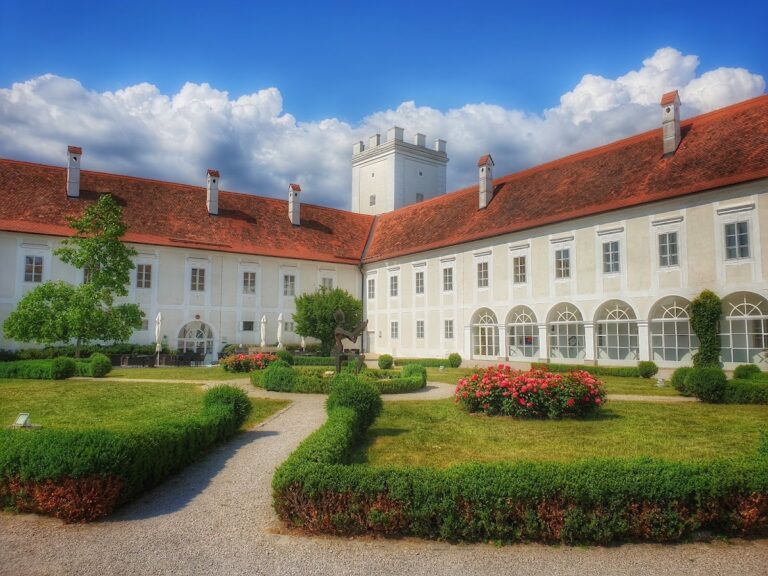
Today the complex accommodates the regional music school, registry office, event rooms, the Mauthausen Local History Museum, and the Mauthausen Pharmacy Museum. The local history museum includes an exhibition on Hans Gerstmayr’s steel-cutting work, a decorative technique in which designs are cut directly into steel, as well as a collection of hunting trophies. Pragstein also appears on the coat of arms of the Mauthausen market municipality. Schloss Pragtal, built by Andreas Prager in Windhaag bei Perg in 1564 and dismantled in 1680 for building materials used by Windhaag Abbey, is a related counterpart rather than a surviving part of Pragstein.
Remains
Island Fortress
Pragstein stands on a rocky projection from the left bank of the Danube. The river formerly surrounded the site, making it a water castle accessible from the mainland only by bridge. The surviving building is a four-storey pentagonal structure with a clothes-iron-shaped plan measuring 19 by 35 metres. Its pointed west end was designed so that floodwater and ice could pass to either side instead of pressing their full force against the walls. Small watch turrets once marked the corners, although the exterior has changed several times.
Gates and Interior Arrangement
A central corridor contains the staircase. The castle formerly had a north gate and a south gate opening toward the Danube. Flood-level marks remain visible at the north gate, while the south side carries the coat of arms of Laßla von Prag, dated 1507. Pragstein is largely preserved, but its physical setting has changed. The channel that separated the castle from the mainland was filled during the middle of the nineteenth century, and the Danube Road B3 has run between the building and the river since the 1960s.