Neue Ennsburg: A Land-Princely Castle in Enns, Austria


Site at a Glance
- Rating
- 5
- Popularity
- Very Low
- Country
- Austria
- Primary era
- Early Modern
- Eras represented
- Early Modern
- Civilizations
- Habsburg, Holy Roman Empire
- Site type
- Military
- Remains
- Castle
On this page8 sections
History
Neue Ennsburg is a land-princely hilltop castle in Enns, Austria, developed under Habsburg rule during the early sixteenth century. A land-princely castle was a fortified residence or administrative stronghold held directly by a territorial sovereign. The site had an earlier castle dating to around 1000, while the construction date of the later castle has been reassessed by more recent research.
Construction and enlargement
The long-standing view placed the construction of the second land-princely castle in 1475, on the orders of Emperor Frederick III, after several burgher houses on the Ennsberg had been demolished. Research now places the beginning of construction no earlier than about 1510, and possibly as late as around 1520. Two houses at Ennsberg 1 and 1a were demolished for the new castle, while houses at Wiener Straße 11 and 13 were incorporated and adapted.
Around 1550, Emperor Maximilian II acquired the former Ennenkel family house at Wiener Straße 9 to enlarge the complex. Around 1565, Hans von Matz redesigned the principal buildings. These changes expanded and reshaped the castle within the existing urban fabric of Enns.
Decline and changing ownership
By 1589, the imperial castle had seriously deteriorated. Archduke Matthias asked his brother, Emperor Rudolf II, for funds to repair it, noting that the roof was in very poor condition and that the floors of the imperial chamber, hall, dining room, and dark chamber had completely rotted. Master builder Christoph Canavale estimated the work at 1,866 gulden, a historical currency used in the German-speaking lands.
The necessary money proved difficult to obtain, and the castle continued to decay. The old Ennsburg was partly used again, while a new castle was planned between the old and New Ennsburgs. Maximilian II permitted his imperial councillor Georg Gienger von Rotteneck to build the present Ennsegg Castle for this purpose.
The castle bailiwick, an administrative and protective authority exercised by a bailiff on behalf of a superior lord, was held by Hanns Berthold zu Saxenek and, in 1630, by his heirs. The castle was later pledged to Christoph Helmhart von Weissenwolf. The Weissenwolf family subsequently purchased it from Emperor Joseph I. Ferdinand Bonaventure von Weissenwolf sold the property in 1722 to Thaddä Adam von Khauten, after which it passed to the Barons von Rumerskirch. Joseph von Rumerskirch owned it in 1816.
Fire, plundering, and survival
A fire in 1730 and plundering by French forces in 1742 damaged the land-princely castle. Parts of the complex survived and were incorporated into residential and commercial buildings. The former castle remains are associated with Ennsberg 1 and Wiener Straße 9–13, where elements of Neue Ennsburg can still be recognized.
Remains
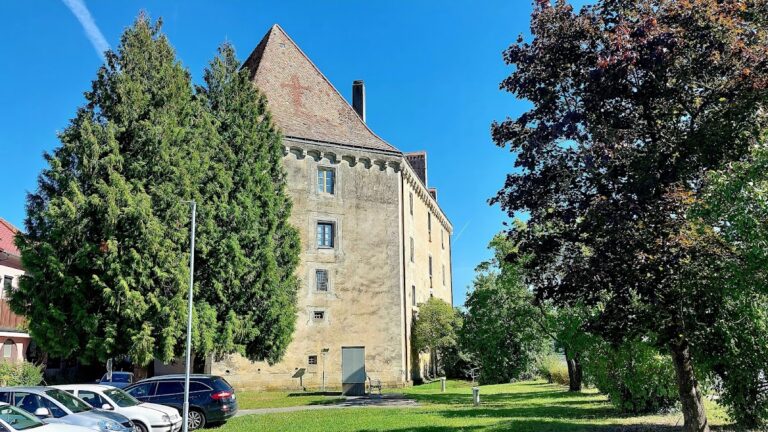
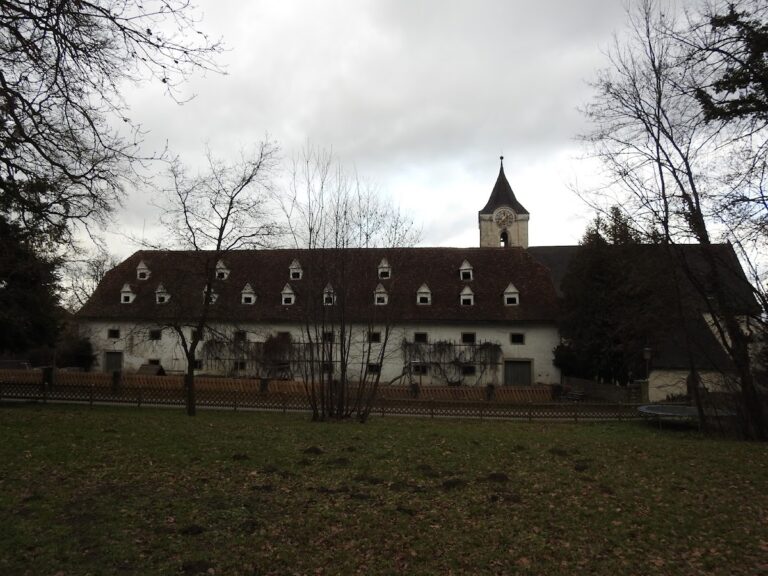
Neue Ennsburg survives as parts of a hilltop fortress incorporated into the town’s residential and commercial buildings. The site stands in Enns at approximately 281 metres above sea level. Its principal buildings occupied Ennsberg 1 and 1a, while the enlarged complex extended along Wiener Straße 9–13. The surviving structures are therefore experienced as fragments within the urban fabric rather than as a separate, intact castle complex.
Castle buildings and surviving fabric
Ennsberg buildings
The main castle buildings were situated at Ennsberg 1 and 1a. Their remains include solid retaining walls and a round corner turret, features that give the surviving fabric a distinctive appearance within the townscape. These elements belong to the principal buildings that were redesigned around 1565.
Wiener Straße buildings
The buildings at Wiener Straße 9–13 formed part of the enlarged castle. The houses at Wiener Straße 11 and 13 were adapted for incorporation into the complex, while the former Ennenkel house at Wiener Straße 9 was acquired around 1550 for the castle’s expansion. Castle fabric remains integrated into the residential and commercial buildings in this area.
Nearby sites