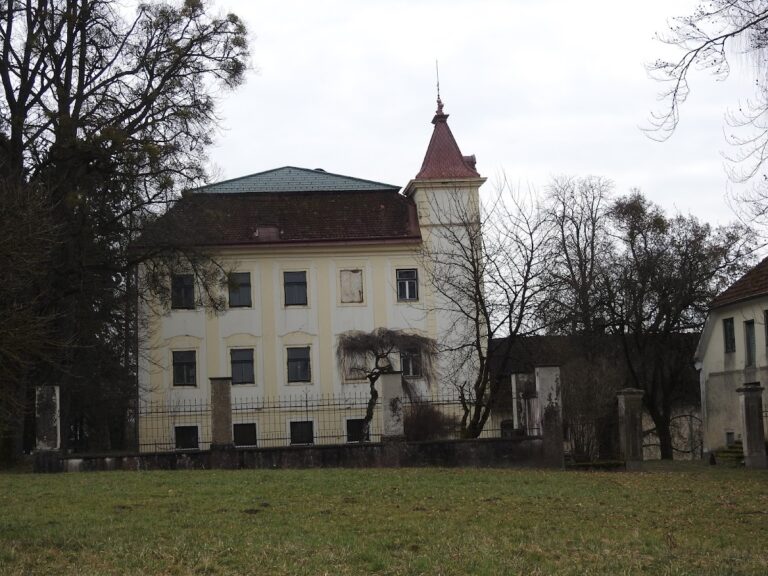
Spielberg Castle Ruins: A Medieval Fortress in Upper Austria


Site at a Glance
- Rating
- 4.2
- Popularity
- Low
- Country
- Austria
- Primary era
- Medieval
- External website
- Open
- Eras represented
- Medieval
- Civilizations
- Duchy of Austria, Habsburg, Holy Roman Empire
- Site type
- Military
- Remains
- Castle
On this page12 sections
History
Spielberg Castle Ruins are the remains of a lowland castle in Austria, about one kilometre southwest of Langenstein in Upper Austria. The medieval fortress probably developed on a site that had earlier served the Roman Danube frontier, and its position near a Danube crossing opposite the mouth of the Enns gave it lasting strategic value.
Roman and early medieval setting
A Roman watchtower is believed to have stood on the castle site as part of the limes, the Roman frontier system of forts, roads, watchtowers, and related installations. The harbour of the former Roman Danube fleet at Lauriacum, a military and settlement centre associated with a legionary camp and the fleet, probably lay about one kilometre away. The castle rock later occupied a position near the northern frontier of the Roman Empire and the eastern frontier of the Carolingian Empire, as well as beside an ancient Danube crossing.
The medieval castle was probably built by the Lords of Perg and Machland. After Otto of Machland died in 1148, the site passed to Otto III of Lengenbach, who became ecclesiastical bailiff of the Regensburg bishopric’s possessions in the Duchy of Austria from 1188. In 1159, Spielberg was held as a fief of the Bishopric of Passau. A fief was land or jurisdiction held from a superior lord in return for specified obligations.
Coins from the Archdiocese of Cologne dated 1156 and 1167 point to the fortress’s early importance. Spielberg stood near the boundary between the Duchy of Bavaria and the newly established Babenberg Duchy of Austria. The Babenbergs were the ruling dynasty of medieval Austria before the Habsburg succession.
From Passau fief to Austrian possession
The Otakar land registers of 1197 to 1230 list Spielberg lordship holdings between Abwinden and Stein, now Langenstein. In 1230, Otto V of Lengenbach, then ecclesiastical bailiff of Regensburg, still held the castle as a Passau fief. In 1236, Spielberg passed to Duke Frederick II of Babenberg, known as the Warlike, and thereby became part of Austria. Otto V had died during a conflict with the duke after unlawfully taking possessions belonging to Garsten Abbey in the Riedmark.
Members of the Spielberg family appear in later records. Dietrich of Spielberg was named in 1259, while between 1273 and 1291 Eberhard of Spielberg sold Spielberg Castle and the town of Enns to King Rudolf I of Habsburg. The castle was subsequently granted several times as a princely fief or pledged estate. A pledged estate was property temporarily assigned as security for a loan.
The princely castellan Hagen held office from 1314 to 1324. In 1329, Spielberg was granted as a life annuity to Eberhard V of Walsee, giving him control or income for his lifetime. The castle then returned as a pledged estate to the Hagen castellans. In 1348, they confirmed an exchange between the castle priest Ott and St. Florian Monastery.
Monastic administration and noble ownership
Around 1353, Duke Albert II pledged Spielberg to Erhart Hagen for a loan of 600 pounds. He also granted Hagen an annual payment of 50 pounds from the toll at Stein to maintain the fortifications. On 29 April 1365, Duke Rudolf IV transferred Spielberg to St. Florian Monastery as a perpetual burgraviate for wartime, in exchange for the monastery’s surrender of old rights in Enns. A burgraviate was a castle jurisdiction administered by a burgrave.
The monastery had to keep the fortress open to the captain of Upper Austria whenever required. Dukes Albert III and Leopold III later confirmed St. Florian’s rights while retaining the power to redeem the castle. Through the monastery, Spielberg was pledged for several years around 1390 to Hans, or Johann I, of Liechtenstein. In 1397, Duke Albert IV granted half of Spielberg as a life annuity to Reinprecht II of Walsee, his captain of Upper Austria.
King Ladislaus Postumus enfeoffed the Ruckendorfer family with Spielberg in 1455, and the family sold it again in 1475. A Banntaiding from the Ruckendorfer period set out the rights and duties of subjects in Langenstein and Au an der Donau. This type of local customary-law assembly or record regulated relationships within a lordship.
In 1484, Emperor Frederick III granted Spielberg Fortress as free property to Bernhard von Scherffenberg, the provincial governor of Upper Austria, in recognition of his service during the war against King Matthias Corvinus of Hungary. Repeated changes of ownership had left the castle in poor condition. The Scherffenberg family strengthened and enlarged it, and in 1597 expanded the Spielberg lordship by purchasing the Lorch office.
Fortress, toll station, and court disputes
Spielberg was still listed in 1594 among Upper Austria’s refuges and principal defensive castles for wartime. A Banntaiding from around 1600, expanded in 1650, survives alongside a fishing ordinance for the Au an der Donau estate from 1608 and a separate land register from 1610.
A Danube toll station was established at the castle in 1619. The Spielberg lordship also claimed the right of wreck, allowing it to confiscate ships wrecked in the rapids north of the castle when their owners could not ransom them.
During the Upper Austrian Peasant War, an army of 700 peasants under Christoph Zeller compelled the surrender of weapons and provisions at Spielberg on 29 May 1626. The castle was last used as an important military base during the seventeenth-century wars against Sweden and Bavaria.
David Ungnad von Weissenwolff acquired Spielberg in 1671. In 1692, Helmhart Christoph von Weissenwolff executed a subject from Langenstein “with fire and sword.” The act caused substantial disputes in the early eighteenth century between holders of the regional courts because Spielberg lay on the boundary between the Traunviertel and Machlandviertel.
Decline and modern history
Schloss Spielberg was allowed to decay during the eighteenth century. The ruins later became involved in twentieth-century political and cultural uses. On 6 September 1936, they hosted a supraregional “knightly festival” and Riedmark celebration organized by illegal National Socialists. The castle also features prominently in Eduard Munninger’s 1937 Blood-and-Soil novel The Confession of Ambros Hannsen, which concerns the peasant uprising led by Martin Aichinger. Blood-and-Soil fiction idealized rural life, ancestry, and attachment to land in accordance with National Socialist ideology.
Extensive archaeological excavations took place in 1941 and 1942, using prisoners from the nearby Gusen I concentration camp. In 1952, Henriette von Thurn und Taxis, of the Weissenwolff family, bequeathed Spielberg and Luftenberg to Maria Immaculata Mensdorff-Pouilly, of the Thurn und Taxis family. Since 1980, the properties have been owned by her daughter, Marie Antoinette Krassay.
Changes to the Danube altered Spielberg’s administrative and physical setting. Since the river was regulated in the mid-nineteenth century, the site has lain north of the Danube, although it traditionally belonged to the Enns locality of Enghagen. On 1 January 1997, the ruins and their northern-bank surroundings were detached from the municipality of Enns and assigned to Langenstein in the Mühlviertel. The Friends of the Spilberg Castle Ruins association was founded in spring 2013 to halt the site’s deterioration.
Remains
Floodplain setting and castle layout
Spielberg was formerly a substantial water castle on an island in the Danube. It now stands in the Schlossau floodplain, about 600 metres from the river, and floodwater still surrounds it when the Danube rises. The castle rock, its former water setting, and the nearby ancient crossing opposite the mouth of the Enns formed part of the defensive landscape.
The surviving complex covers approximately 7,500 square metres and is preserved as a ruin. Its remains are enclosed by a surrounding wall 16 metres high, while the high castle contains a 35-metre-high Romanesque battlement tower. These elements preserve the principal defensive scale of the former fortress.
Defensive structures
Romanesque battlement tower
The high castle’s 35-metre tower is Romanesque and retains its role as the dominant vertical element of the surviving complex. Its battlements and masonry belong to the defensive architecture of the castle, which occupied the castle rock within the former water landscape.
Surrounding wall
A 16-metre-high wall encloses the castle ruins. Together with the elevated castle area and surrounding floodplain, it formed the main defensive enclosure. The complex now survives in ruined condition, while floodwater continues to reach the site when the Danube rises.
Archaeological evidence
Numerous Roman gravestones were recovered from the fabric of the ruins during the excavations of 1941 and 1942. Their reuse in the castle fabric connects the surviving medieval remains with the Roman period and supports the close architectural and building-historical relationship between the site and its earlier frontier setting.
Coins from the Archdiocese of Cologne dated 1156 and 1167 were found in connection with Spielberg. They provide physical evidence for the fortress’s early medieval importance, when it stood near the boundary between Bavaria and the Babenberg Duchy of Austria.