Schloss Broich: A Historic Fortress in Mülheim an der Ruhr, Germany
Visitor Information
Google Rating: 4.5
Popularity: Medium
Official Website: www.schloss-broich-muelheim.de
Country: Germany
Civilization: Early Modern, Medieval European, Modern
Site type: Military
Remains: Castle
History
Schloss Broich stands in the municipality of Mülheim an der Ruhr, Germany, and its origins trace back to the late Carolingian period, constructed by the East Frankish realm. This fortified site was first established as a military camp during the winter of 883/884 by Duke Heinrich of the East Franks. The castle was designed as a swift response to Viking raids along the Ruhr River, notably following the capture of Duisburg by Viking forces who had wintered there in 883. Its strategic position atop an 11-meter-high spur overlooked a ford on the Ruhr and commanded the Hellweg trade route, an important thoroughfare in early medieval Europe.
Initially, the fortification consisted of an oval enclosure featuring multi-room buildings, some rising to two stories, though it lacked permanent facilities such as kitchens, storage, or wells, suggesting it was intended for temporary military use. After Duke Heinrich succeeded in expelling the Vikings in April 884, the camp was abandoned, although archaeological and historical evidence indicates some fortified presence lingered into the early 10th century. Chronicler Flodoard of Reims records a meeting near the lower Ruhr in 923 involving King Heinrich I of East Francia, which some historians associate with the Broich site.
By the end of the 11th century, the noble family of Broich restored and expanded the castle, marking the first documented appearance of the Broich lords in 1093. Over the following centuries, the site evolved into a full fortress. In the late 12th century, significant strengthening took place: walls were thickened and raised, a defensive outer ward called a zwinger was established on the northern side, and a tall bergfried, a type of fortified tower, was built reaching nearly 18 meters high. The fortress demonstrated its resilience in 1240 when it resisted a siege led by Archbishop Konrad of Cologne amid regional conflicts involving the Counts of Jülich and Dukes of Limburg.
The original male line of the Broich family ended in 1372 with Dietrich V. Through his daughter Lukardis’s marriage to Count Dietrich IV of Limburg, control passed to the Limburg family. In the late 14th century, between 1380 and 1400, a two-story Gothic hall building—known as a palas—with distinctive stepped gables was added within the southern section of the castle. The 15th century brought intense warfare, including sieges between 1437 and 1439 during feuds involving Count Heinrich of Limburg-Broich and Archbishop Dietrich II of Cologne. The most devastating attack occurred in 1443 when a large allied force of up to 22,000 soldiers captured the castle, burning the bergfried and one of the corner towers, causing heavy damage to the defensive walls and residences. This marked the first time Schloss Broich was successfully taken by an enemy. Repairs were financed the following year, though the bergfried was deliberately demolished and the planned stone bridge over the Ruhr never realized.
In the early 16th century, Count Johann of Limburg-Broich transferred ownership by adopting his niece Irmgard of Sayn and marrying her to Wirich V of Daun-Falkenstein. During Wirich’s tenure, the castle underwent extensive renovation, including the closure of the northwest gate, the creation of a larger entrance on the western wall, and the addition of several two-story buildings and timber-framed houses within the castle compound. However, these modifications focused on residential improvements and did not include new defensive works.
From 1584 onward, the castle was caught between the turbulent conflicts of the Cologne War and the Eighty Years’ War, hosting changing garrisons of Spanish and Dutch troops. In October 1598, a Spanish force led by Admiral Francisco de Mendoza besieged Schloss Broich with 5,000 soldiers. The siege inflicted severe damage, breaching the walls in the northwest corner and forcing Count Wirich VI to surrender; he subsequently died soon after these events.
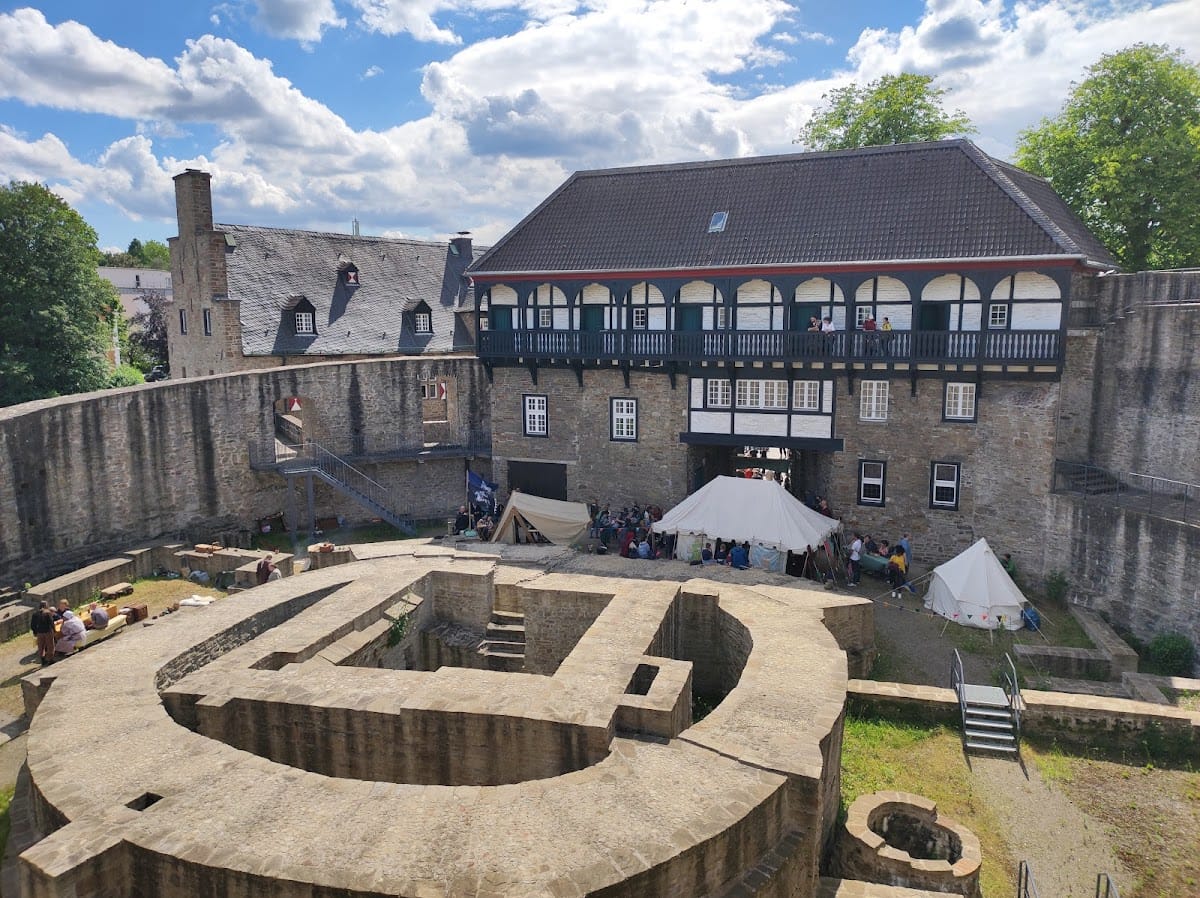
Restoration efforts took place from 1644 to 1648 under Count Wilhelm Wirich von Daun-Falkenstein. He rebuilt and expanded the residential buildings, adding a timber-framed upper story and a wooden gallery above the gatehouse—the structure now known as the Hochschloss. His coat of arms and titles remain inscribed over the main gate, commemorating this work. A two-story palace wing with an octagonal stair tower was also constructed in the courtyard by linking the Gothic palas and earlier residential buildings. Around the castle, a garden was laid out to the south, and an outer bailey with a surrounding moat was constructed to the northwest, though this feature was removed in the 19th century.
Following Wilhelm Wirich’s death in 1682, ownership passed to his daughter Christine Luise and her husband Count Emich Christian of Leiningen-Dagsburg. As military threats subsided, Schloss Broich gradually lost its defensive role and was used primarily as an administrative center. In 1789, the west wing was renovated in an early classical style under the direction of architect Nicolas de Pigage, commissioned by Maria Luise Albertine, Christine Luise’s granddaughter. This renovation included rebuilding the stair tower and demolition of the northern wing.
The lordship was dissolved during the Napoleonic occupation in the early 19th century, with the region annexed by Prussia in 1815. The castle then fell into neglect, and after the last private owner died in 1830, it changed hands. In 1857, banker Eduard Stöcker purchased the estate, removed the timber-framed buildings, and constructed a neoclassical two-story villa adjoining the Hochschloss.
The 19th and 20th centuries brought further damage due to expanding railway and road projects. Ownership transferred to the municipality in 1938, but wartime and postwar conditions led to continued deterioration. In 1952, the hall building received a new roof as part of initial preservation efforts. Archaeological excavations conducted from 1967 to 1974 under Professor Günther Binding revealed foundational remains of the original Carolingian fortification and later medieval expansions. The castle was officially reopened in 1975.
Structural decline of the ring wall became critical by 2009, prompting a comprehensive restoration beginning in 2010 that spanned a decade. This renovation, fully funded by donations and costing approximately 4.6 million euros, repaired damage including dangerous falling stone blocks and strengthened the castle’s historic fabric. Today, Schloss Broich stands preserved as a site reflecting more than a millennium of military, noble, and administrative history.
Remains
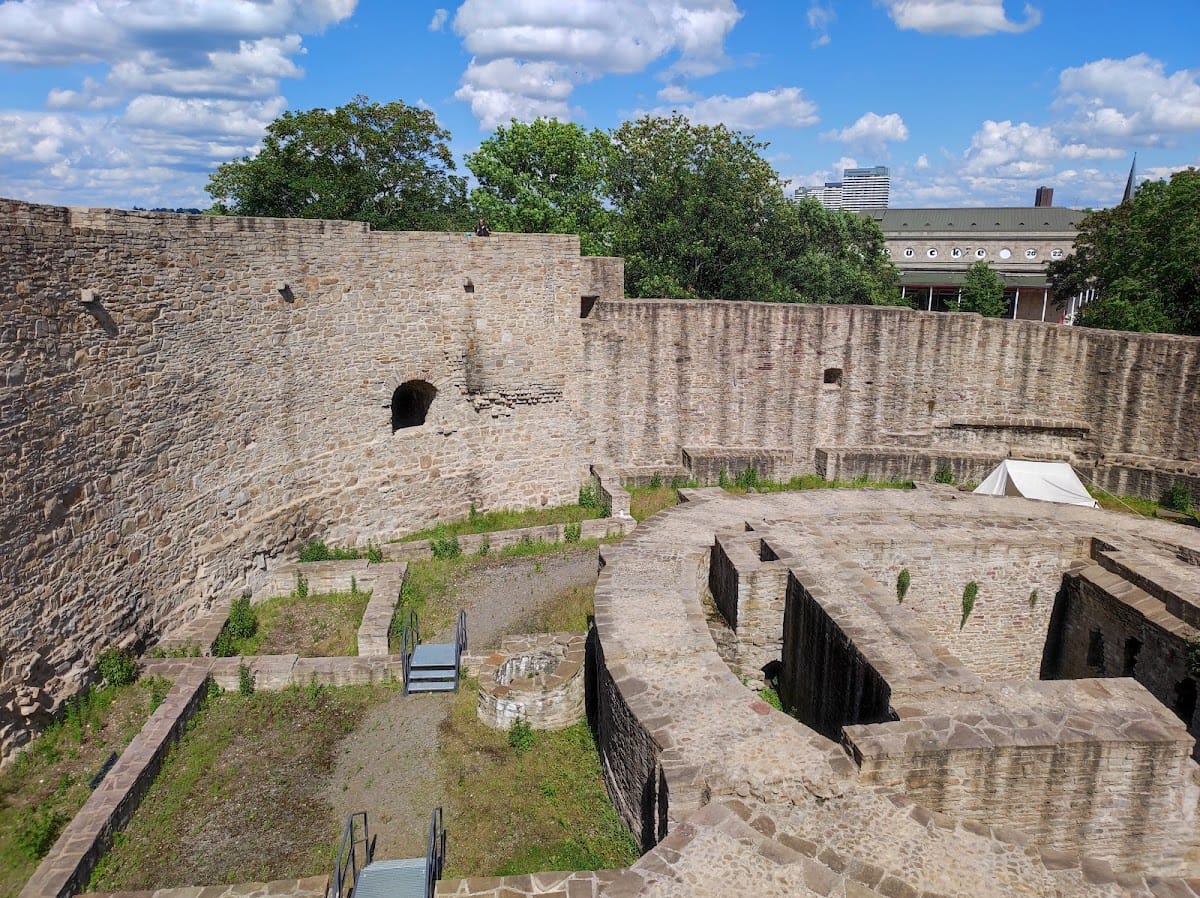
The earliest confirmed structure at Schloss Broich is a fortified enclosure dating to the late 9th century. This original fortification occupied a natural spur rising 11 meters above the Ruhr River, chosen to control a ford on the Hellweg, a key medieval trade route. Archaeological investigations revealed an oval-shaped ring wall surrounding multiple buildings, some with two stories. These early buildings, framed within the enclosure, were constructed for temporary military defense rather than long-term residence, as they notably lacked permanent features like kitchens or wells.
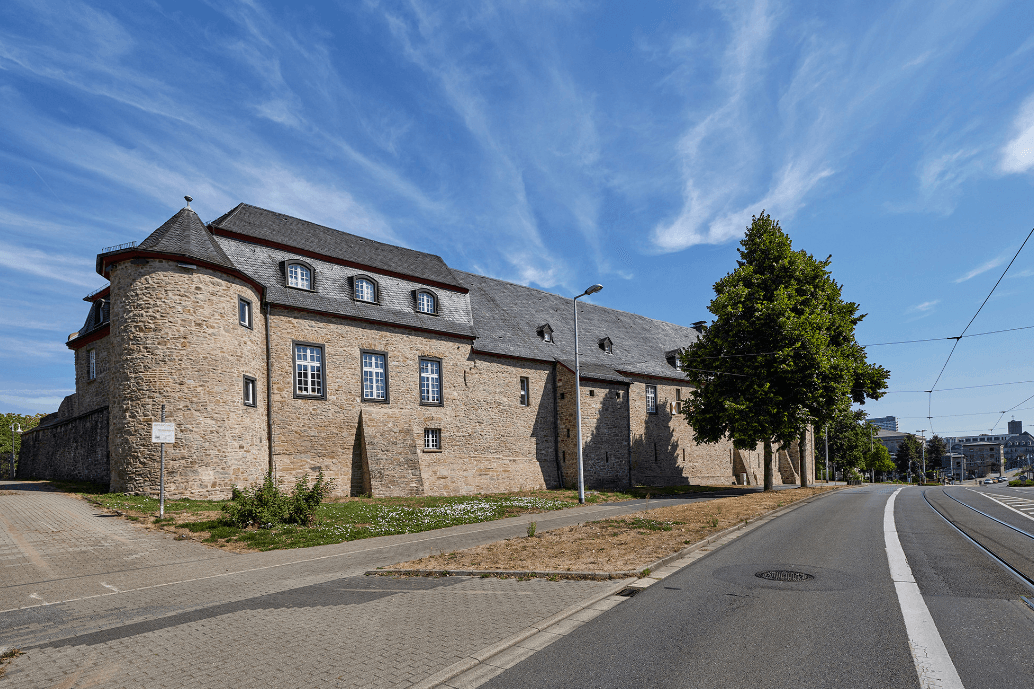
By the late 12th century, the castle underwent significant architectural reinforcement. The ring wall was rebuilt to a thickness of approximately 1.5 meters and raised to around 9 meters in height, enhancing its defensive capabilities. A northern zwinger, or outer ward space, was created as an additional layer of protection. The centerpiece of this phase was a massive bergfried—an imposing tower typical of medieval fortresses—rising about 17.4 meters. This stone keep served as a last refuge during attacks and a strong visual symbol of the castle’s strength.
Between 1380 and 1400, a prominent two-story Gothic palas was constructed along the southern castle wall, which had been partially demolished in earlier conflicts. This hall building featured characteristic stepped gables rising above the roofline and provided fortified but more comfortable residential space. During a major siege in 1443, the bergfried and a southwest tower were destroyed by fire, and heavy damage was inflicted on the ring wall and living quarters, rendering them uninhabitable. Repairs were made soon after, but the bergfried was not rebuilt and was instead dismantled as part of the restoration funded by the victorious forces.
In the early 1500s, modifications reshaped the castle’s entrance and internal structures. The northwest tower gate was sealed off, and the western ring wall was opened to create a larger, more accessible entrance. Between this area and the castle courtyard walls, a new two-story building was erected. Within the castle enclosure, three timber-framed houses were constructed, notable for their wooden frameworks visible in later records. A two-story stone residence was also added against the southern courtyard wall near the Gothic palas, further expanding domestic accommodations.
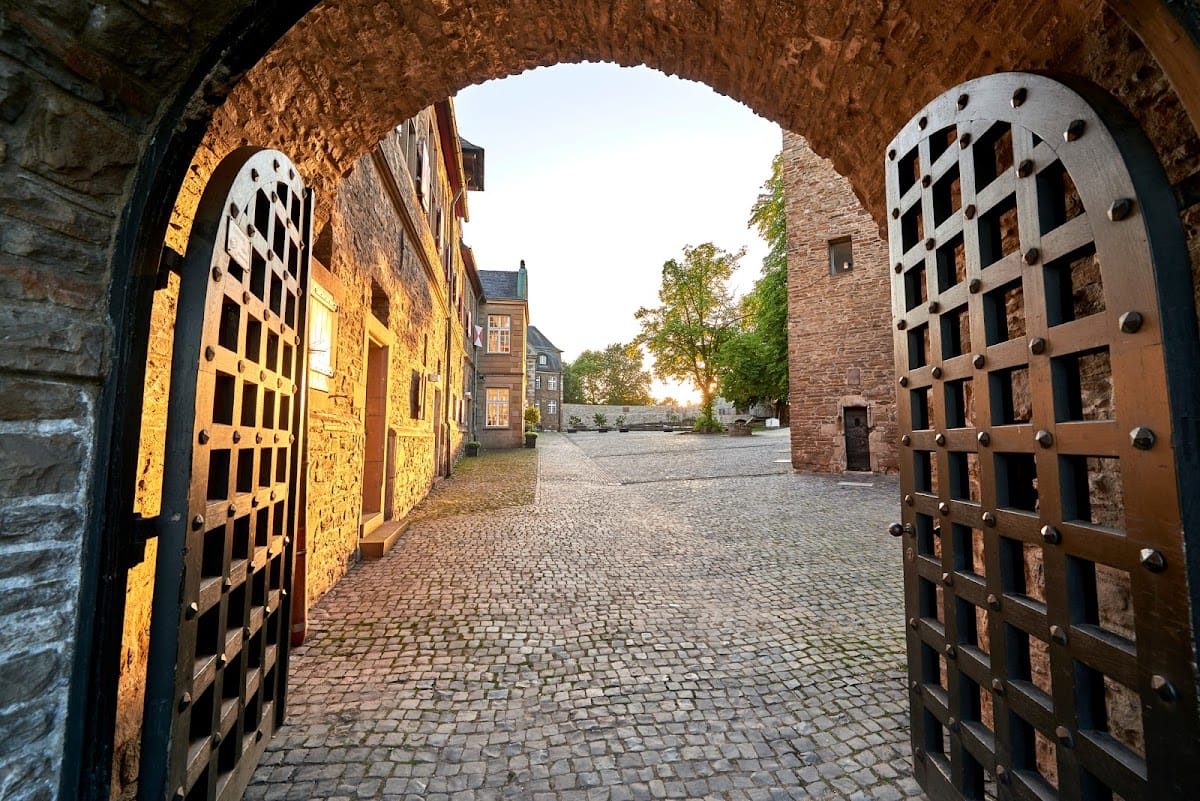
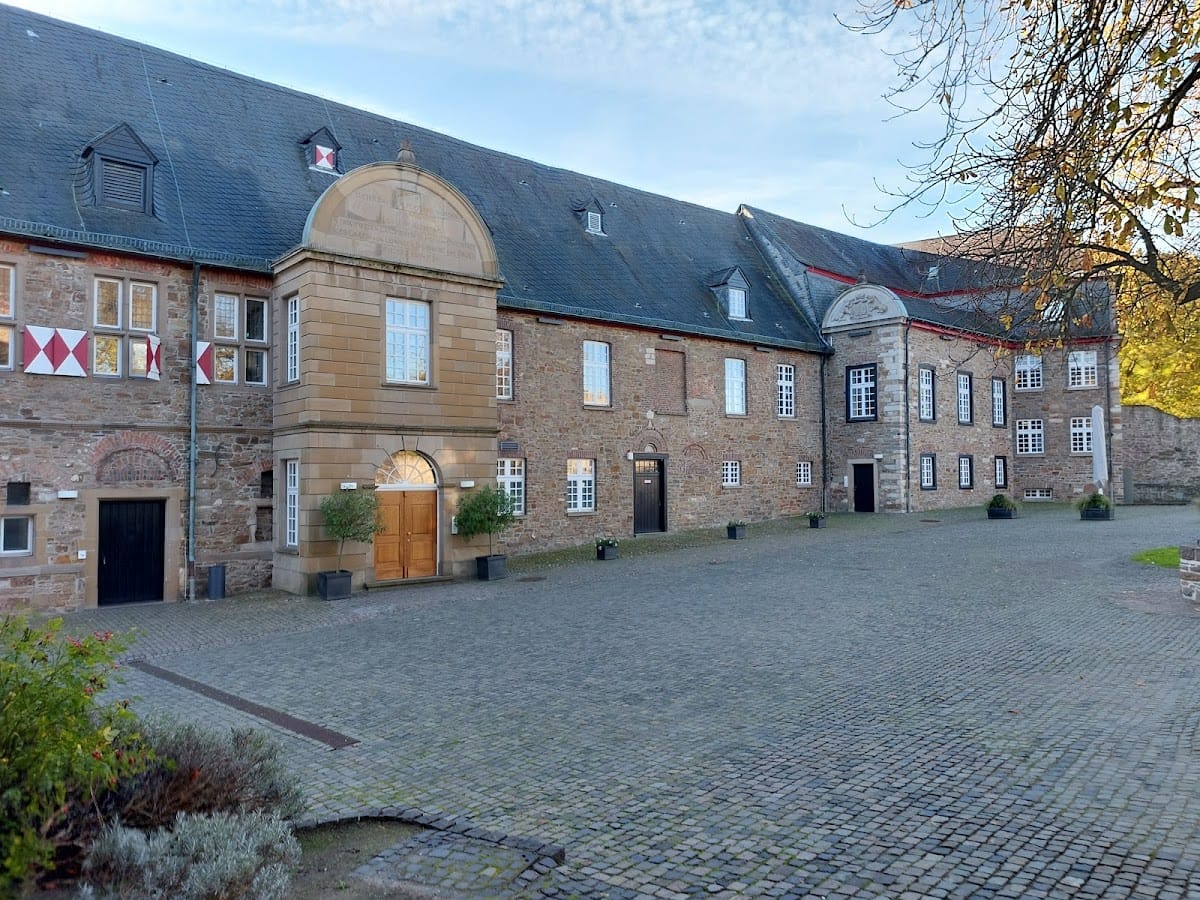
Mid-17th-century restoration under Count Wilhelm Wirich von Daun-Falkenstein brought renewed architectural features. The residential buildings were rebuilt and expanded, including the addition of a timber-framed upper story with a wooden gallery over the main gatehouse. This building, called the Hochschloss, displays Wilhelm Wirich’s coat of arms and an inscribed date of 1648 above the gate, bearing his full titles. Within the courtyard, a two-story palace wing featuring an octagonal stair tower was integrated with the existing Gothic palas and 16th-century dwellings, creating a unified residential complex. Further expansions included wings along the courtyard’s northern and western sides, and a large garden was laid out to the south. The main castle gate was extended outward by roughly 80 meters into the approach area.
A distinctive tower-like outer bailey with a surrounding moat was constructed northwest of the main castle during the same period, serving as an additional defensive element. However, this structure was later demolished in the 19th century during subsequent property changes.
In 1789, under the patronage of Maria Luise Albertine, parts of the west wing were rebuilt in the early classical style. The stair tower was also renewed at this time, replacing earlier medieval elements. This phase involved demolishing the northern courtyard wing. A commemorative inscription marks the entrance of the west wing, documenting this late 18th-century work.
The 19th century brought further changes with the removal of the timber-framed core structures. Eduard Stöcker, who acquired the castle in 1857, constructed a two-story neoclassical villa adjoining the Hochschloss, aligning with architectural tastes of that era and replacing earlier medieval fabric.
Archaeological excavations from 1967 to 1974 played a crucial role in uncovering the site’s layered history. These studies exposed foundations from the late Carolingian fortification, including the original ring wall and building layouts, along with remains of the later medieval defensive and residential structures. The excavations provided direct evidence of the castle’s complex development over more than a thousand years.
Recently, between 2010 and 2020, the ring wall underwent extensive restoration to address severe structural damage, including the replacement of large, falling stones. Today, the surviving elements of Schloss Broich include representative event spaces such as the knights’ hall, fireplace room, and coat-of-arms room, all housed within the restored medieval and early modern buildings. The Hochschloss houses the local history museum, and office spaces occupy the upper floors, maintaining continued use of this historic fortress in the heart of Mülheim an der Ruhr.
Nearby sites