Abbey Church of Santa Maria Assunta, La Spezia: A Catholic Church and Former Pro-Cathedral
Site at a Glance
- Rating
- 4.4
- Popularity
- Very Low
- Country
- Italy
- Primary era
- Medieval
- Eras represented
- Medieval, Early Modern, Modern
- Civilizations
- Genoese, Italian
- Site type
- Religious
- Remains
- Church
On this page25 sections
History
The Abbey Church of Santa Maria Assunta is a Roman Catholic church in La Spezia, Italy, dedicated to the Assumption of Mary, the Catholic belief that Mary was taken body and soul into heaven. Its foundation is traditionally placed in 1271, although the date is undocumented; the church is known to have existed by 1371. Its medieval fabric included late-Gothic features, and work on the rebuilt church continued until its Renaissance sandstone façade was completed in 1550.
Medieval foundation and reconstruction
In 1371, an agreement placing two local administrative districts under Genoese authority was signed inside the church. Santa Maria remained dependent on the older church of Marinasco until it became a parish in 1434.
In 1436, the church was demolished because its position beyond La Spezia’s defensive walls left it vulnerable to use as a military advance post. Niccolò Piccinino, a commander serving the Duke of Milan during fighting between Milan and Genoa, was the threat cited. The church was rebuilt on the same site in 1443, this time within an enlarged defensive circuit, and was consecrated in 1471. Construction continued into the sixteenth century, reaching the completion of the sandstone façade in 1550.
Parish status and nineteenth-century change
On 12 October 1685, the parish was raised to a provostship, a parish office led by a provost. A papal bull made it a collegiate church in 1712, giving it a formal group of clergy to serve the congregation. In 1734 it received the higher title of collegiate abbey church, and its parish priest became an abbot, a title the parish priest still holds.
Abbot Domenico Battolla led the church from 1850 to 1884 and directed extensive restoration between 1860 and 1872. His work in La Spezia also brought the Salesians, a Catholic congregation founded by John Bosco, and the Pious Franzonian Sisters, a Catholic women’s congregation, to the city. On 14 May 1858, he established a local charitable group of the Society of St Vincent de Paul.
Following a flood, Battolla arranged for the much-revered icon of Our Lady of the Snow to be moved in 1864 from its namesake oratory beside the Lagora stream to Santa Maria’s Chapel of the Holy Sacrament. It remained there until 1881, when it was transferred to the Salesians at their new church of Our Lady of the Snow.
Diocesan role, destruction and rebuilding
Pope Pius XI established the Diocese of La Spezia-Sarzana-Brugnato in 1927. A diocese is a territory of the Catholic Church overseen by a bishop. While a new cathedral was being planned, Santa Maria became the diocese’s pro-cathedral on 19 March 1929, serving as the bishop’s principal church until a cathedral was available. In 1927, architect Franco Oliva designed a new façade intended to respect the sixteenth-century design while better fitting the church’s larger scale.
In 1935, during Abbot Giovanni Battista Cafferata’s tenure, the sixteenth-century bell tower attributed to Simone da Pistoia was demolished. Its bell, affectionately called Lavezàa, meaning “cooking pot” in the local dialect, rang at noon to signal workers to stop and return home for lunch.
A bombing on 19 April 1943 destroyed almost all of the church. After the armistice and the end of hostilities, it was rebuilt and enlarged, with the naves extended toward Piazza Giulio Beverini. Oliva designed the replacement façade. Bishop Giuseppe Stella consecrated the reconstructed church on 20 November 1954; Abbot Cafferata celebrated the Mass in the presence of the seminary. On 8 December, Stella renewed the consecration of La Spezia and its diocese to the Immaculate Heart of Mary, a Catholic devotional title emphasizing Mary’s holiness and inner life.
Later worship and diocesan use
In the late 1950s, Abbot Antonio Mori placed a venerated wooden crucifix in a dedicated chapel. The community regarded it as miraculous and associated it with graces received during difficult periods in La Spezia’s history. Following the Second Vatican Council, the major Catholic Church council held from 1962 to 1965, Abbot Giacinto Bertonelli oversaw an interior reorganization by engineer Ferdinando Carrozzi. A new marble altar table was consecrated on 8 September 1969, and Abbot Dino Viviani later adapted the old pulpit as a raised stand for readings.
The inauguration of the new Cathedral of Christ the King of the Ages in 1975 ended Santa Maria’s role as pro-cathedral. Further major restoration took place under Abbot Monsignor Ilvo Corniglia. On 22 January 2012, Bishop Francesco Moraglia established a diocesan centre for Perpetual Eucharistic Adoration in the Chapel of the Holy Crucifix, where worshippers continuously pray before the Eucharist.
Remains
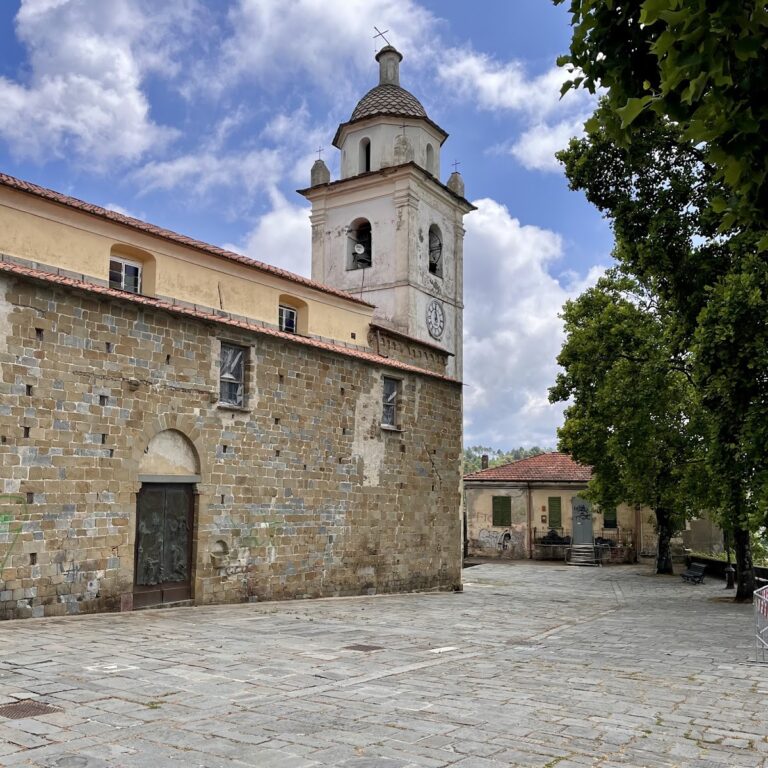
The present church has broad naves divided by columns, with two narrower aisles leading to raised chapels beside the presbytery, the area around the altar reserved for clergy. It is described as neo-Romanesque outside, a later revival of Romanesque architecture, and neo-Renaissance within, a revival of Renaissance design. Its vaulted ceiling has grey-stone ribs set against pale-yellow plaster.
Plan and surviving fabric
Present arrangement
The side chapels are arranged on both sides of the presbytery. The Chapel of Mercy is on the right and the Chapel of the Immaculate Conception on the left; the right side also contains the Chapel of the Sacred Heart, while the left has chapels dedicated to the Crucifix and Saint Joseph, patron saint of the city.
Earlier church and wartime remains
The earlier church had a Latin-cross plan, meaning a long central space crossed by shorter arms. Six columns, assembled from cylindrical sections of white Carrara marble, divided its three naves. The late-Gothic interior had vaulted ceilings supported by ribs, pointed arches, black-and-white wall bands and a central rose window, a large circular window. The 1943 bombing left a bell tower, part of the presbytery and the two columns facing it; those columns are the only ones identified as surviving from the original structure.
Façade and entrance
Façade
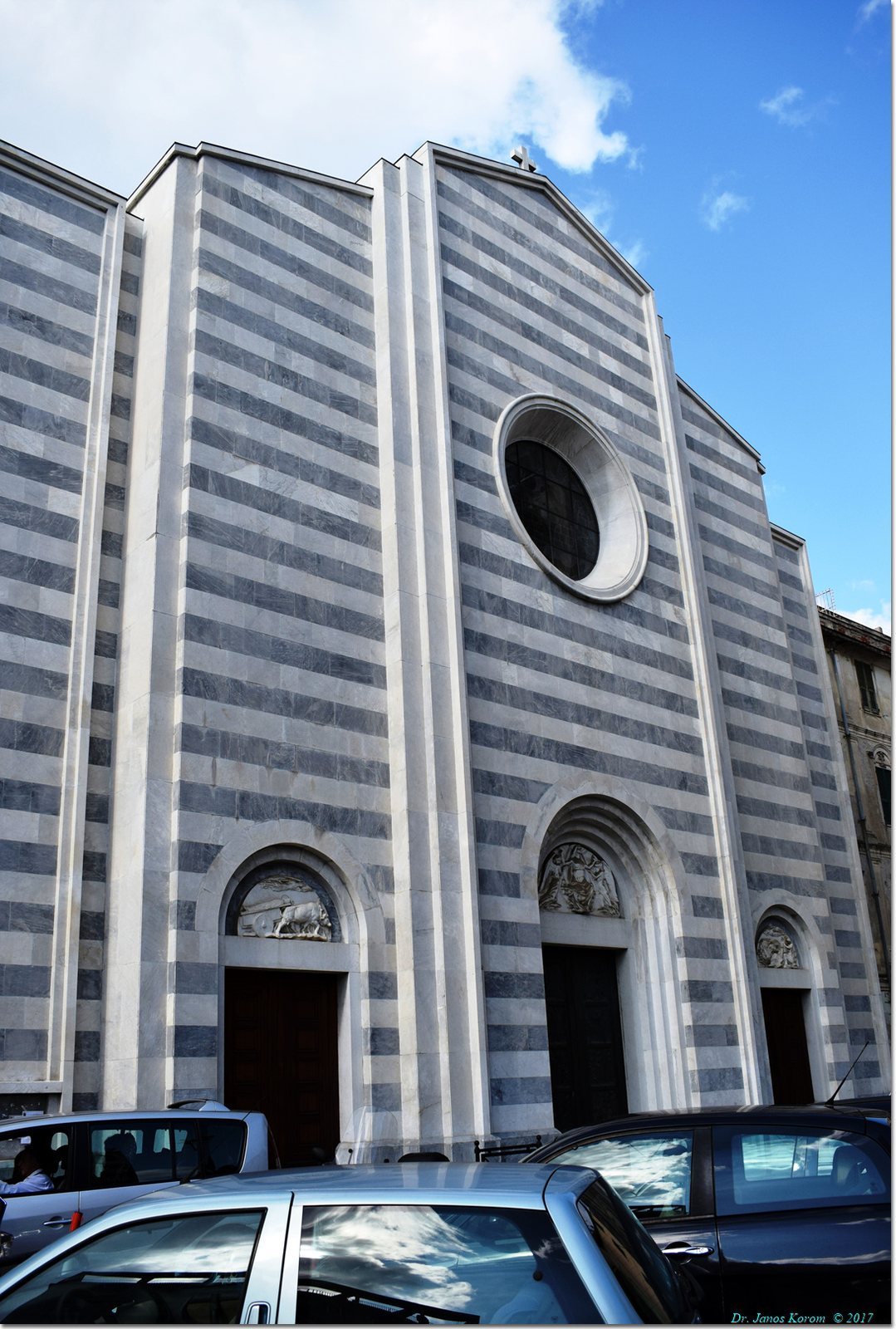
The baroque façade that stood before the war had pilasters, a central pediment, curved mouldings at the sides, a marble rose window and three entrances topped by semicircular marble panels. The postwar façade is divided into five sections, with its central three rising in steps. Coloured marble forms horizontal bands, and a flared circular opening takes the place of the former rose window. Above the three portals, marble panels by Angiolo Del Santo show, from left to right, the transport of Saint Terenzio of Luni’s remains, the Assumption of Mary and Saint Venerio driving away a dragon.
Door of Mercy
The central bronze entrance, called the Porta della Misericordia, was made by sculptor Guglielmo Carro and inaugurated in 1999. Its eight raised panels depict the seven acts of mercy and Pope John Paul II in prayer.
Chapels and altar furnishings
Chapel of the Immaculate Conception
The chapel, named for the Catholic doctrine that Mary was conceived without original sin, was decorated by Navarrini and has an altar by Baratta, dating to the seventeenth or eighteenth century. Its wooden crucifix, known as the Venerabile, was made by an unnamed Piedmontese sculptor in the second half of the fifteenth century. Restoration revealed its original appearance, including Christ’s strained face and arched body. A fluted holy-water stoup from the late fifteenth century stands at the entrance.
Chapel of Mercy
The Chapel of Mercy contains wooden sculptures and a marble altar that can be dated to the seventeenth century. Giovanni Battista Casoni’s painting of the Madonna of Mercy shows the Christ Child in glory holding Saint Bernardino’s initials, with the Madonna, John the Baptist, Joseph, Bernardino and other Franciscan saints around them.
Chapel of the Sacred Heart
La Spezia painter Luigi Agretti created the chapel’s frescoes in the 1930s. It also contains a marble statue of Christ the Redeemer, made by Angiolo Del Santo in 1936.
Presbytery altar
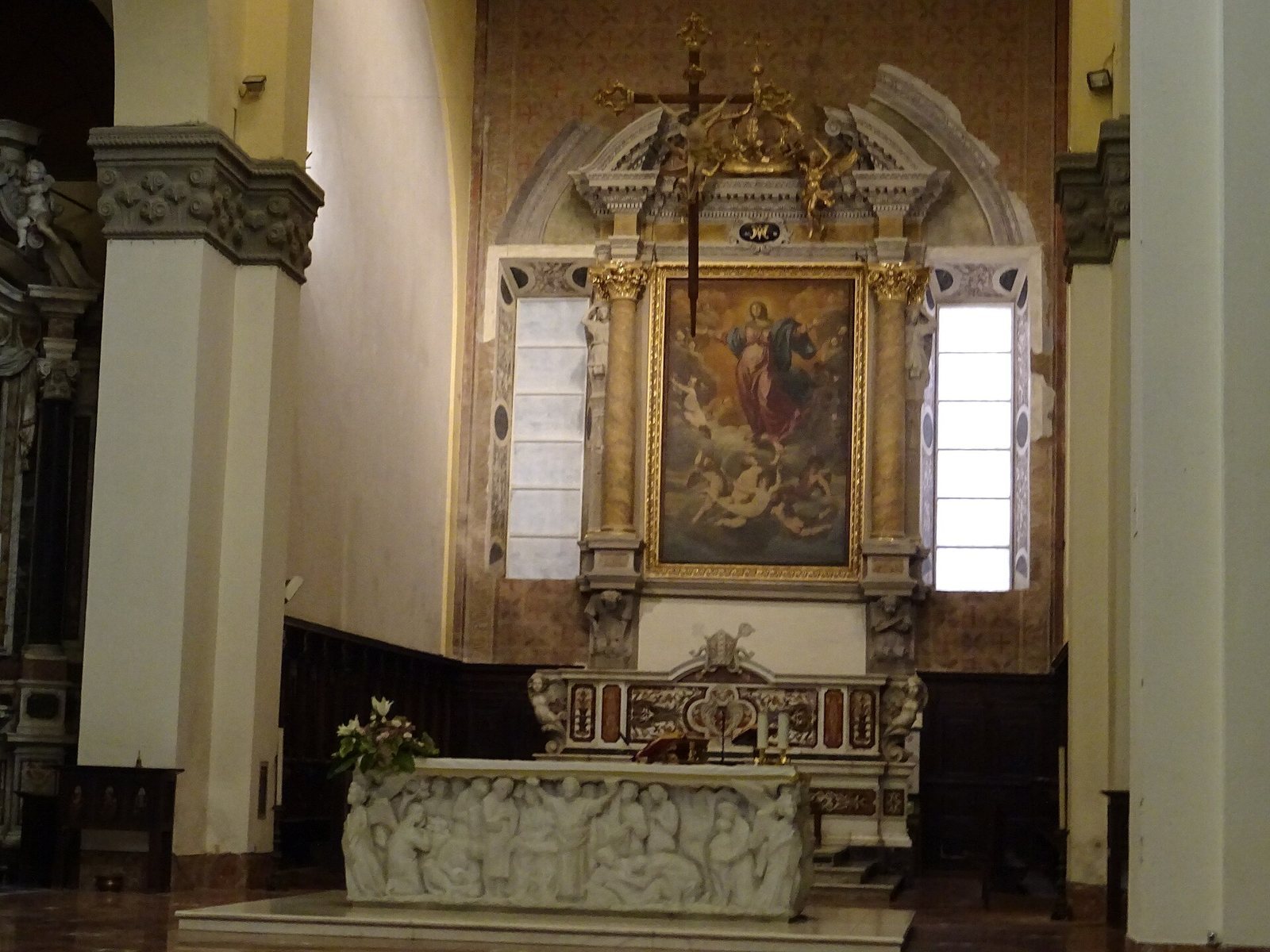
Ferruccio Vezzoni of Pietrasanta carved the marble altar table from a single block. One side depicts themes from the Old and New Testaments, and the other relates to the Second Vatican Council. The old pulpit is now used in the presbytery as an ambo, a raised stand for proclaiming readings.
Artworks and memorials
Coronation of the Virgin
The left nave contains a multicoloured glazed-clay relief of the Coronation of the Virgin, about three metres high and roughly 2.5 metres wide at its base. It was once attributed to Luca della Robbia and is now assigned to his nephew Andrea della Robbia. The Virgin appears among angels before the enthroned Lord, who crowns her; a dove representing the Holy Spirit occupies the centre. Below are six saints, including Francis, Bernardino, Anthony, John the Baptist and Mary Magdalene. A raised garland of fruit and leaves frames the scene.
The relief came from the choir of San Francesco Grande. It was seized in 1814 during confiscations under Napoleonic rule and taken to Arles. After Napoleon’s defeat, the mayor sought its return from Victor Emmanuel I, then King of Sardinia, and the work came back to La Spezia in 1817 for installation on Santa Maria’s altar of Mercy. The friars reclaimed it in 1823 and kept it until their convent was demolished in 1863 to make way for the military arsenal. The state then assigned it to the Ligurian Academy of Fine Arts until 1892, after which it went to Genoa’s Palazzo Bianco museum. Following intervention by Marquis Da Passano and the Society for Moral and Industrial Encouragement of La Spezia, it returned to the city and was installed in the left nave in 1904.
Paintings from other churches
Several works came from churches suppressed or demolished during the late nineteenth and early twentieth centuries, as redevelopment, road building and construction of the military arsenal altered the city. A large 1642 Multiplication of the Loaves and Fishes by Giovan Battista Casone, originally from the San Francesco convent refectory, hangs on the inner entrance wall. Andrea Semino’s late-sixteenth-century Annunciation is on the left side. The left wall also displays Aurelio Lomi’s seventeenth-century Miracles of Saint Diego.
Two paintings by Giuseppe Palmieri, Saint Francis in Ecstasy and Saint Francis in Prayer, are in the right nave, alongside Luca Cambiaso’s Martyrdom of Saint Bartholomew, which includes a portrait of the armed commissioner. A large painting of the Assumption hangs behind the eighteenth-century wooden choir. Dated to the sixteenth or seventeenth century and long attributed to Domenico Fiasella, it is a work from his workshop; its subject reflects the church’s dedication.
Funerary chest and sculptures
The first bay of the left nave contains a fifteenth- or sixteenth-century funerary chest for Francesca Malaspina da Mulazzo and her husband Baldassarre Biassa, a La Spezia commander of the papal fleet. It rests on supports carved as lions, and its front bears worn inscriptions and coats of arms. Nearby are a marble statue of Saint Anthony the Abbot attributed to Fabio Del Medico and a marble statue of Our Lady of Mount Carmel by Carlo Tantardini.
Baptistery
Within the baptistery enclosure are a sixteenth-century baptismal font and Bartolomeo Guidobono’s painting Madonna of the Milk.
Music and organ
Musical chapel
Founded in the late sixteenth century, the church’s musical chapel remained active for at least 370 years, providing music for civic religious life. Church records preserve its activity, including original compositions and sacred orchestral works printed or written by hand during the nineteenth and twentieth centuries. Its chapel master Domenico Cortopassi composed a Pastorale, a Mass for Christmas 1936 and the four-voice Mass performed at the church’s 1954 consecration.
Pipe organ and other furnishings
The Milanese firm Balbiani Vegezzi-Bossi built the pipe organ in 1932. It has undergone several alterations and restorations and now has electric transmission, two keyboards of 61 notes each and a concave-radial pedalboard with 32 notes. Other furnishings include a cross and a voice-amplifying fixture by La Spezia sculptor Claudio Ambrogetti.