Santo Stefano: A Medieval Pieve and Catholic Church in La Spezia


Site at a Glance
- Rating
- 4.4
- Popularity
- Low
- Country
- Italy
- Primary era
- Medieval
- Eras represented
- Medieval, Early Modern
- Civilizations
- Holy Roman Empire
- Site type
- Religious
- Remains
- Church
On this page13 sections
History
Santo Stefano is a Catholic church in Italy, located at Marinasco above the northern part of La Spezia. The present building dates no earlier than the thirteenth century, with construction also placed around 1200, and combines Gothic-Cistercian architecture with earlier Romanesque elements. It developed as one of the five ancient pievi of the Diocese of Luni, the medieval ecclesiastical jurisdiction centered on Luni and extending around the Gulf of La Spezia.
Medieval pieve of Marinasco
A pieve was a rural church with pastoral and often administrative authority over surrounding settlements and dependent chapels. The Marinasco pieve probably grew from an older territorial organization and may have been associated with the late Roman pagus system, a network of rural territorial districts. Its medieval jurisdiction extended westward beyond the gulf to Riomaggiore, Manarola, and probably Portovenere.
The first certain record of the Pieve of Marinasco dates to 950, when its archpriest Berulfo signed a document with representatives of the church of Santa Maria of Luni. In 1094, Archpriest Azone witnessed a record of a donation by Marquis Oberto and his mother, Countess Giulietta, the widow of Marquis Alberto Ruffo d’Este, to the monastery of San Venerio del Tino. The properties at Marnasco lay beside the pieve of Santo Stefano, and the transaction was made under Lombard law during the Frankish imperial period.
A papal document of 1154 lists the pieve of Marinasco after Saint Peter in Portovenere. The order of the entry indicates an institutional connection between the two ecclesiastical territories. The church that stands today belongs to the Diocese of La Spezia-Sarzana-Brugnato and is included in Italy’s General Catalogue of Cultural Heritage.
Reorientation and stabilization
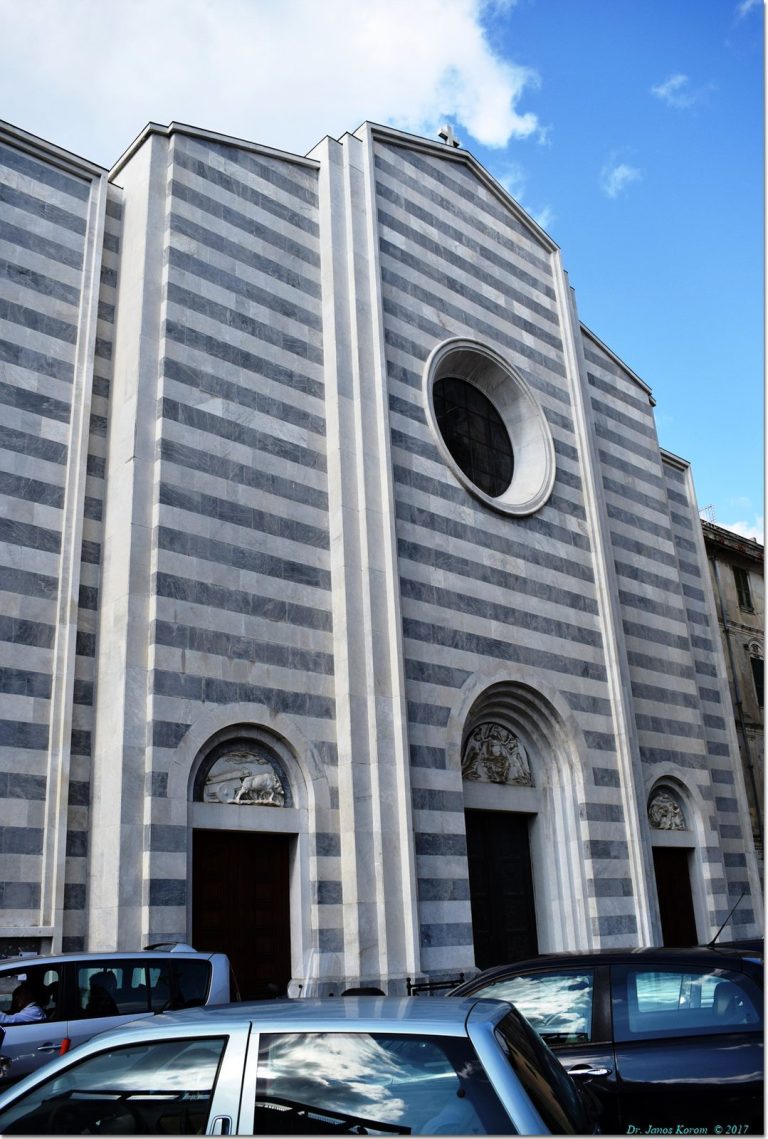
At the end of the eighteenth century, concern over the building’s structural stability led to a major reorganization. The original façade was demolished, a new apse was constructed for the choir and altar, and the former apse was transformed into a pronaos, an entrance porch before the main church interior.
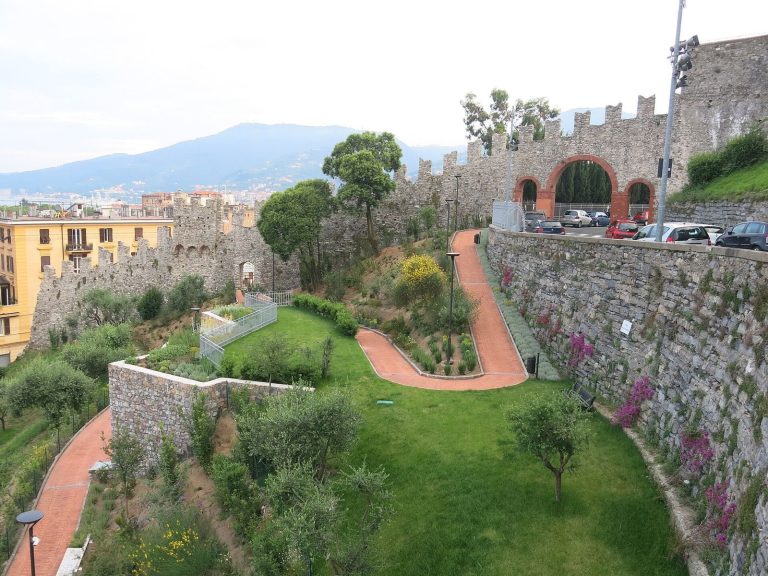
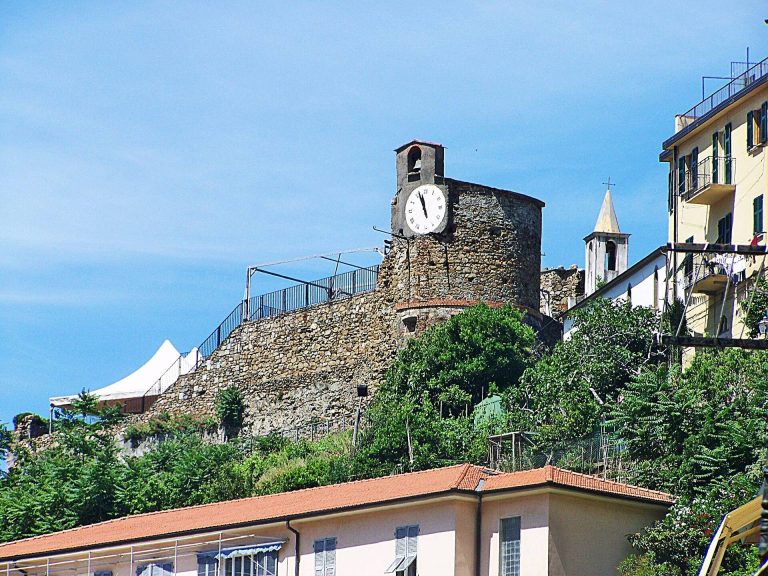
Unstable ground also required the construction of a retaining wall to support a new forecourt. The bell tower was erected in 1780 as part of the effort to reinforce the building. Its vivid colors made it a landmark for navigators checking their bearings in the gulf.
Remains
Santo Stefano stands in the historic center of Marinasco as a three-naved basilica. Four piers, each enclosing four sandstone columns, divide the interior. The church combines squared sandstone blocks from the nearby hills of Valdipino and Casella with bluish limestone from Monte Parodi, reused from an earlier religious structure. The building’s medieval fabric is therefore interwoven with material from an older phase.
Medieval structure and carved details
Naves, arches, and stonework
The church’s basilical plan and internal supports organize the space into a central nave and two lateral naves. Four internal arches are probably Romanesque and may also be made of sandstone, although late-Baroque decoration dating to 1780 conceals them. Romanesque remains are visible around the central portal, which now occupies the position of the former apse.
Doorways and holy-water basin
Sandstone arches frame the lateral entrance doors. One lateral doorway has an architrave carved with a small head, a lamb, a lion, and another unidentified animal. A carved capital has been incorporated into the wall on the right side and hollowed out for use as a holy-water basin.
Interior furnishings and later additions
Marble Madonna and baptistery
A thirteenth-century marble tabernacle once stood in the demolished façade or on an altar. Its surviving Madonna is now placed on the baptistery and is attributed to the school of Nino Pisano, a fourteenth-century Italian sculptor associated with the Pisan tradition. The attribution indicates a stylistic connection rather than confirmed authorship by Nino Pisano himself.
The Madonna is about one metre high and carved from white marble. Mary holds the Child on her left arm and a flowering branch in her right hand. The Child holds a small bird, while traces of color remain on the branch. The Virgin wears a crown, a mantle bordered at the front by a frieze, a belt, and a flower-shaped ornament on her chest. The baptismal font bears the date 1463.
Paintings and bronze portal
The church contains eighteenth-century sacred paintings and Stations of the Cross. Its lateral portal is closed by bronze doors made by Pietro Ravecca, whose reliefs depict the Martyrdom of Saint Stephen. Saint Stephen was an early Christian deacon traditionally regarded as the first Christian martyr, and churches dedicated to him commonly bear the Italian name Santo Stefano.
Forecourt, bell tower, and adjoining hall
Bell tower and retaining wall
The 1780 bell tower and the retaining wall supporting the forecourt belong to the church’s eighteenth-century stabilization works. Together they reflect the physical challenges that led to the reorientation and reinforcement of the building.
Adjoining exhibition hall
An adjoining hall forms part of the church complex and is frequently used for exhibitions of visual art.