Ryūsen-ji Temple: A Tendai Buddhist Temple in Tokyo


Site at a Glance
- Rating
- 4.3
- Popularity
- Medium
- Country
- Japan
- Primary era
- Early Modern
- External website
- Open
- Eras represented
- Early Modern
- Civilizations
- Tokugawa
- Site type
- Religious
- Remains
- Temple
On this page15 sections
History
Ryūsen-ji Temple is a Tendai Buddhist temple in Tokyo, Japan, traditionally founded in 808 and devoted principally to Fudō-myōō, a Buddhist protector associated with defeating evil and maintaining unwavering resolve. It is widely known as Meguro Fudō, while its formal name is Taieizan Ryūsen-ji. The traditional account connects its foundation with Ennin, a prominent ninth-century Tendai monk, although the historicity of this story remains uncertain.
Traditional Foundation and Early History
According to temple tradition, the 15-year-old Ennin encountered a visionary figure while traveling from Shimotsuke Province toward Mount Hiei, the principal center of Tendai Buddhism in Japan. The figure identified itself as a protector who would overcome evil and bring peace to the country. Ennin then carved an image resembling it and enshrined the resulting statue of Fudō-myōō.
The same tradition says that Ennin cast a tokko, a Buddhist ritual implement commonly represented as a vajra, into the ground. A spring emerged at the spot and became known as the Tokko Waterfall. The feature gave the temple its name, Ryūsen-ji, meaning a temple associated with a dragon waterfall. Records from 860 state that Emperor Seiwa authorized a change to the temple’s mountain name, which became Taieizan. Ryūsen-ji then disappears from the historical record for several centuries before reappearing in the early Edo period.
Reconstruction under the Tokugawa Shogunate
The main hall burned in 1615. In 1630, under the direction of Tenkai, a leading Tendai monk of the early Edo period, Ryūsen-ji became a subsidiary temple of Kanei-ji. It was placed under joint administration with Gokoku-in, another Kanei-ji subsidiary, and a disciple of Tenkai served both institutions.
With the patronage of Tokugawa Iemitsu, the third shogun of the Tokugawa shogunate, the complex was restored in 1634 and expanded to approximately 53 buildings. Its lavish appearance led to the name “Meguro Palace.” A later tradition explains Iemitsu’s support through a miraculous episode during a hawking excursion in Meguro. After praying before the temple’s Fudō, he is said to have recovered his favorite lost hawk at the Taka-oi Pine in front of the main hall.
Edo-Period Religious and Popular Life
Ryūsen-ji became a destination for both pilgrimage and recreation during the Edo period. Its springs and waterfall were believed to possess healing powers, and bathing in them was said to cure illness. The temple appeared in the Edo meisho zue, a guide to notable places in Edo, while a busy settlement developed around its entrance. Restaurants, shops selling souvenirs, and other businesses extended from the present-day Gyōnin-zaka area toward the temple gate.
A lottery held at Ryūsen-ji in 1812 became known as one of the “Three Great Lotteries of Edo.” It ended in 1842 during the Tenpo Reforms, a series of measures intended to regulate society and public expenditure under the Tokugawa government. The temple approach was also associated with the Old Man’s Teahouse, traditionally identified as the setting for the rakugo story “Meguro’s Pacific Saury.” Local commerce included bamboo products, bamboo-shoot dishes, bamboo-shaped sweets, mochi flowers displayed on thin bamboo, millet cakes, and Meguro candy. Bamboo shoots had become a commercial crop after being introduced from Satsuma Domain during the Edo period.
One traditional explanation for the name Meguro derives it from the temple’s black-eyed Fudō, one of five protective Fudō statues associated with different colors and with the outskirts of Edo. This remains a theory rather than an established fact. Ryūsen-ji is also traditionally associated with the graves of the lovers Hirai Gonpachi and Komurasaki, whose story was adapted in numerous kabuki plays. Another association links the temple with the friendship between the Filipino national hero Jose Rizal and Seiko Usui, known as Osei-san, the daughter of a samurai.
Fire and Continuing Religious Associations
A fire in May 1978 destroyed the main hall and memorial hall. The principal Fudō image was carried outside and survived, but most of the buildings now visible at Ryūsen-ji date from the modern period. The temple remains associated with several established religious traditions. It is counted among the Three Great Fudō temples of Edo and the Five Colored Fudō temples of Edo. It is also the 33rd station of the Edo Thirty-three Kannon pilgrimage, the 18th temple of the Kantō Thirty-six Fudō pilgrimage, and a site on the original Yamanote Seven Lucky Gods circuit, where it represents Jūrōjin.
Remains
Terraces and Temple Approach
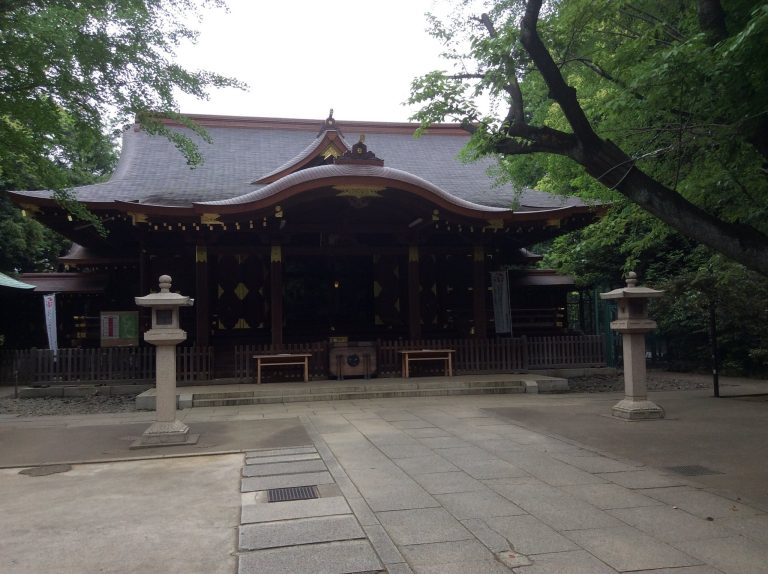
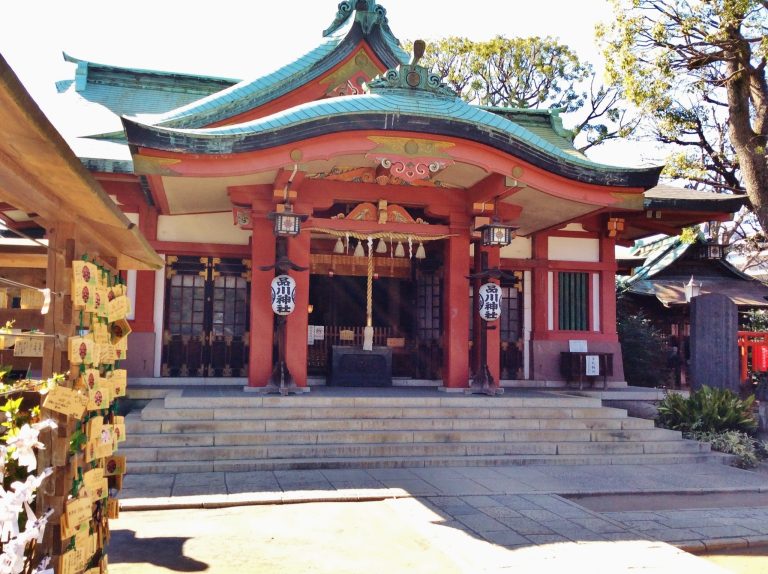
Ryūsen-ji occupies the boundary between a plateau and level ground, and its precinct is arranged across two terraces. The lower level contains the Niōmon, a temple gate traditionally guarded by two fierce Buddhist figures, together with related buildings. The upper level contains the main hall. This arrangement gives the precinct a clear change in elevation between its entrance area and principal worship space.
Niōmon and Staircase
After the Niōmon, a steep stone staircase leads directly toward the main hall. The staircase forms the central approach through the two-tiered precinct, with halls and the Tokko Waterfall positioned to either side. The surviving arrangement preserves the relationship between the lower entrance terrace and the upper level of the temple.
Halls beside the Approach
The Tokko Waterfall, the Front Fudō Hall, and the Seishi Hall stand to the left of the staircase. On the right are the study hall, a shoin or study and reception hall, together with the Jizō Hall, Kannon Hall, and Amida Hall. Most of these visible structures belong to the modern period because of the destruction caused by the 1978 fire.
Worship and Historic Structures
Fudō Image and Tokko Waterfall
The principal object of worship is a hidden sacred image, or hibutsu, of Fudō-myōō. It holds the Amakuni Treasure Sword, a sword associated with subduing demons. The Tokko Waterfall is the spring traditionally linked with Ennin’s ritual tokko. This natural feature gave the temple its name and remains part of the physical setting of the worship precinct.
Seishi Hall
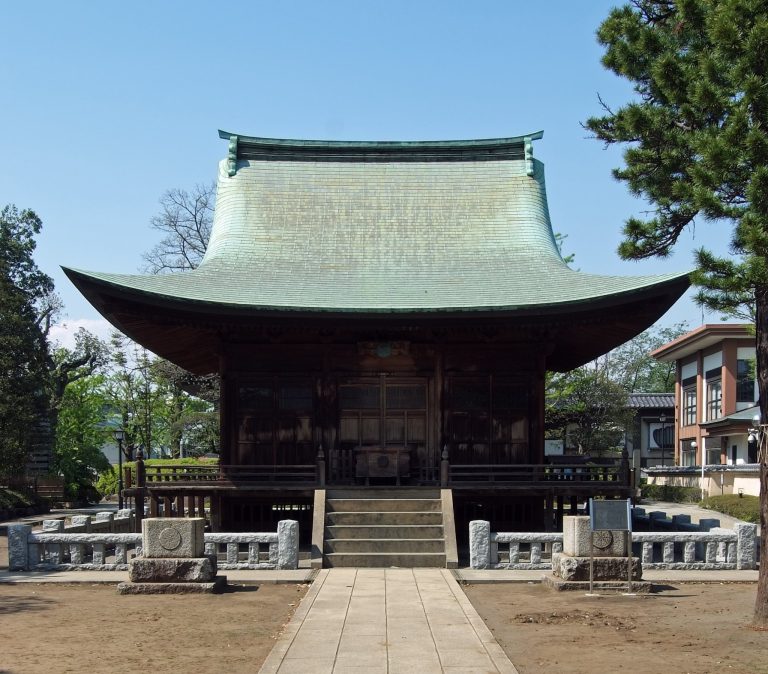
Built in the middle of the Edo period, the Seishi Hall is one of the few Edo-period structures to survive the 1978 fire. It is a designated tangible cultural property of Meguro Ward. Its survival provides a direct physical link with the temple complex of the Edo period, while the main hall and memorial hall were rebuilt or replaced after their destruction.
Graves and Memorials
Aoki Konyō’s Grave
The temple grounds contain the grave of Aoki Konyō, an Edo-period Confucian scholar and agricultural advocate associated particularly with the spread of sweet-potato cultivation in Japan. His grave is a simple stone monument engraved with the words “Tomb of Master Konyō.” It is said to have been erected by Konyō during his lifetime. The grave was designated a National Historic Site in 1943.
Other Memorial Monuments
A memorial monument to the composer Nagayo Motoori stands near the temple. The grounds also contain a memorial monument to the prewar political philosopher Ikki Kita. Kita’s grave is in the temple cemetery, which also contains the grave of Shumei Okawa, the writer of the inscription on Kita’s memorial monument.