Motoyama-ji Temple: A Koyasan Shingon Buddhist Temple in Japan


Site at a Glance
- Rating
- 4.3
- Popularity
- Low
- Country
- Japan
- Primary era
- Medieval
- External website
- Open
- Eras represented
- Medieval, Early Modern, Modern
- Civilizations
- Ashikaga shogunate, Japanese, Kamakura shogunate, Tokugawa
- Site type
- Religious
- Remains
- Monastery
On this page20 sections
History
Motoyama-ji Temple is a Koyasan Shingon Buddhist temple in Mitoyo, Kagawa, Japan, traditionally founded in 807 during the Heian period. It is also called Shippōzan and Jihōin, and serves as temple 70 on the Shikoku Pilgrimage and temple 29 on the Shikoku Thirty-Six Fudo pilgrimage. These affiliations place it within major pilgrimage traditions associated with Kūkai, the monk who founded Shingon Buddhism and established its monastic center on Mount Kōya.
Foundation and medieval prosperity
Temple tradition attributes the foundation to Emperor Heizei, who ordered its establishment in 807, and to Kūkai, who founded it as Chōfuku-ji. Kūkai is said to have carved the hidden principal image, a Hayagriva, a powerful horse-headed Buddhist protector also known in Japan as Batō Kannon. Amitabha and the Medicine Buddha were placed as attendant figures. The same tradition says that the original Main Hall was completed in a single night.
During the medieval period, Motoyama-ji controlled estates assessed at 2,000 koku, a measure of agricultural production, and twenty-four subsidiary temple residences. Its landholdings and network of affiliated residences made it a large and prosperous religious institution.
Survival during the provincial wars
In the wars of the Eiroku and Tenshō periods, most major temples in Sanuki Province were burned. Motoyama-ji survived under the influence of the Kagawa clan. An early marriage alliance between the Kagawa and Chōsokabe clans included an agreement of non-aggression, which helped protect the temple. Excavation at the site has found no traces of burning.
A different tradition describes an encounter with invading soldiers. According to the story, the troops entered the precinct despite the abbot’s resistance. When they opened the sanctuary of the Main Hall, blood supposedly fell from Amitabha’s body. Frightened, the soldiers withdrew without burning either the Main Hall or the Niōmon Gate, the entrance gate flanked by two guardian figures. The image thereafter became known as the “Amitabha who received the sword.”
Expansion and renewal in the early modern period
Pilgrimage records from 1653 and 1687 mention the Main Hall, Niōmon Gate, and bell tower. By the eighteenth century, the precinct had developed approximately its present arrangement, apart from the later five-story pagoda. An illustrated guide of 1800 shows the Daishidō, completed in 1795, the Jūōdō from 1759, the Dainichidō, the Chinjū-dō, and the Kōshin-dō, built in 1730.
The lords Ikoma and Kyōgoku supported the temple’s revival during the Edo period. During the Tenpō era, the temple took the name Motoyama-ji from the local place-name. Its principal image, buildings, and Buddhist images were opened to public worship from 3 March to 3 April 1805 in an event involving the surrounding village.
Fire damaged the abbot’s quarters and kitchen in 1854, and these buildings were rebuilt in 1867. The late-Edo guest hall and kitchen are likewise associated with rebuilding after a fire. These changes formed part of the temple’s continuing reconstruction before the modern period.
Modern construction and religious continuity
Work on the five-story pagoda began in 1896. Its completion was marked by an inauguration ceremony on 10 December 1910, attended by 50,000 people. The pagoda was later dismantled and repaired between 17 September 2015 and 9 April 2019. Among the Five Wisdom Buddhas formerly enshrined on its first story, a new central image of Mahavairocana in the Womb Realm was made after the earlier image had been lost. Its consecration took place on 5 November 2023.
Motoyama-ji continues several religious practices. The annual cucumber purification rite takes place on the Day of the Ox in the seventh month. Monthly goma rites, in which offerings are burned before a sacred image while prayers are recited, are held at the Jūōdō. Zennyo Ryūō is opened for worship every twelve years in the Year of the Dragon, most recently in 2024.
The Main Hall is a National Treasure. The Niōmon Gate is an Important Cultural Property, while the Daishidō, Jūōdō, Dainichidō, treasure storehouse, bell tower, main gate, and beam gate are registered tangible cultural properties. The Chinjū-dō, images of Zennyo Ryūō, Kongōrikishi, and Aizen Myōō, and the temple’s sutra-printing blocks have prefectural cultural-property status. Five stone gorintō, memorial monuments made from five stacked elemental forms, have municipal designation.
Remains
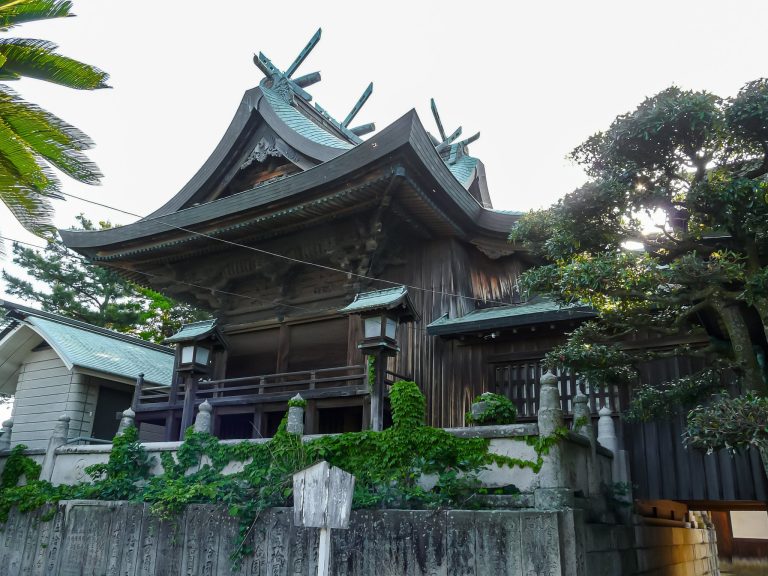
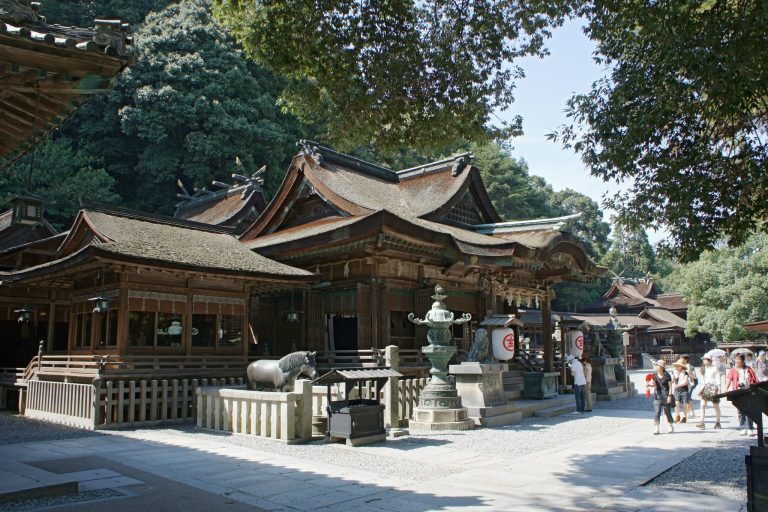
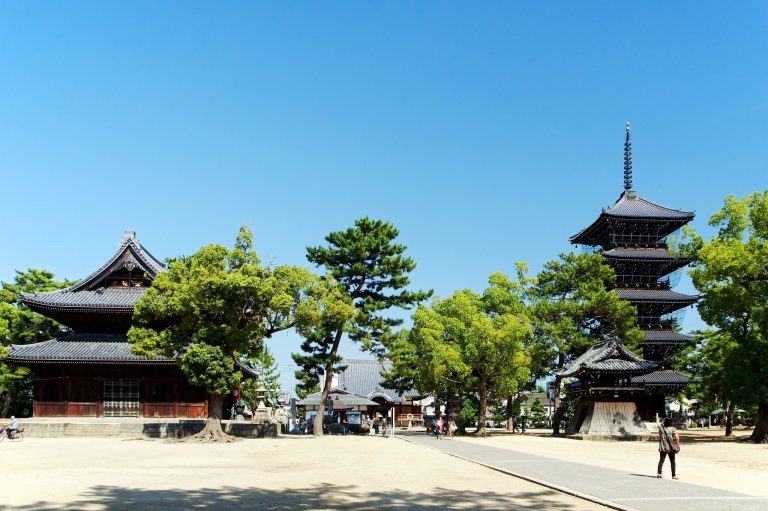
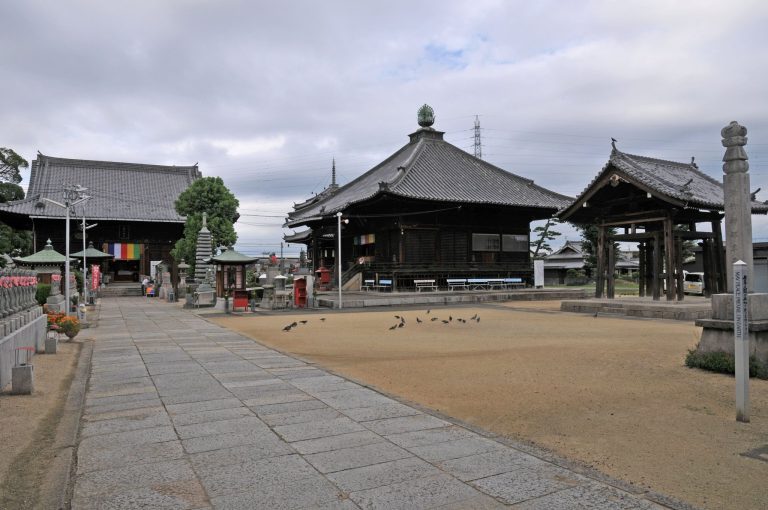
The principal precinct is organized along an eastward approach from the main gate. The Niōmon stands before the central group, with the Main Hall at the rear, the Daishidō to its right, and the Jūōdō to its left. The five-story pagoda stands beside the Main Hall. North of these buildings, another gate leads to the abbot’s compound and its attached guesthouse. The buildings combine architectural forms from several periods, preserving a layered view of the temple’s development.
Central worship buildings
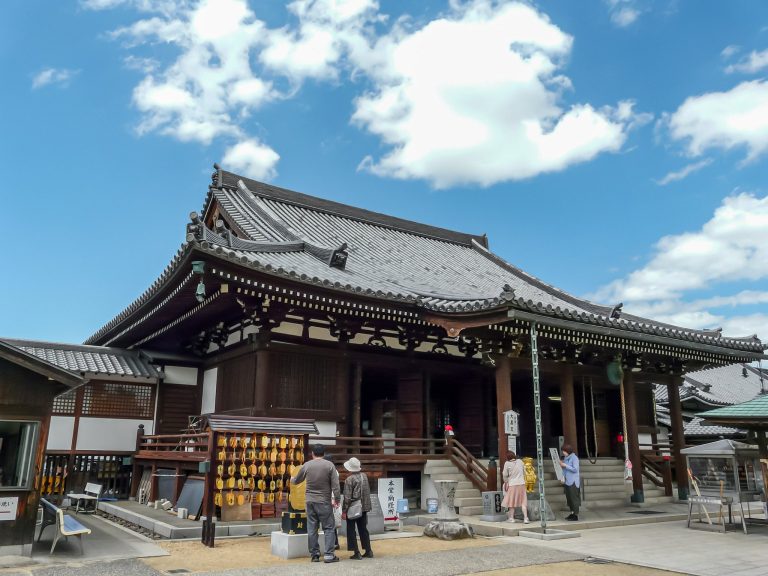
Main Hall
The Main Hall is a precisely square structure of five by five ken, with each ken representing a traditional structural bay. It measures approximately 14.5 metres on each side. The present building began to be rebuilt in 1300 after the earlier hall was lost in 1291. The names Suekiyo and Kunishige survive as those of its builders. Its design uses a mixed architectural style.
The principal image and its attendant figures are sealed inside a small sanctuary and are not ordinarily opened. A front image of Hayagriva, traditionally attributed to the sculptor Kitagawa Unchō and made by copying the hidden image’s form and dimensions, was displayed in 2014. This Edo-period sculpture is normally kept beside the sanctuary as another hidden image. In the rear left of the Main Hall is a seated Aizen Myōō from the late Heian period. The joined-cypress sculpture has carved eyes, while its coloring and ornaments date from the Edo period.
Niōmon Gate
The Niōmon is an eight-legged gate, supported by four additional posts on each side beyond its principal structural posts. It has a hipped-and-gabled roof and a mixed architectural style. Two standing temple guardians occupy the gate, reinforcing its role as the protected entrance to the central precinct.
Daishidō
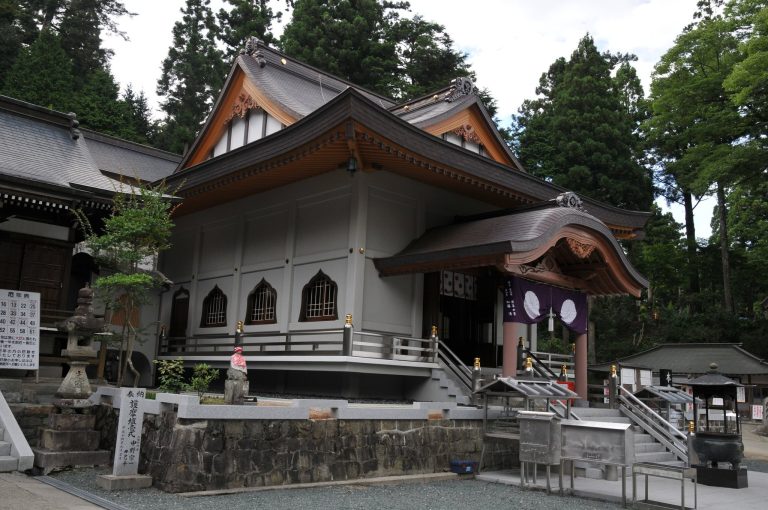
The Daishidō stands to the right of the Main Hall. Built in 1795 and repaired in 1883, it is a three-bay building with a hipped-and-gabled roof. It houses an image of Kūkai. The image was opened for worship in 2014 and is subsequently opened on the twenty-first day of each month.
Jūōdō
The Jūōdō stands to the left of the Main Hall. Its five-bay building was constructed in 1759 and repaired in 1993. The Ten Kings, judges of the dead in East Asian Buddhism, are arranged on the right. On the left are a seated Amitabha preaching image and a three-faced Daikokuten, a Buddhist deity associated with prosperity and good fortune. A fire-ritual hall added at the rear in 1996 contains a standing Fudō Myōō carved by Kondō Taizan in 1935.
Pagoda and historic subsidiary halls
Five-story pagoda
The five-story pagoda rises beside the Main Hall. From its foundation stones to the tip of its finial, it measures 31.75 metres. Its first story formerly housed the Five Wisdom Buddhas, each carved from a single cypress trunk with carved eyes and an antiqued surface treatment. The central Mahavairocana image associated with the Womb Realm was newly made after the original was lost.
Dainichidō
The Dainichidō, also called the Red Hall, dates from the middle of the Muromachi period. It houses Dainichi Buddha of the Diamond Realm. Standing guardian figures of Jikokuten and Tamonten, both made during the Kamakura period, protect the hall. These guardian kings are traditionally associated with defense of the Buddhist realm.
Chinjū-dō
The Chinjū-dō dates from the sixteenth century. Ink inscriptions on the building record the years 1543 and 1547, while its roof has been restored with cedar-bark shingles. The hall houses the Five Guardian Gongen, Buddhist-shinto manifestations associated with local protective deities. The group includes three Hachiman deities, Tenjin, and the deity of Suwa.
Images, memorials, and other features
Zennyo Ryūō
Zennyo Ryūō was once enshrined in a hall on the riverbank south of the temple, where prayers for rain addressed severe water shortages. After that hall disappeared, the image was placed with the Chinjū-dō and later moved to the treasure storehouse. The wooden statue dates from the Northern and Southern Courts period. It was made from joined cypress blocks, has crystal-inlaid eyes, and measures 47.5 centimetres in height.
Memorial and worship halls
The Manchurian Settlement Memorial Hall, also called the Amitabha Hall, contains a seated Amitabha from Amidain as a guest image. The memorial commemorates 5,506 adults and 2,379 young people from the surrounding area who went to Manchuria as settlers after 1931. Many died during the Soviet occupation in 1945.
The Ichibata Yakushi Hall houses a boat-shaped stone Buddhist image brought from Ichibata-ji in Shimane Prefecture. Behind the Daishidō stand five stone gorintō. A stone poem monument behind and to the left of the hall is accompanied by a waka monument. One inscription speaks of “the unshaken ring of heaven, rain clouds on its surface,” while the other refers to the five-story pagoda, old trees, bell tower, and the temple as a place filled with Buddhist teaching.
Bell tower and gates
The bell tower contains a bell recast in 1949 after the earlier bell had been surrendered for wartime metal collection. The main gate stands on the approach from the former Iyo Highway. It was transferred to Motoyama-ji from Hōkō-ji in Ushimado, Okayama Prefecture, in 1913. The beam gate was built in 1910.
Sutra blocks and sculptures
The temple’s cultural-property holdings include a wooden standing Kongōrikishi and eighty-three sutra-printing blocks, with four additional blocks receiving a later supplementary designation. The wooden image of Zennyo Ryūō and the seated Aizen Myōō in the Main Hall are also among its preserved religious sculptures.