En’yū-ji Temple: A Tendai Buddhist Temple in Tokyo


Site at a Glance
- Rating
- 4.2
- Popularity
- Low
- Country
- Japan
- Primary era
- Medieval
- External website
- Open
- Eras represented
- Medieval
- Civilizations
- Ashikaga shogunate
- Site type
- Religious
- Remains
- Monastery
On this page9 sections
History
En’yū-ji Temple is a Tendai Buddhist temple in Tokyo, Japan, traditionally founded in 853. Its principal object of worship is Amida Buddha, the Buddha associated with rebirth in the Western Pure Land, and the temple is linked with the 98th station of the Kanto 108 Jizo Pilgrimage, a regional circuit devoted to Jizo, the Buddhist protector of travelers, children, and the dead.
From Tendai Temple to Hokke-ji
Temple tradition attributes the foundation of En’yū-ji to Ennin, also known as Jikaku Daishi, a prominent monk of the Tendai tradition. The early institution was formerly a Tendai temple under another name. In 1283, Nichigen, a disciple of Nichiren, converted it to Nichiren Buddhism and renamed it Hokke-ji. Nichiren was a thirteenth-century Buddhist teacher whose teachings formed the basis of the tradition that bears his name.
From the medieval period into the early modern era, the Kira and Tokugawa families protected the temple. During this period, it developed 18 residential quarters and 75 affiliated branch temples, reflecting an extensive institutional network.
Doctrinal Conflict and Return to Tendai
In 1630, Nisshin represented the temple in the Shinchitai-ron, a doctrinal debate within Nichiren Buddhism. The temple belonged to the Fuju-fuse movement, whose followers believed they should neither accept offerings from, nor make offerings to, people who did not follow the Lotus Sutra. This position brought the movement into conflict with established Nichiren institutions and led to persecution by the Edo shogunate, the military government that ruled Japan from 1603 to 1868. The temple was eventually compelled to change its affiliation.
En’yū-ji returned to the Tendai tradition in 1698 and adopted its present name in 1834. The religious lineage associated with Nichigen ended completely with this change. Several objects once connected with the temple were later transferred to related temples, including images of the founder and patriarchs, an image of the Three Treasures, a painting of the Buddha’s nirvana, the Lotus Gate, and an image of Lady Maya.
Historic Status and Later Associations
The Shakado received designation as a national Important Cultural Property on April 17, 1911. The temple cemetery later became associated with members of the Kinoshita family of Ashimori Domain and the Hirano family of Tawaramoto Domain, as well as with prominent figures from modern Japanese entertainment and sport.
Remains
Principal Hall
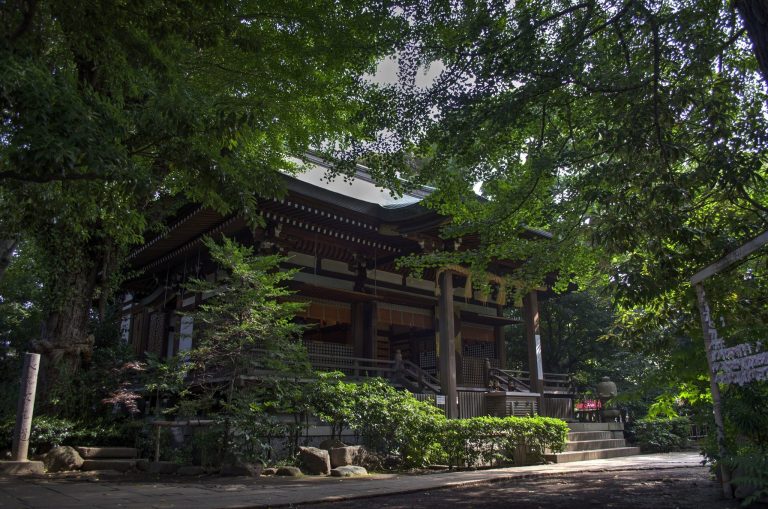
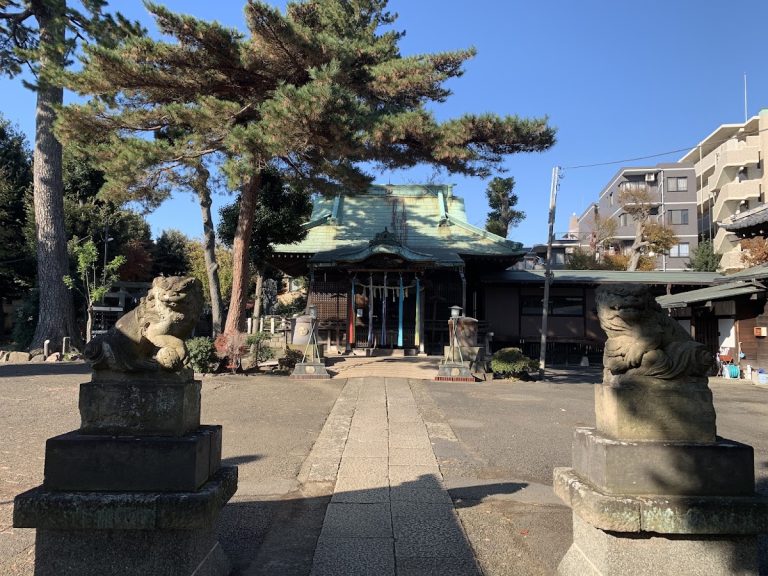
The principal hall, known as the Shakado, dates from the middle Muromachi period, approximately 1393–1466. The Muromachi period was a medieval era of Japanese history conventionally dated from 1336 to 1573. The hall is a single-story building with a three-bay frontage and four-bay depth. Its copper-sheet roof is an irimoya roof, a traditional form that combines a central gable with sloping hipped sections. The Shakado is designated a national Important Cultural Property.
Cemetery and Memorials
Family Monuments
The cemetery contains five-ring monuments associated with women of the Kinoshita family of Ashimori Domain and with the later Hirano family of Tawaramoto Domain. A five-ring monument is a Japanese Buddhist funerary monument made of five geometric elements representing the elements of existence.
Modern Graves
Other graves and memorial monuments commemorate singer and actor Hideki Saijo, actor and singer Tetsuya Watari, baseball figures Sadaharu Oh and Isao Harimoto, and the four Matsunaga brothers associated with the founding of All Japan Women’s Pro-Wrestling. The Oh family cemetery was also the scene of the theft of his wife’s cremated remains.