Takanawa Shrine: A Shinto Shrine in Tokyo


Site at a Glance
- Rating
- 4.1
- Popularity
- Low
- Country
- Japan
- Primary era
- Early Modern
- External website
- Open
- Eras represented
- Early Modern, Modern
- Civilizations
- Japanese, Tokugawa
- Site type
- Religious
- Remains
- Sanctuary
On this page12 sections
History
Takanawa Shrine is a Shinto shrine in Tokyo, Japan, traditionally founded as an Inari shrine during the Meio period, from 1492 to 1501. Formerly known as Inari-sha, it developed as a local place of worship on the elevated edge of Takanawa, overlooking former coastal lowlands to the east.
Foundation and religious traditions
The shrine’s principal deity is Ukanomitama no Mikoto, a Shinto kami associated with food, grain, and rice and widely worshipped through Inari shrines. Hondawake no Mikoto, identified with Emperor Ojin and also worshipped as the kami Hachiman, is enshrined alongside Sarutahiko no Kami, a deity traditionally associated with guidance, roads, and the passage between divine and human realms.
During the Meireki era, from 1655 to 1658, a Taishido was said to have been established within the precincts for an image of Prince Shotoku at the age of sixteen. Prince Shotoku was a revered early Japanese statesman and Buddhist patron associated with the promotion of Buddhism and centralized government. A Koshindo was also said to have been founded around this time for a statue of the Blue-Faced Vajra King. Both buildings were connected with the former Jōshōji, a temple that no longer exists.
Edo-period setting and disaster
An illustrated guide published between 1834 and 1836, Picturesque Places in Edo, shows an Inari shrine, Taishido, and Koshindo together within a coastal landscape. An approximately 1850 map of the Shiba-Takanawa area likewise represents an Inari shrine beside a highway. These records place the shrine complex within an Edo-period landscape whose shoreline differed greatly from the modern coast.
In January 1845, the Aoyama Fire reportedly destroyed the shrine buildings, historical records, and many treasures. The annual Fire-Quelling Festival on January 22 preserves the memory of the disaster and remains associated with local awareness of disaster prevention. The shrine’s principal annual festival is held on September 10, while a mid-level festival takes place on May 22.
Modern changes
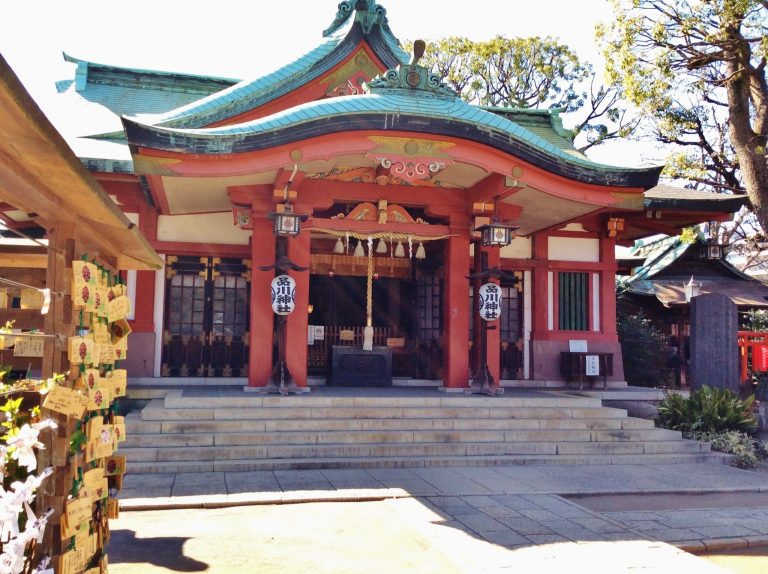
During the Meiji-period separation of Buddhism and Shinto, the policy that formally reorganized Buddhist institutions and images apart from Shinto shrines, the Koshindo was renamed Sarutahiko Shrine and is understood to have been incorporated into the main sanctuary. In 1929, the former Inari-sha adopted the name Takanawa Shrine, taking the name of the locality and clarifying its role as the local tutelary shrine. The present main hall dates from 1980.
The name Takanawa has several proposed origins, including a possible connection with the Battle of Takanawahara in 1524, mentioned in war chronicles. In the medieval period, Takanawa referred to a wider area; during the early modern period, the name came to cover a smaller territory divided into Kamitakanawa and Shimotakanawa. Within the present town area, Takanawa Shrine is the only shrine or temple associated with an early foundation tradition.
Reclamation and harbor development transformed the coastline shown in Edo-period records, and the construction of the Takanawa embankment for the railway altered it further during the Meiji period. A shell layer was traditionally said to have been found during road-widening work in the late Taisho period, in conditions comparable to those at the nearby Isarago Shell Mound. Site-purification ceremonies were conducted in connection with the construction of Takanawa Gateway Station and TAKANAWA GATEWAY CITY.
Remains
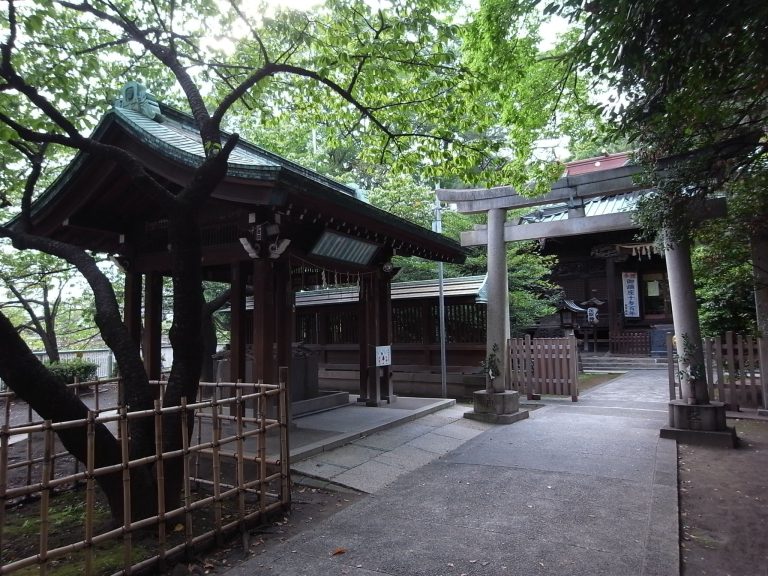
The shrine occupies the edge of a north-south-running elevated area, with the former coastal lowlands lying to the east. Its surviving features include the 1980 main hall, stone entrance structures, and Taishigu on the left side of the shrine buildings. Edo-period maps place the Inari shrine beside a highway and within a coastal setting, although the shoreline has since been reshaped by reclamation, harbor works, and railway construction.
Stone entrance and precinct features
Stone gate and torii
The stone gate and stone torii survived the Aoyama Fire of 1845, which destroyed much of the shrine complex. Their survival provides a physical link with the earlier sanctuary. In front of the Taishigu stone gate stand an Edo-period stone weight and komainu, guardian sculptures traditionally placed at Shinto shrine entrances. Both objects are designated cultural properties of Minato Ward.
Stonemasons’ inscription
A stone wall bears the names of approximately 300 stonemasons. The names are arranged by group beneath an inscription identifying young members of thirteen stonemason groups within Edo. The wall expresses the religious devotion and professional solidarity of the craftsmen who contributed to the shrine during the Edo period.
Taishigu
Prince Shotoku’s shrine
Taishigu stands on the left side of the shrine buildings and continues the tradition of the former Taishido. Dedicated to Prince Shotoku, it represents the survival of a religious institution that was associated with the former Jōshōji and established within the precincts during the Meireki era. The present structure preserves that dedication under the name Taishigu.
Carved stone gate
The stone gate of Taishigu was donated in July 1827 by the Edo stonemasons’ association. Its carvings draw on the story of the Three Harms of Zhou Chu, included in the Tang-period Chinese anthology Mengqiu, and are attributed to two sculptors. The gate therefore combines a local craftsmen’s donation with imagery drawn from a Chinese moral tale.
Portable shrines
Two mikoshi, portable shrines used to carry or symbolically transport a kami during processions and festivals, are displayed inside Taishigu. One dates from 1875 and the other from 1916. Both are said to have escaped damage in the 1923 Great Kanto Earthquake and are regarded as relatively rare surviving examples of their kind in Tokyo.