Yoshimine-dera Temple: A Tendai Buddhist Temple in Kyoto


Site at a Glance
- Rating
- 4.4
- Popularity
- Medium
- Country
- Japan
- Primary era
- Early Modern
- External website
- Open
- Eras represented
- Medieval, Early Modern
- Civilizations
- Kamakura shogunate, Tokugawa
- Site type
- Religious
- Remains
- Monastery
On this page12 sections
History
Yoshimine-dera is a Tendai Buddhist temple in Kyoto, Japan, whose tradition traces its foundation to 1029 and whose surviving complex reflects centuries of imperial patronage, destruction, and rebuilding. Tendai is a major Japanese Buddhist tradition derived from the Chinese Tiantai school, with an institutional network that included temples connected to the imperial and aristocratic courts.
Foundation and imperial recognition
The temple’s origin is uncertain, although the Yoshimine-dera Engi Emaki, an Edo-period illustrated account of the temple’s history, places its foundation in 1029. According to this tradition, Gensan, a 47-year-old disciple of the Tendai scholar Genshin, entered the mountain, built a small chapel, and enshrined a Thousand-Armed Kannon that he had made. Thousand-Armed Kannon is an expanded form of Kannon, the Buddhist bodhisattva associated with compassion, conventionally represented with many arms.
In 1034, Emperor Go-Ichijo designated the temple as a site for imperial prayers and gave it the name Ryohō-ji. Eight years later, Emperor Go-Suzaku ordered the transfer of another Thousand-Armed Kannon from Washio-ji in eastern Kyoto. The image, made by Ninko-hoshi, became the temple’s new principal image.
Imperial support continued under Emperor Shirakawa, who donated the Hondō, Amida-dō, Yakushi-dō, Jizō-dō, a three-story pagoda, a bell tower, the Niōmon Gate, and buildings associated with seven guardian shrines. These gifts established a substantial religious complex on the mountainside.
Kamakura-period development
During the early Kamakura period, the Tendai monk and historian Jien resided at the temple in 1192. After Emperor Go-Toba presented it with a plaque bearing the name Yoshimine-dera, the temple adopted the name by which it is known today.
Later, Shoku, a disciple of Hōnen, served as chief priest. Hōnen founded the Pure Land school associated with devotion to Amida Buddha. After Shoku’s tenure, numerous imperial princes entered Yoshimine-dera, beginning with Dōkaku Hōshinnō of Nishiyama and including princes from Shōren-in. The temple consequently became a monzeki institution, an elite Buddhist temple traditionally headed or occupied by an imperial prince or another member of the imperial family, and acquired the designation Nishiyama Monzeki.
Imperial patronage and destruction
Members of the imperial family, including Emperor Go-Saga and Emperor Go-Fukakusa, offered the temple their patronage and veneration. Imperial donations, particularly one from Emperor Go-Hanazono, supported improvements to the buildings. During the Muromachi period, the number of monastic quarters reached 52.
Most of the complex was burned during the Ōnin War of 1467–1477, a civil conflict that caused widespread destruction in Kyoto and weakened the authority of the Muromachi shogunate. The temple was later rebuilt and restored during the Edo period, largely through the patronage of Keishōin, the mother of Tokugawa Tsunayoshi, the fifth shogun of the Tokugawa shogunate. The shogunate was Japan’s military government under the Tokugawa ruling house.
The complex that developed with Keishōin’s support preserves an arrangement associated with an early-modern Tendai-affiliated temple and provides evidence for architectural practice during the Genroku period, an Edo-period era conventionally dated to 1688–1704. Yoshimine-dera is also the twentieth temple on the Saigoku Kannon pilgrimage route, the first temple of the Kyoto Rakusai Kannon pilgrimage, and the eighty-fifth stop on the Shinto-Buddhist pilgrimage route.
Several designations recognize the temple’s historical and cultural value. Its Tahōtō is an Important Cultural Property, Yōryū no matsu is a national natural monument, and the Yoshimine-dera and Sankō-ji pilgrimage mandalas are tangible cultural properties designated by Kyoto Prefecture. In 2000, the temple’s principal group of 12 buildings and one hōkyōintō, a Buddhist memorial stupa, also received prefectural tangible cultural property designation.
Remains
Mountain layout and approach
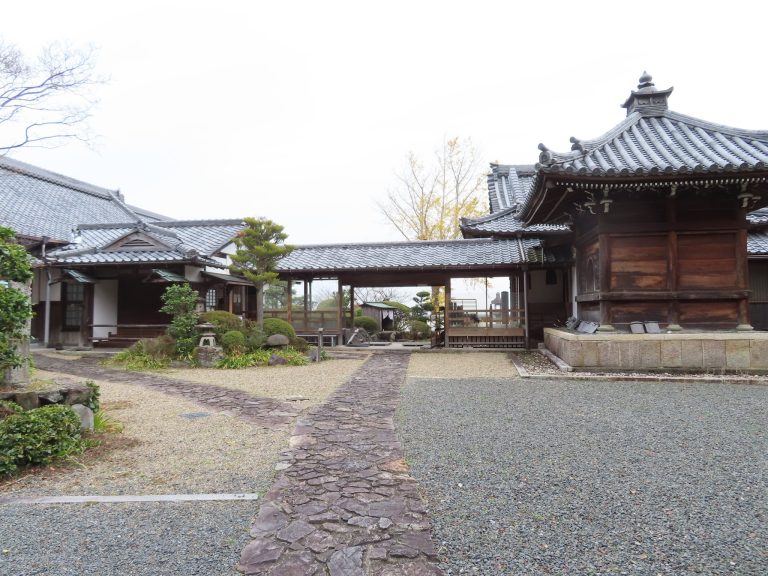
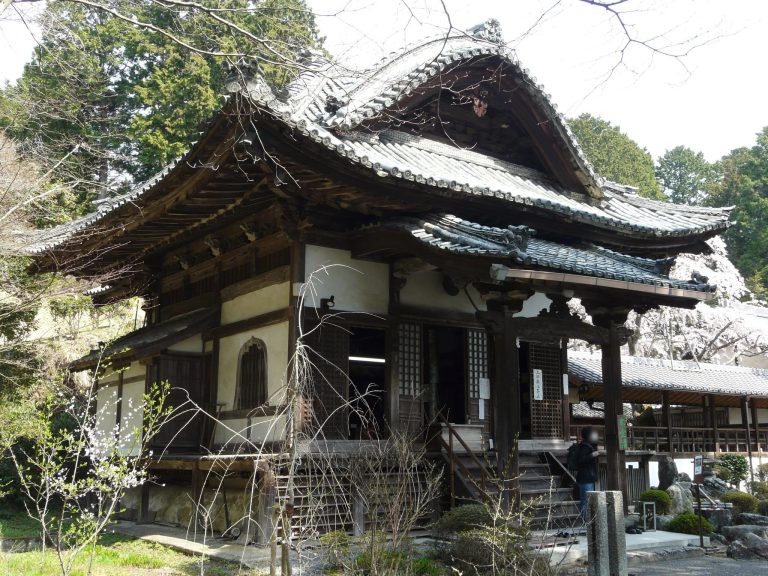
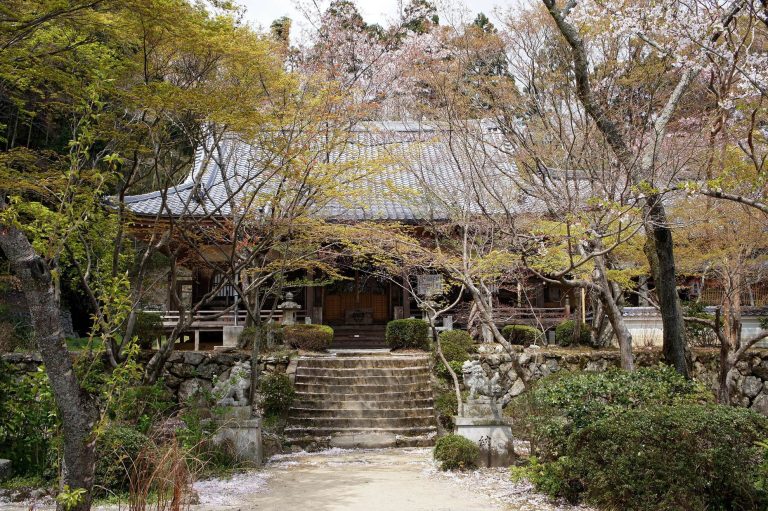
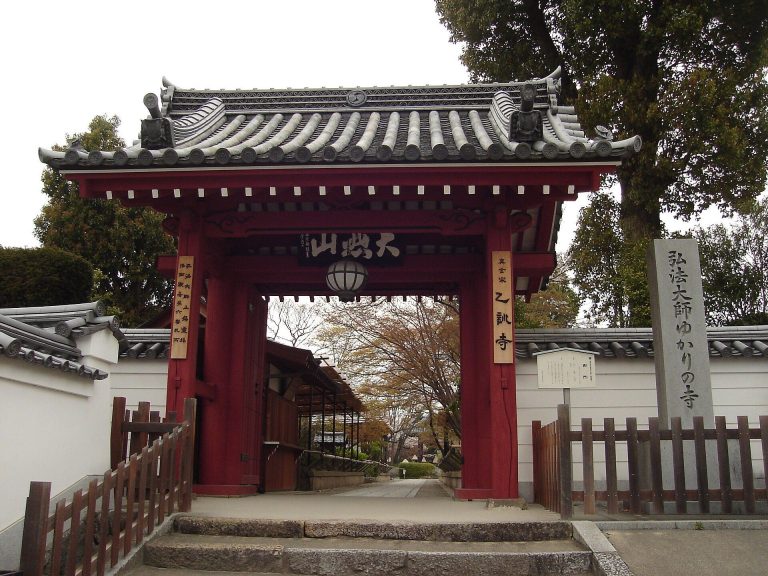
Yoshimine-dera occupies Yoshimine, a northeastern branch of Mount Shaka, whose summit reaches 630.8 meters above sea level. The buildings spread across the mountainside near the southwestern edge of Kyoto City. The Sanmon stands above the approach, and a stone stairway descends or rises from it to the Hondō, which is situated at approximately 305 meters above sea level. The Monju Treasure Hall lies to the south, or left, of the Hondō. From the Hondō, another flight of stone steps leads upward on the right toward the Tahōtō and other buildings. The Shakadō stands higher on the slope, followed above by the Amidō. At the far end of the grounds are the Yakushidō and the cemetery of the princes of Shōren-in. Sankō-ji adjoins the temple on its north side.
Images and principal buildings
Principal Kannon images
The temple houses two wooden standing images of Jūichimen Kannon, or Eleven-Headed Kannon. This form of Kannon bears eleven faces representing different aspects of compassionate response. The hidden principal image is covered with lacquer and gold leaf and measures 178.8 centimeters in height. It is regarded as a work of the late Heian to early Kamakura period and is traditionally attributed to Ninko-hoshi. The accompanying image measures 174.5 centimeters, is considered a work of the early eleventh century, and is traditionally attributed to Gensan. Its entire surface has a darkened, aged appearance.
Temple buildings and pagoda
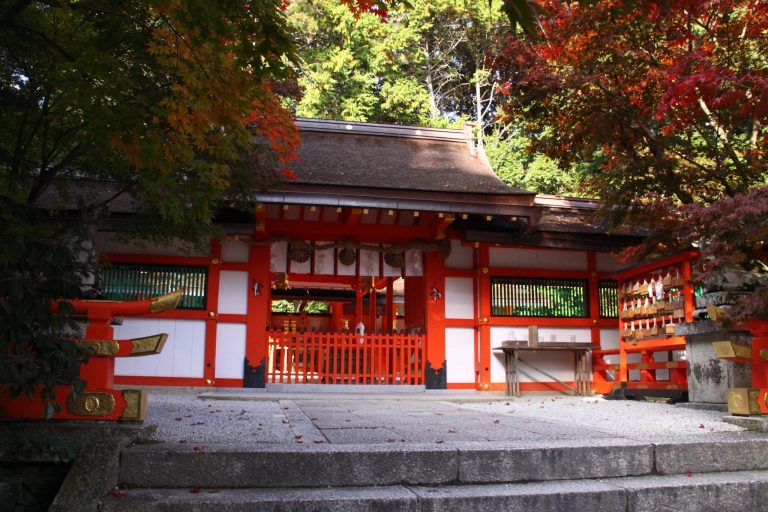
The Tahōtō is a three-bay pagoda with a cypress-bark roof, built in 1621 during the Edo period. A Tahōtō combines a lower square section with a rounded upper structure. The principal Edo-period building group comprises the Hondō, Yakushidō, Amidō, Kyōdō, Kaisandō, Gomadō, Shōrō, Sanmon, and four Chinjū-dō shrine structures. The group also includes a Kamakura-period hōkyōintō.
Natural feature and pilgrimage mandalas
Yōryū no matsu
Yōryū no matsu, or the “Gliding Dragon” pine, is a Japanese five-needle pine estimated to be about 600 years old. Its trunk extends horizontally as though it were crawling along the ground. The tree once exceeded 50 meters in length, but more than 10 meters was cut away in 1994 after damage caused by pine pests.
Pilgrimage mandalas
Two Edo-period pilgrimage mandalas are associated with Yoshimine-dera. The Yoshimine-dera Pilgrimage Mandala shows the temple with its Hondō standing independently. The Sankō-ji Pilgrimage Mandala presents a different arrangement, with the Hondō connected to other buildings by a corridor. That arrangement does not correspond to Yoshimine-dera’s actual layout and is considered a depiction of Sankō-ji.
In the Sankō-ji mandala, mist separates the pilgrimage route from the temple buildings. Mukō Shrine, Ōharano Shrine, and Konzō-ji are placed at some distance from the route, separated by mist or clouds. The composition reflects the mountainous approach and the scarcity of obvious landmarks or buildings along the path.