Merola Castle (Castell de Merola): A Medieval Fortress in Spain


Site at a Glance
- Rating
- 4.3
- Popularity
- Very Low
- Country
- Spain
- Primary era
- Medieval
- Eras represented
- Medieval
- Civilizations
- Crown of Aragon
- Site type
- Military
- Remains
- Castle
On this page6 sections
History
Merola Castle, also known as Castell de Merola or the Tower of Merola, is a former fortress at Puig-reig in Catalonia, Spain. The site was part of the territory of Puig-reig Castle during the ninth and tenth centuries, when farmers held land there as free property rather than through direct feudal tenure. Merola is recorded as a fortress in 983.
Early medieval Merola
The church of Santa Maria de Merola was recorded by 1050. From the middle of the eleventh century, the family of the lords of Merola appears in the historical record. Its members served as representatives of Puig-reig Castle and protected the Monastery of Sant Pere de la Portella.
The lords of Merola
The family became more prominent during the twelfth century. Bernard of Merola, one of its most active members, was a friend of the troubadour Guillem de Berguedà and repeatedly opposed the bishop of Vic. His marriage to Berenguela of Joval greatly expanded his property, which included the castles of Olius, Joval, and Lavit.
Bernard probably commissioned the tower and fortress. His grandson, Bertran of Merola, sold the family inheritance to Peter of Olvan in 1225. By the end of the thirteenth century, the castle’s domains had passed to the lords of Berga. Their possessions, together with the County of Pallars, a medieval county in the Pyrenean region, later became royal property through acquisition.
Royal ownership and later memory
In 1363, Queen Eleanor, wife of Peter the Ceremonious, the fourteenth-century king of Aragon, sold Castell de Merola, along with other possessions and churches, to Pere Fresc, a merchant from Berga.
Joan Amades, a Catalan folklorist, recorded the legend of the Knight of Merola. In the story, after James I of Aragon conquered Valencia, the queen and the wives and daughters of knights campaigning there travelled toward the region to surprise their relatives. They crossed the agreed frontier and were surrounded by Muslim forces, but the Knight of Merola, who had followed them with armed men, rescued them after a fierce battle.
The legend says that James I, also known as James the Conqueror, offered the knight any reward he wished. The knight requested one of the five red bars then shown on the royal arms of Catalonia. The story attributes the reduction of the arms from five bars to four to this request and says that a red bar was added to the arms of the lord of Merola, whose shield otherwise displayed water.
Merola Castle is included in the Inventory of Catalan Architectural Heritage and is protected as a Cultural Asset of National Interest. This protection was declared on 22 April 1944.
Remains
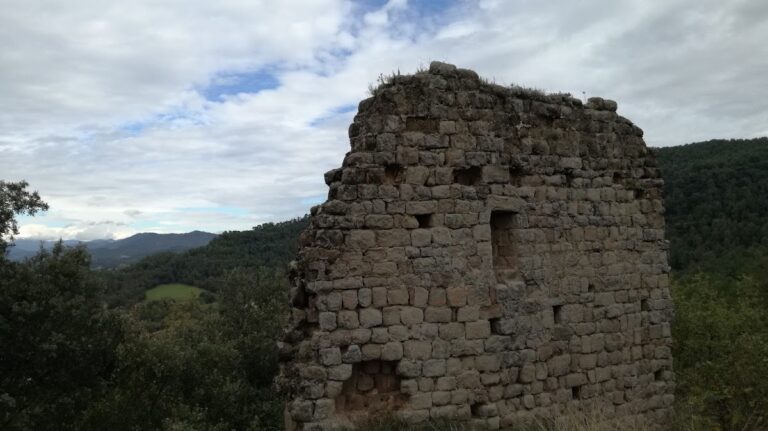
The surviving structure is limited to the north wall of the keep, the principal fortified tower of the medieval castle. Known popularly as the Tower of the Moors, it is partially collapsed. The rectangular, nearly square tower stood 4.95 metres high, with walls 1.20 metres thick. Its relatively regular masonry, arranged in courses, points to construction in the twelfth century, while the wider monument is dated to the twelfth or thirteenth century.
The keep
The tower contained three levels. The first two were covered by vaults, while the upper level had a timber covering. Battlements, the raised defensive sections along the top of a wall or tower, crowned the structure. Two entrances were probably formed by lintelled openings with semicircular arches.
Much of the stone from the tower and the wider fortification was reused in later centuries for farmhouses in the Merola area. This later reuse contributed to the fragmentary condition in which the castle survives.
Nearby sites