Schloss Rif: A Salzburg Archiepiscopal Residence in Austria


Site at a Glance
- Rating
- 4.6
- Popularity
- Very Low
- Country
- Austria
- Primary era
- Early Modern
- External website
- Open
- Eras represented
- Medieval, Early Modern
- Civilizations
- Holy Roman Empire
- Site type
- Domestic
- Remains
- Castle
On this page9 sections
History
Schloss Rif is a historic castle in Austria, located in Taxach within the municipality of Hallein, between the settlements of Rif and Taxach. Its origins are generally placed in the twelfth century, although the date 1111 has also been proposed without reliable evidence. The estate later became a Salzburg archiepiscopal residence, a hunting estate, and a centre of agricultural and brewing activity.
Medieval origins
The early history of Rif is uncertain. A document from 1125 names Fridericus de Rifaren, who may have been connected with the estate. Another charter, issued by Emperor Frederick II, contains the name Riue. This name derives from the Latin ripa, meaning “bank” or “shore”. At that time, the estate belonged to the Salzburg Cathedral Chapter, the corporate body of canons responsible for a cathedral’s religious administration and landed property.
In 1250, Otto and Kuno of Guetrat received the Rif estate as a fief in an exchange. A fief was land granted in return for service and other obligations. After the Guetrat family died out, Rif became a peasant fief held by non-noble tenants. Leonhard Muschl possessed it for about fifty years, after which several local farmers held the estate.
From estate to knightly fief
Leonhard Griesenawer sold Rif to Cristannus Nuecht in 1495, and Nuecht later transferred it to his son Steffan. In 1533, Cristoff Perner of Rettenwörth acquired the estate. Cardinal Matthäus Lang, whose councillor and chamber scribe Perner was, then granted him Rif as a knightly fief. The estate was divided into four properties and included the Oberloch and Thiergarttenloch.
Under Cristoff Perner, the residence acquired much of its present form. Perner later became bankrupt and surrendered all his property. In 1560, Rif passed to Archbishop Johann Jakob Khuen von Belasi, beginning its development as an archiepiscopal residence.
Archiepiscopal residence and agricultural estate
Johann Jakob Khuen von Belasi converted Schloss Rif into a summer residence for the archdiocese and installed water displays. Flooding destroyed part of the surrounding wall in 1572. Archbishop Georg von Kuenburg established a stud farm at the castle in 1586, and the estate also served for an extended period as a hunting estate.
The castle chapel received the designation Capella Regia, or royal chapel, when Archbishop Michael von Kuenburg consecrated it in 1557. The chapel was abolished in 1860, and its altarpiece showing the Deposition from the Cross was transferred to St Peter’s Abbey in the same year. In 1704, a barley malt house serving the Kaltenhausen court brewery was installed at Schloss Rif.
Fire, ownership changes, and university use
A fire in 1831 destroyed the southern wing, which had stood one storey higher than the rest of the building. The wing was not rebuilt. A cadastral survey from 1830 already described the castle as a ruin. Schloss Rif and the Kaltenhausen brewery belonged to the widowed Electress Maria Leopoldine of Bavaria. In 1849, the estate passed by inheritance to Count Maximilian Arco-Zinneberg. The dairy farm, sold to Michael Fink in 1800, was bought back by his heirs in 1876.
Josef Count Arco-Zinneberg became the owner in 1887 but sold Rif to the Bavarian branch of Deutsche Bank in 1898. Karl Colin and Erich Breustadt followed as owners in 1899, the Kaltenhausen brewery acquired it in 1901, and Count Hugo Boos-Waldeck took ownership in 1912. Count Philipp Boos-Waldeck followed in 1946, and Countess Carlotta Plettenberg in 1970. The parcel containing the castle was sold to Walter and Elise Pleitner in 1942. In 1972, inheritance transferred it to Philipp and Renate Pleintner, from whom Elisabeth Hager bought the residence in 1974.
The University of Salzburg and the Province of Salzburg acquired Schloss Rif in 2003 and adapted it for university use. Since October 2004, it has housed the university’s sports-science campus, including the Christian Doppler Laboratory “Biomechanics in Skiing”. It forms part of the University and Provincial Sports Centre Salzburg Rif. University facilities also include a publicly accessible specialist library containing approximately 26,000 books and printed works on sport and movement science. Schloss Rif and part of its enclosing wall are protected architectural monuments.
Remains
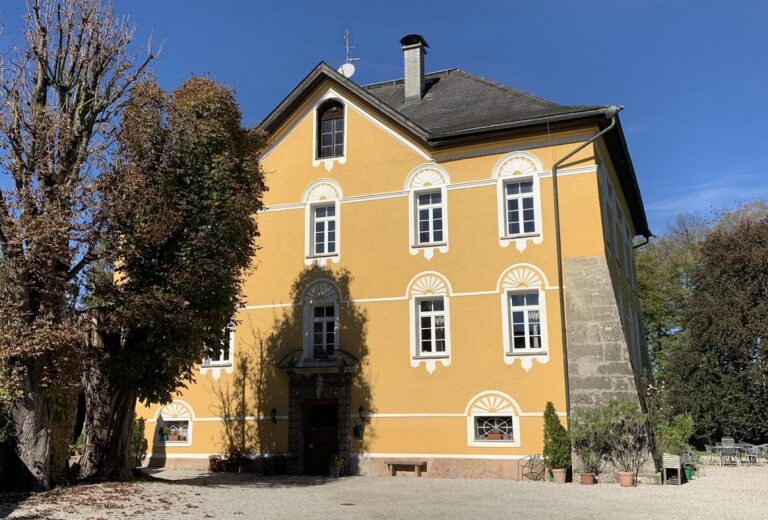
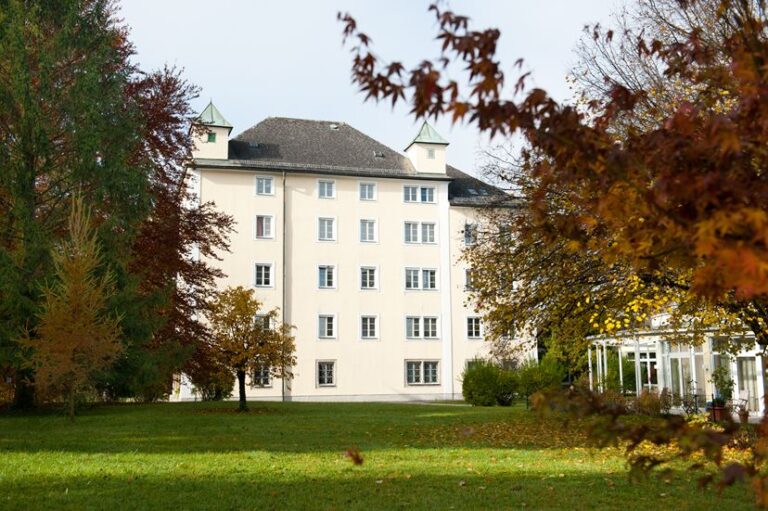
Schloss Rif now consists of a three-winged, three-storey building within the former manorial estate and castle park. The complex was originally arranged as four wings. Its entrance is marked by a high masonry gateway with a rendered surround, beside which stands a gatekeeper’s lodge associated with the estate’s traditional farm use. A surviving section of the former enclosing wall extends from the lodge, and a 1.6-kilometre avenue connects the gateway with the castle.
Castle building and entrance
The two corners of the northwest wing are formed as corner towers with tent roofs. The western tower retains a sundial. A broad stone portal with a segmental arch forms the main entrance. Most of the original window surrounds are made from Untersberg conglomerate, a coarse natural stone from the area near Salzburg, and some windows still have protective window baskets.
The northwest-facing main facade carries coats of arms associated with Salzburg archbishops Markus Sittikus von Hohenems, Guidobald von Thun, and Franz Anton von Harrach. Some of these elements are spolia, architectural pieces reused from an earlier or dismantled structure, taken from the Kaltenhausen court brewery.
Interior and surviving southern wing
The former stables occupy the west wing. This vaulted, two-aisled space now serves as an events hall. The southern wing destroyed by fire survives only in a conglomerate-stone retaining wall with a pronounced edge moulding.
A depiction from 1800 presents Schloss Rif as a four-storey building with a trench roof, whose surfaces sloped inward toward a concealed central drainage channel. An eastern pond lay in front of the building and was used chiefly for breeding carp.
Water displays and grounds
Part of the former water-display system survives south of the castle as a rectangular pond lined with stone blocks. Beneath the pond, the base wall contains a barrel-vaulted space that can be reached only from the garden. These surviving elements belong to the landscape and water features created when Schloss Rif was developed as an archiepiscopal summer residence.