Roscommon Castle: An Anglo-Norman Fortress in Ireland


Site at a Glance
- Rating
- 4.6
- Popularity
- Medium
- Country
- Ireland
- Primary era
- Medieval
- External website
- Open
- Eras represented
- Medieval, Early Modern
- Civilizations
- English, Norman
- Site type
- Military
- Remains
- Castle
On this page7 sections
History
Roscommon Castle is a thirteenth-century Anglo-Norman fortress in Ireland, near the town of Roscommon in County Roscommon. Robert of Ufford, an Anglo-Norman lord and Justiciar of Ireland, built it in 1269 on land taken from an Augustinian monastery. A Justiciar was the principal royal representative and chief governor of English administration in medieval Ireland.
Anglo-Norman foundation and Irish recapture
In 1272, Aodh Ó Conchobhair, king of Connacht, one of Ireland’s historic provinces, besieged and captured the castle. An English force retook it in 1280, but the fighting caused severe damage. The castle was subsequently repaired and enlarged.
The O’Connor clan recaptured Roscommon Castle in 1340. Apart from two brief interruptions, the clan held it until 1559 and repelled repeated English attacks during that period.
English control and rebuilding
Sir Henry Sidney captured the castle in 1559. In 1578, Queen Elizabeth I of England granted it to Sir Nicholas Malbie, governor of Connacht. During the late sixteenth century, the castle was rebuilt and altered, including the insertion of large windows into its towers and curtain wall.
Wars, destruction, and abandonment
During the Irish uprising that began in 1641, Roscommon Castle became a site of fighting between Irish rebels and English forces, including conflict between Catholic and Protestant factions. The Roundheads, the Parliamentarian forces in the Wars of the Three Kingdoms, captured it in 1641. Confederate Catholics, an Irish Catholic political and military alliance formed during the 1640s, retook it in 1645 under the command of Preston.
The castle remained in Irish hands until 1652, when Cromwellian forces under Commissioner Reynolds attacked it. Artillery and the subsequent demolition of its fortifications caused severe damage, and parts of the castle were blown up. A fire destroyed the castle in 1690. It was then abandoned and gradually fell into ruin from the end of the seventeenth century.
Name and heritage status
The name Roscommon derives from the Irish name Caisleán Ros Comáin, interpreted as “castle of the wood of Saint Coman.” A tradition associated with the site holds that Saint Coman, a fifth-century Irish religious figure, founded a monastery there. Roscommon Castle is recognized as an Irish National Monument and as a nationally important historical and architectural monument.
Remains
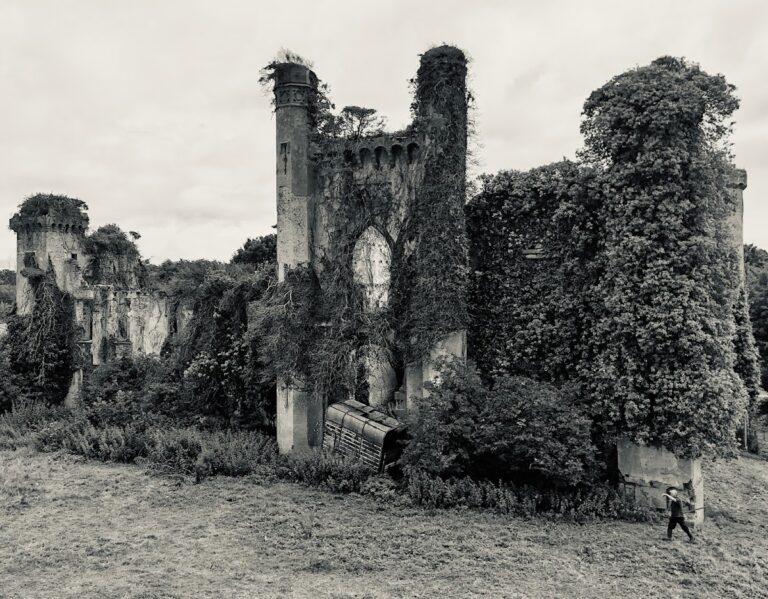
Roscommon Castle survives as a ruin on a slope near the town of Roscommon. The lowland fortress occupies a rectangular plan and was built principally of rubble stone. A high curtain wall enclosed the castle, while a symmetrical ditch surrounded the entire fortress at some distance from the wall. Its surviving form reflects repeated repair, enlargement, alteration, military damage, fire, and abandonment.
Entrance and towers
The entrance was formed by a gatehouse, a fortified entrance structure, with two projecting towers. One entrance tower retains its substantial vaulted roof. Four D-shaped towers projected from the castle, each rising three storeys. A D-shaped tower has a straight inner wall and a curved outer face, providing the main projecting elements of the rectangular enclosure.
Nearby sites