Donamon Castle: A Long-Inhabited Fortified Site in Ireland


Site at a Glance
- Rating
- 4.8
- Popularity
- Very Low
- Country
- Ireland
- Primary era
- Iron Age
- Eras represented
- Iron Age, Modern
- Civilizations
- Unclassified
- Site type
- Military
- Remains
- Castle
On this page8 sections
History
Donamon Castle is a long-inhabited fortified site in Ireland, in County Roscommon, whose origins reach back to an early fort associated with the Iron Age. The site is regarded as one of Ireland’s oldest continuously inhabited buildings. Its first recorded reference appears under 1154 in the Annals of the Four Masters, a major Irish chronicle compiled from earlier records.
Early Irish and Norman control
The early fort was known as Dún Iomghain, a name associated with the meaning “fort of Iomán.” It was the residence of the chief Ó Fionnachta of Clann Chonnmhaigh, one of the two principal branches of a Connacht family. In 1232, Adam de Staunton strengthened the site during the Norman conquest, the medieval expansion of Norman political and military power into Ireland. The O’Connors retook the new fortification in the following year and destroyed it.
The castle was rebuilt and occupied by de Oddingseles in 1294. He died the next year, after which the de Birminghams took possession. The O’Connors destroyed the castle again in 1303, continuing the pattern of conflict that had shaped control of the site during the medieval period.
The MacDavid Burkes
In 1307, a branch of the Burkes led by a chief known as MacDavid displaced the O’Connors. The MacDavid Burkes then occupied Donamon for approximately 300 years. Their long tenure formed the principal later medieval phase in the castle’s history.
Caulfeild ownership and twentieth-century occupation
During the seventeenth-century wars of conquest and confiscation in Ireland, a junior branch of the Caulfeild family acquired Donamon Castle and its surrounding lands. The family retained the property throughout the Protestant Ascendancy, a period when political, economic, and landholding power was concentrated largely among Ireland’s Protestant ruling elite.
In late 1932, an IRA unit commanded by Seán McCool and Mick Price took over the castle and used it as a training camp. The IRA, or Irish Republican Army, was a republican paramilitary organization involved in campaigns connected with Irish independence and later republican politics.
Missionary campus and later use
The Divine Word Missionaries came to Ireland in 1939 and purchased Donamon Castle from the Irish Land Commission, the state body responsible for land redistribution and related land administration. The missionary congregation repaired the deteriorating castle, built several additional structures, and established a training campus for students preparing to work overseas. Donamon Castle remains the centre of the Divine Word Mission in Ireland.
The former training campus was later managed by the Irish Wheelchair Association as a national holiday and rehabilitation centre. That use ended in 2019, and the complex reopened in 2022 to house Ukrainian refugees arriving in Ireland.
Remains
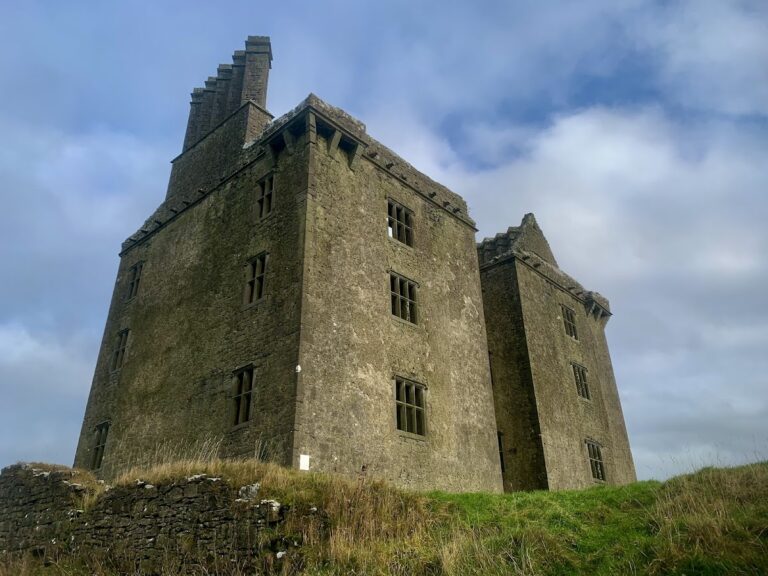
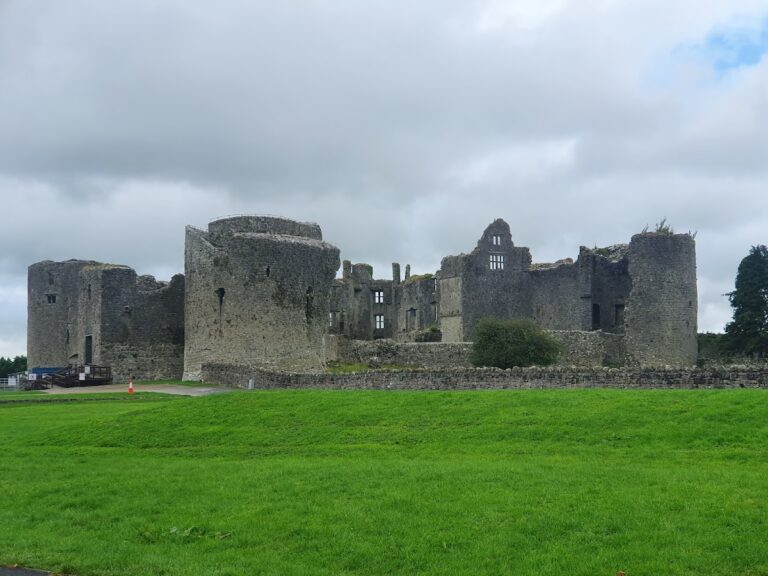
Donamon Castle occupies raised ground overlooking the River Suck near Williamstown in County Roscommon. The physical site combines the castle with later buildings erected by the Divine Word Missionaries as part of a campus complex. Its earliest known defensive element was the fort associated with Dún Iomáin, while the surviving arrangement also reflects the site’s later religious and institutional development.
The castle and fortified site
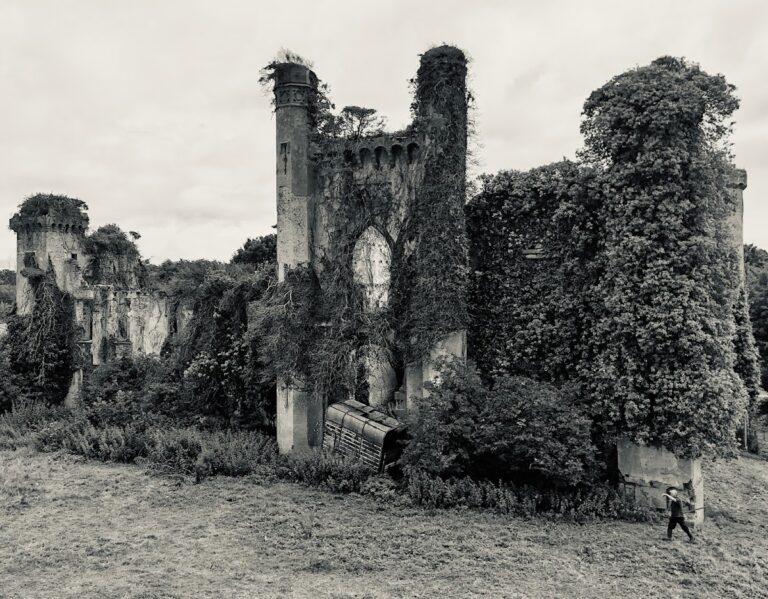
The castle developed on the position of the earlier fort and was repeatedly rebuilt and destroyed during medieval struggles for control. Before the missionary restoration, the building was in poor condition and beginning to deteriorate. It was subsequently repaired, preserving the castle as the central structure of the later complex.
The missionary campus
Several buildings erected by the Divine Word Missionaries accompany the castle and remain part of the site’s later physical development. They were created for the training campus established in the twentieth century, extending the site beyond its medieval defensive core into a larger institutional complex.