Rindoon Castle: An Anglo-Norman Fortress in Ireland


Site at a Glance
- Rating
- 4.5
- Popularity
- Very Low
- Country
- Ireland
- Primary era
- Medieval
- Eras represented
- Medieval
- Civilizations
- Norman
- Site type
- Military
- Remains
- Castle
On this page12 sections
History
Rindoon Castle is a ruined Anglo-Norman fortress in Ireland, built in 1227 on the western shore of Lough Ree during the English crown’s expansion into Connacht. Henry III of England authorized its construction, and Geoffrey de Marisco, the justiciar, or chief royal representative, of Ireland is identified as its builder or principal patron. The castle formed part of the king’s fortifications in Connacht, alongside Athlone, and helped protect five baronies held by the English king as Lord of Ireland.
Earlier strategic importance
The site had strategic associations before the castle was built. Ruaidri Ua Conchobair, described as Ireland’s last High King, used it as a base for his fleet during the winter of 1156. A possible ringfort, meaning a generally circular fortified settlement or enclosure, may also have occupied the site during the ninth century. This proposed connection is traditionally attributed to Turgesius, a Viking leader, although the identification remains uncertain. The location also had a fortification associated with a local Irish clan before the Anglo-Norman conquest.
The Anglo-Norman foundation
The castle’s construction followed Henry III’s grant of the “rough third of Connaught” to Áed mac Cathail Ua Conchobair, heir of the Connacht king Cathal Crobderg, after Cathal’s death in 1224. Rindoon was first recorded in 1227, when responsibility for the castle was assigned to Phillip de Angulo, Baron of Navan. A settlement developed beside the fortress and appeared in Exchequer accounts in 1241 and 1259.
The settlement was connected with English-controlled trade in western Ireland. Its exports included hides, wool, and dairy products, while merchants imported wine, grain, and textiles from France. The castle and town therefore formed part of a fortified and commercial landscape, although their position remained vulnerable to conflict between the English administration and Irish powers.
Conflict, destruction, and repair
In 1236, Felim mac Cathal Crobderg Ua Conchobair, king of Connacht, destroyed Meelick Castle and advanced toward Rindoon. His forces plundered the newly established town but did not besiege the castle, apparently concentrating instead on the herds in the surrounding area. Maintenance and repairs at Rindoon were neglected between 1235 and 1256 while resources were directed toward the construction of a bridge at Athlone.
Áed, the son of Felim, captured and burned Rindoon Castle in 1271, along with the recently completed castle at Roscommon and the town of Athlone. By 1273, Rindoon and its surrounding lands had been abandoned. Geoffrey de Geneville, the justiciar of Ireland and later lord of Connacht, sought to repair the castle and repopulate the district. The town had recovered some prosperity by 1285, although continued political and military pressure affected the area.
Repairs to the castle, town, and a bridge required £3,200 in 1277. Around 1284 and 1285, William Prene, Edward I’s royal carpenter, was called to undertake further work. No revenue was obtained from the lands of Rindoon in 1286 to 1289 or in 1294 to 1296, reflecting pressure from Irish forces and rivalry among Anglo-Norman barons.
Late medieval decline
John FitzThomas Fitzgerald, who held Rindoon, imprisoned Richard the Red Earl, Earl of Ulster, at the end of 1294. After FitzGerald was forced to surrender his possessions, Geoffrey de Geneville arranged for two boats to supply Rindoon across Lough Ree. During another period of Geneville’s administration, Walter de Ivethorn was responsible for the castle when a large group of prisoners escaped, including a son of Áed mac Cathail Ua Conchobair.
During Edward Bruce’s invasion of Ireland in 1315, Fedlim Ó Conchobair, king of Connacht, supported Bruce, and Rindoon and Athlone were burned. Richard the Red Earl ordered Rindoon’s reconstruction in 1318. The O’Reillys and O’Naghlans destroyed it again in 1321, after which Robert de Kendall rebuilt the walls. The town remained abandoned and apparently was not recolonized. John de Fountayns was the last lord responsible for the castle. Irish forces reconquered the territory between 1340 and 1342, after which Rindoon appears to have been permanently abandoned as a castle.
The priory and later settlement
A religious foundation beside the castle appears to have been established before 1216, during the reign of John of England, and therefore predates the fortress. Current interpretations generally associate it with the Fratres Cruciferi, a medieval religious hospitaller order, rather than the Knights Hospitaller. The two groups were distinct, but their charitable and religious functions contributed to later confusion. Hospitaller officials were recorded at Rindoon, and fifteenth-century papal letters incorrectly attributed the priory to the Hospitallers of Saint John.
In the early fourteenth century, the priory received the former Templar commandery of Loghnehely. A papal bull known as Ad Providam had assigned former Templar possessions to the Order of Saint John. A Hospitaller prior of Kilmainham was recorded at Rindoon in 1274, and the Hospitaller prior of Ireland may have been there between 1285 and 1290. These references leave the foundation’s institutional identity uncertain. The adjacent priory survived longer than the castle and was mentioned in papal letters of the fifteenth century.
Settlement around the ruins continued during the sixteenth and early seventeenth centuries. The Earl of Clanricarde sought recognition of his claim to the lands in 1544, and the settlement remained under Irish-clan control until 1574. In 1578, Thomas Chester and George Goodman received the lands on the condition that they maintain an English force of archers there. Following the English conquest of Ireland, Edward Crofton acquired the lands and ruins in 1605. His description referred to a monastery of Saint John the Baptist, a church with a bell tower, a residential building, gardens, and six houses near the ruins.
Remains
Rindoon Castle occupies the centre of the Rindown peninsula on the western shore of Lough Ree, within woodland known as Saint John’s Wood. The area is also called Warren Loop or Warren Point. The ruined fortress overlooked the lake and stood beside a medieval settlement, creating a fortified site and an associated deserted medieval town.
Fortress and settlement
Castle walls
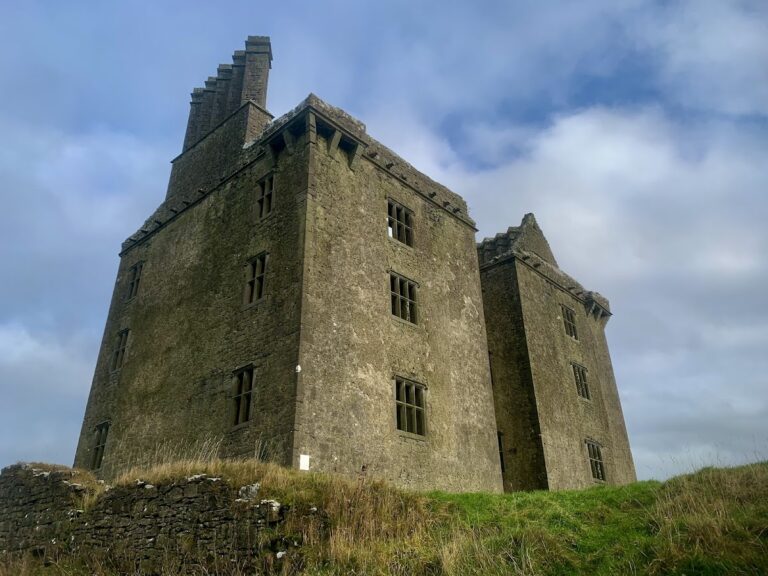
The castle survives as a ruined medieval fortress with defensive walls. Those walls were repaired or rebuilt after the destruction of 1271, during works to the castle and settlement in 1277 and around 1284 to 1285, and again in 1321 after the O’Reillys and O’Naghlans destroyed the castle. These repeated interventions form part of the physical history of the surviving ruins.
Town and lake supply
The settlement grew beside the castle and was connected with the fortress’s role in controlling the surrounding lands and trade. A bridge served the castle and town and required repair in 1277. In the late thirteenth century, two boats were constructed to supply Rindoon from Lough Ree. The early modern settlement landscape described in 1605 included six houses, gardens, a residential building, and a church with a bell tower.
Religious foundation
A priory or hospice stood immediately south of the fortress. The location of its church is known, and the foundation’s changing interpretation reflects the overlapping references to the Fratres Cruciferi and the Knights Hospitaller. The church’s dedication remains uncertain. The 1605 description associated the settlement with a monastery of Saint John the Baptist, while the priory continued to be linked with the site in later historical references.
Earlier defensive features
The site’s earlier occupation included a possible ringfort and a fortification associated with a local Irish clan. The proposed ringfort connection with Turgesius belongs to the site’s traditional early medieval associations, while its identification remains uncertain. These earlier defensive features form part of the sequence of occupation that preceded the Anglo-Norman castle.
Nearby sites