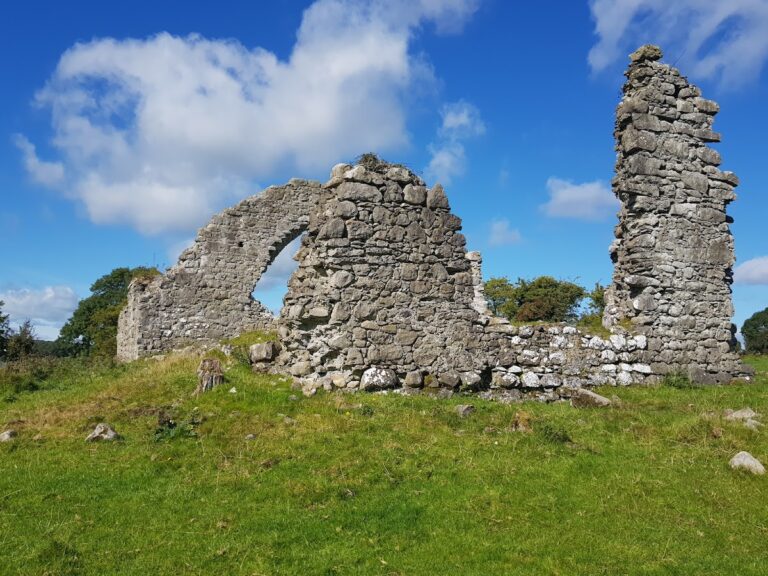
Clonmacnoise: An Early Christian Monastery on the River Shannon


Site at a Glance
- Rating
- 4.6
- Popularity
- Medium
- Country
- Ireland
- Primary era
- Medieval
- External website
- Open
- Eras represented
- Medieval, Early Modern
- Civilizations
- English, Irish
- Site type
- Religious
- Remains
- Monastery
On this page21 sections
History
Clonmacnoise is a ruined early Christian monastery in County Offaly, Ireland, founded by the Irish monk Saint Ciarán in AD 544. It stood beside the River Shannon in the ancient territory of Uí Maine, where the major east-west route called the Slighe Mhor crossed the river after following the Esker Riada through Ireland’s central wetlands. This position helped the monastery develop into a major centre of religion, learning, craftsmanship, and trade.
Foundation and early development
Saint Ciarán came from Rathcroghan in County Roscommon with seven companions. At Clonmacnoise he met Diarmait mac Cerbaill, who later became the first Christian-crowned High King of Ireland. Together they built the monastery’s first church, a small wooden structure. Ciarán died of plague in September 549, before reaching the age of thirty-three, and tradition identifies the ground beneath that original church as his burial place.
The monastery maintained close connections with the kings of Connacht until the ninth century. From the ninth through the eleventh centuries, it was allied with the kings of Meath, and many High Kings of Tara and Connacht were buried there. Saint Columba, a sixth-century Irish missionary and monastic founder, was said by Adomnán of Iona to have visited Clonmacnoise while establishing the monastery at Durrow. According to this tradition, Columba foretold future Irish disputes over the date of Easter, declared that angels had visited Clonmacnoise, and blessed the young monk Ernéne mac Craséni, who later became well known in Ireland.
Growth as a monastic centre
A plague at the end of the seventh century killed many of Clonmacnoise’s students and teachers. The community nevertheless expanded greatly between the eighth and twelfth centuries. Its population grew from fewer than ten people to an estimated 1,500 to 2,000 by the eleventh century. A larger secular settlement developed around the monastery, with metalworkers, craftsmen, farmers, and other inhabitants living in nearby houses and streets.
Clonmacnoise and Clonard became two of Ireland’s best-known religious centres, attracting scholars from across Europe. The local community produced important metalwork and stone sculpture, including the Clonmacnoise Crozier and the Cross of the Scriptures. The monastery’s position beside a major route and river crossing supported its wider religious and economic role.
Attacks and decline
During its period of growth, Clonmacnoise was attacked at least twenty-seven times by Irish forces, at least seven times by Vikings, and at least six times by the Normans. Máel Muire mac Céilechair meic Cuinn na mBocht, principal compiler of the twelfth-century Book of the Dun Cow, was reportedly killed during a Viking raid in 1106.
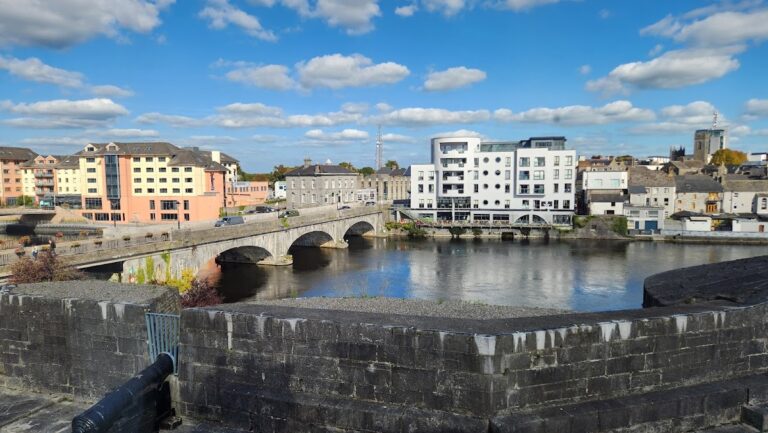
The monastery began to decline during the twelfth century. Repeated Viking and Norman attacks contributed to the process, but the expansion of Athlone to the north was described as the most damaging factor. People and economic support moved towards Athlone, which became the region’s principal trading centre and a major crossing of the Shannon. The arrival of competing religious orders from continental Europe, together with Ireland’s change from a monastic system to a diocesan framework, further reduced Clonmacnoise’s influence. It became the centre of a small and impoverished diocese.
Later religious use and preservation
Clonmacnoise was associated with the Canons Regular of Saint Augustine from about 1140 to about 1144. From 1144 until its disestablishment in 1568, it was associated with the Augustinian Canons Regular of the Arroasian observance, a reform tradition within that canonical movement. An English garrison from Athlone destroyed and looted the monastery for the final time in 1552, leaving the complex in ruins.
The Annals of Clonmacnoise describe events in Ireland from prehistory to AD 1408. Their original manuscript or manuscripts have been lost, and their compilers are unknown, but the title reflects the belief that the annals drew on material gathered at Clonmacnoise. The Church of Ireland transferred the site to the Irish Government in 1955. Archaeological excavation, conservation, and restoration have continued, with most churches receiving extensive conservation work, especially repointing. Clonmacnoise has also been proposed for inclusion on Ireland’s UNESCO World Heritage List through two submissions. The preserved ruins are managed by the Office of Public Works on behalf of the relevant government department.
Remains
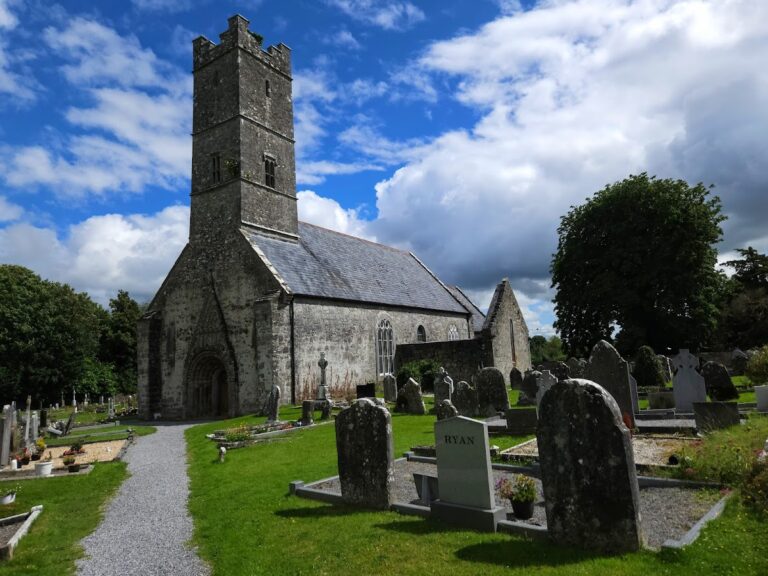
Clonmacnoise is arranged around churches, high crosses, graves, ecclesiastical dwellings, and workshops. The preserved core contains the cathedral, seven churches, two round towers, three high crosses, and a large collection of Early Christian grave slabs. The wider group includes nine churches, among them the Nun’s Church, which stands about one kilometre from the main complex. Many grave slabs carry knotwork and interlacing, while the surviving buildings and monuments preserve evidence of the site’s changing religious and architectural history.
Round towers
O’Rourke’s Tower takes its name from the tenth-century Connacht king Fergal O’Rourke. The Chronicum Scotorum states that it was completed in 1124 by Turlough O’Connor, king of Connacht, and Gilla Christ Ua Maoileoin, abbot of Clonmacnoise. Lightning struck the tower eleven years later and removed its head, or uppermost section. The surviving upper masonry belongs to later work, and material brought down in the storm of 1135 may have been reused in McCarthy’s Tower.
Romanesque church and tower
Temple Finghín is a twelfth-century Romanesque church, built in a medieval style known for rounded arches and heavy masonry. It is attached to McCarthy’s Tower, forming an unusual early Irish combination of a church and round tower in one structure. Temple Finghín was vandalised in 1864, and part of the money raised for the prosecution was later used to repair the tower’s cap.
Small churches and later chapels
Temple Ciarán
Temple Ciarán stands near the centre of the site and measures 2.8 by 3.8 metres. Built in 909, it is the smallest church at Clonmacnoise and retains much of its original walling. It is regarded as the oldest dated surviving stone church in Ireland. Tradition identifies it as Saint Ciarán’s burial place. Excavations found the Clonmacnoise Crozier there, but no remains identified as those of the saint.
Temple Kelly
Temple Kelly survives as low perimeter stones that indicate the original size of the church.
Temple Dowling and Temple Hurpan
Temple Dowling is a small church first built in the tenth century. Edmund Dowling renovated it in 1689 and placed a stone carving of his family crest above the doorway. Temple Hurpan, a seventeenth-century annex at the east end of Temple Dowling, served as a burial ground for members of the local parish and is also known as MacClaffey’s Church.
Temple Connor
Temple Connor has been used by the Church of Ireland since the eighteenth century. A major restoration during the second decade of the twentieth century raised the roof pitch and remodelled the interior. The church is maintained under the auspices of the Athlone Union of Parishes, and services are held there on summer Sundays.
Temple Melaghlin
Temple Melaghlin, also called the King’s Church, was built around 1200. Tradition associates it with the burials of at least seven generations of Melaghlin kings. It is also believed to have housed the scriptorium, the room where manuscripts were written, copied, and decorated.
Nun’s Church
The Nun’s Church forms part of the wider Clonmacnoise group of ruins and stands about one kilometre from the main enclosure. It has received conservation work of the same general type as the churches in the principal complex, including repointing.
Cathedral
The cathedral, also known as Temple McDermot, is the largest church at Clonmacnoise. Construction began around 909 under King Flann Sinna, who became High King of Ireland, and Abbot Colmán mac Ailella. Its Gothic north doorway, often called the Whispering Arch, dates from the middle of the fifteenth century. The west doorway has undergone extensive and controversial modern restoration.
Rory O’Connor, the last High King of Ireland, was buried near the altar in 1198 beside his father, Turlough. Most of the visible graves inside the cathedral belong to the Coghlan family, whose patriarch extensively rebuilt the building in the middle of the seventeenth century.
High crosses
North Cross
Created around 800, the North Cross is the oldest of the three surviving high crosses at Clonmacnoise. A high cross is a monumental Irish stone cross that may combine religious scenes, inscriptions, and ornament. The North Cross retains its limestone shaft and sandstone base, the latter formed from a former millstone. A cross-legged figure has been interpreted as Cernunnos, a Celtic deity associated with animals and horned imagery, or as a similar deity. Another interpretation identifies the figure as the Devil.
Cross of the Scriptures
The Cross of the Scriptures is a four-metre-high sandstone cross carved around 900. Its panels show the Crucifixion, the Last Judgement, and Christ in the Tomb. An inscription asks for prayers for Flann Sinna, King of Ireland, and Abbot Colmán, who commissioned the cross and were also responsible for building the cathedral. The original cross was moved indoors in 1991 to protect it from weathering, and a replica now stands in its former position.
South Cross
The South Cross is a ninth-century monument that originally stood at the southern end of the site’s central area. Its west face carries a rough carving of the Crucifixion, and it may have partly inspired the later Cross of the Scriptures. The original is now displayed indoors, while a replica marks its former location.
Stone remains and archaeological collections
Several limestone boulders stand near the Chapel of Clonfinlough. One, known as the Fairy’s Stone or Horseman’s Stone, bears numerous cup-shaped hollows, crosses, daggers, and two human-foot impressions. Such an alleged body-part impression in stone is called a petrosomatoglyph, and this example may be connected with the inauguration of Gaelic rulers.
The original stone crosses are displayed in the interpretive centre for their conservation and protection. The centre also contains archaeological artefacts and exhibits relating to Clonmacnoise and the surrounding area. Replicas mark the original positions of the Cross of the Scriptures and the South Cross, while the surviving churches, towers, grave slabs, and sculpted stones remain distributed through the preserved monastic complex.
Nearby sites