Rakvere Castle: A Historic Fortress in Estonia
Visitor Information
Google Rating: 4.7
Popularity: Medium
Official Website: www.rakverelinnus.ee
Country: Estonia
Civilization: Crusader, Early Modern, Medieval European
Site type: Military
Remains: Castle
History
Rakvere Castle stands on Castle Hill in the town of Rakvere, Estonia. The earliest fortifications at this site were established by ancient Estonians, with archaeological evidence revealing a stronghold known as Tarvanpe dating back to the 5th and 6th centuries. Originally constructed of wood and surrounded by a pine palisade, this early stronghold marked the strategic importance of the location long before the arrival of stone fortifications.
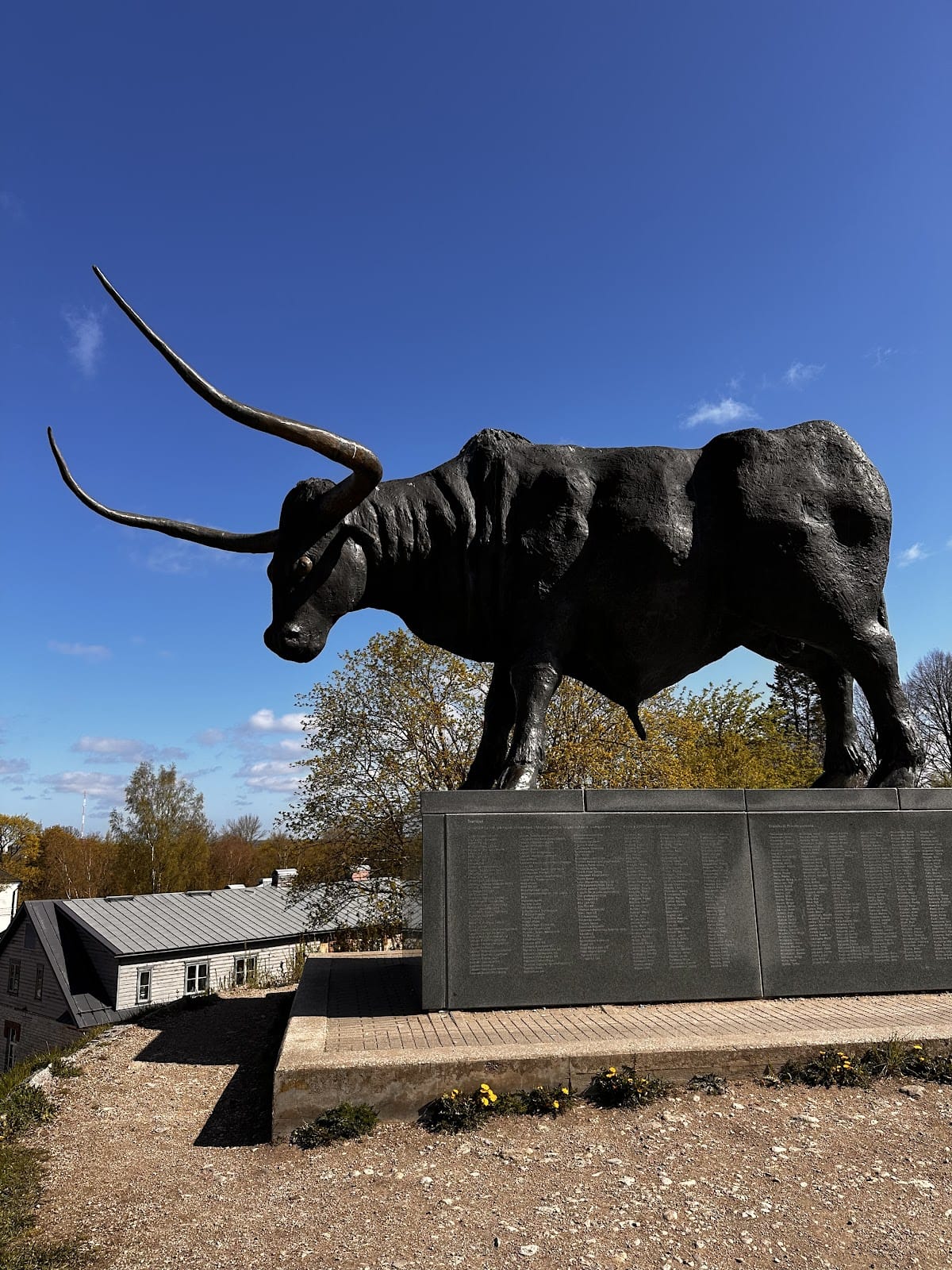
By the early 13th century, the site was referenced in written records as Tarvanpe, while the Danish name Wesenberg first appeared in 1252. The name Wesenberg is linked to the image of a bull’s head featured on the later town seal, reflecting the site’s symbolic association. The Russian chronicles of Novgorod mention the name Rakovor in 1268, marking the castle’s significance in regional conflicts.
In 1226, Johannes Dolenist, a vassal under the Bishop of Tartu, captured the stronghold with support from Johannes, a papal legate. However, the castle returned to Danish rule following the 1238 Stensby Treaty, after which the Danish king established the Duchy of Estonia. Rakvere became one of three royal castles, alongside Tallinn and Narva, serving as vital military posts within the duchy’s defense system.
The castle faced military tension throughout the 13th century, notably with Novgorod forces attempting but ultimately failing to capture it in 1268. Following this, the Danes began constructing the first stone buildings on the site. These initial structures were modest convent house-type constructions, representing a transition from wooden to stone fortifications.
Control of Rakvere passed to the Livonian Order in 1347. During their rule, the castle was expanded, serving as the administrative center of the Rakvere vogtei. The vogt, or local commander, wielded military, judicial, and administrative power, overseeing taxation, troop recruitment, legal matters, and the management of local estates.
The Livonian War, beginning in 1558, transformed Rakvere into a contested fortress on the border between rival powers. The castle fell to Russian forces in that year, who enhanced its defenses with wooden outer walls and bastions, adapting it to the evolving demands of warfare. Under Russian control, Rakvere functioned as the center of a district governed by voyevodas appointed by the Tsar’s lieutenant in Livonia.
Swedish attempts to reclaim the fortress in 1573 and 1574 ended in failure, with heavy casualties and internal strife among their mercenaries. Eventually, in 1581, Pontus de la Gardie led the Swedish capture of Rakvere, forcing the Russian garrison to withdraw. The castle then became the administrative heart of the Swedish Rakvere county, governed by a castle commander with military and civil authority.
During the early 17th century’s Polish-Swedish conflicts, Rakvere changed hands several times and sustained damage. Eventually, to deny its military use to enemies, the Swedes deliberately destroyed the fortress. From 1635 onward, Rakvere Castle was officially removed from defensive lists and incorporated into the Rakvere manor estate.
In the following centuries, the castle ruins were quarried for building materials, though partial restorations began in the early 1900s. More extensive conservation took place between 1975 and 1988. Since 2002, the site has operated as a museum and interactive center, preserving the layered history of Rakvere Castle.
Remains
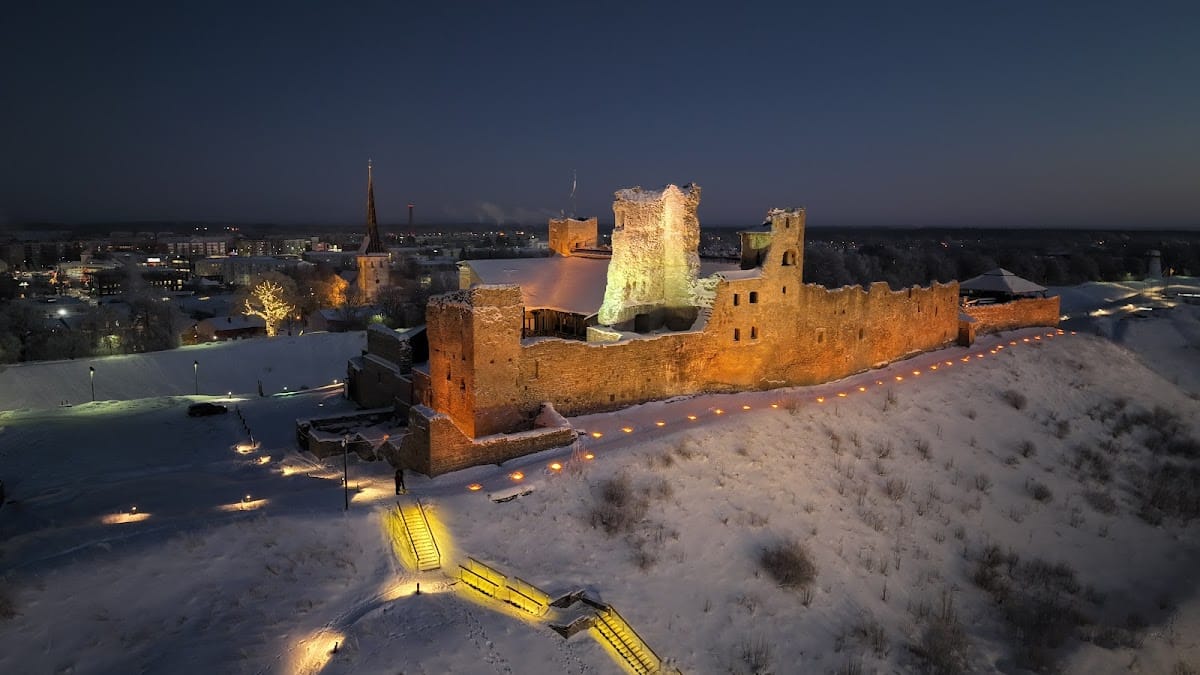
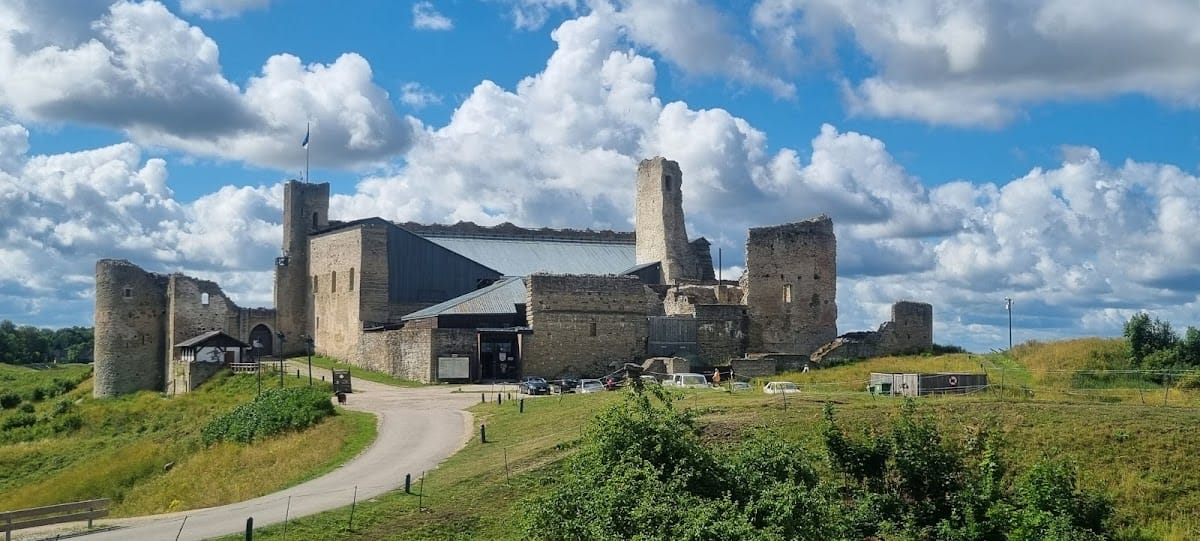
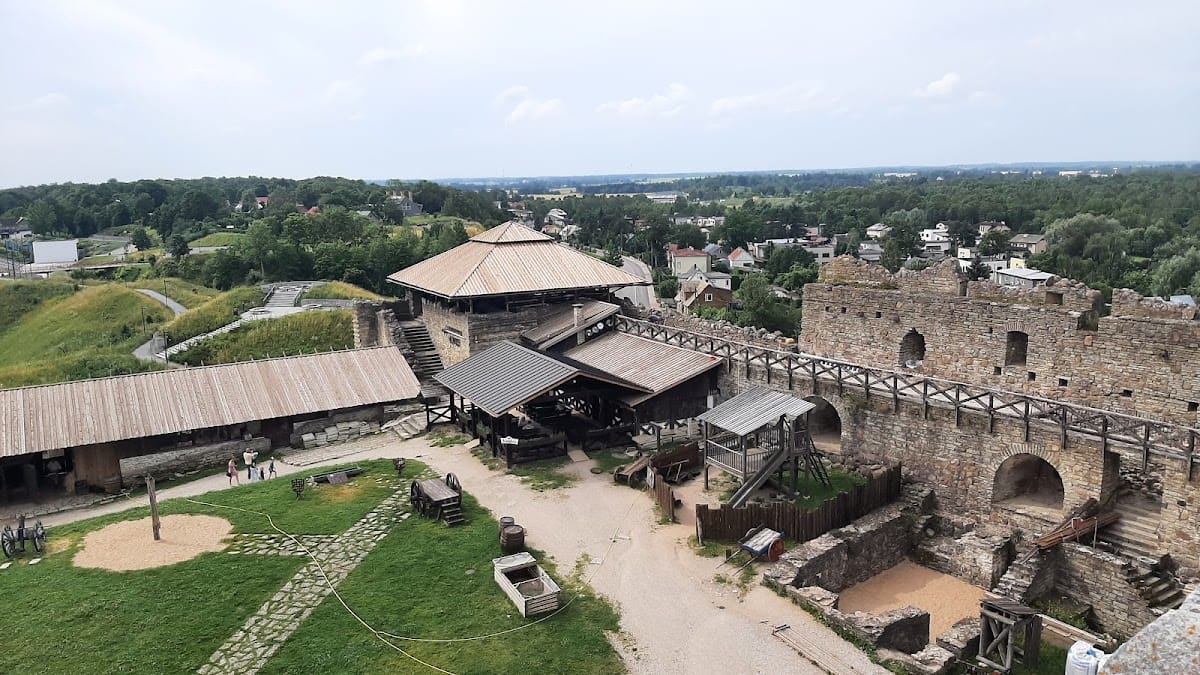
Rakvere Castle occupies a hilltop position 105 meters above sea level, rising about 25 meters above the surrounding landscape. Its layout evolved from an early wooden stronghold into a complex stone fortress shaped principally by medieval military needs. The earliest stone remains, dating to the 13th century, include half-cellars located in the southwestern corner of the main castle area, signaling the beginning of stone construction at the site with a convent house-style structure.
An irregular quadrangular stone curtain wall was added in the early 14th century under Danish rule. This wall, up to two meters thick, was built using a combination of lime mortar, fieldstones, rounded limestone, and broken limestone. The western wall stands out for its height, reaching seven meters, and supports a battlement walkway resting on stone buttresses. Over subsequent periods, the curtain wall was raised several times, reflecting ongoing fortification efforts.
During the Livonian Order period, the castle expanded northward by more than fifteen meters to include additional defensive works at the hill’s base. This expansion introduced outer walls enclosing vaulted cellars and a gate complex on the northern side. The northern section became a convent house featuring vaulted arcades at ground level, indicating an architectural style common to monastic military orders.
The western tower, rectangular in form and built with broken limestone, acquired a distinctive east-west wall dividing the northern section from the main castle body. Heated wooden buildings with stoves characterized the southern wing, while additional fortifications included two corner towers flanking the castle and an eastern gate complex. Adaptations for artillery use are evident in the four-story towers equipped with gun openings.
A notable artillery feature is the southwestern rondel, a round tower designed to accommodate cannon fire, connected to other wings via a courtyard enclosed by vaulted arcades. The main entrance was fortified with a large gatehouse possessing two eastern gates; one gate featured a drawbridge, and the gatehouse also included a “wolf hole” (a pit or hole for defensive purposes) and an inner portcullis—a heavy gridded door that could be lowered to block entry. Adjacent to this gatehouse stood a sizable semicircular tower with a guardroom heated by a fireplace and hypocaust stove—an ancient system providing warm air under the floor.
Under Russian control in the late 16th century, the castle’s northern, southern, and eastern sides were reinforced by a large wooden outer bailey constructed on the steep slopes of the hill. This wooden fortification was surrounded by a stone wall made from materials reclaimed from dismantled religious and civic buildings, showcasing resourcefulness in defense. The wooden structures included palisades, blockhouses filled with large stones, tall towers, and bastions. The outer bailey accommodated a substantial wooden settlement housing several thousand men, attesting to the castle’s role as a major military center.
While the stone castle itself was primarily used as a prison and storehouse during the Russian period, with only the voyevoda permitted residence inside, the outer defenses reflected an integrated military complex.
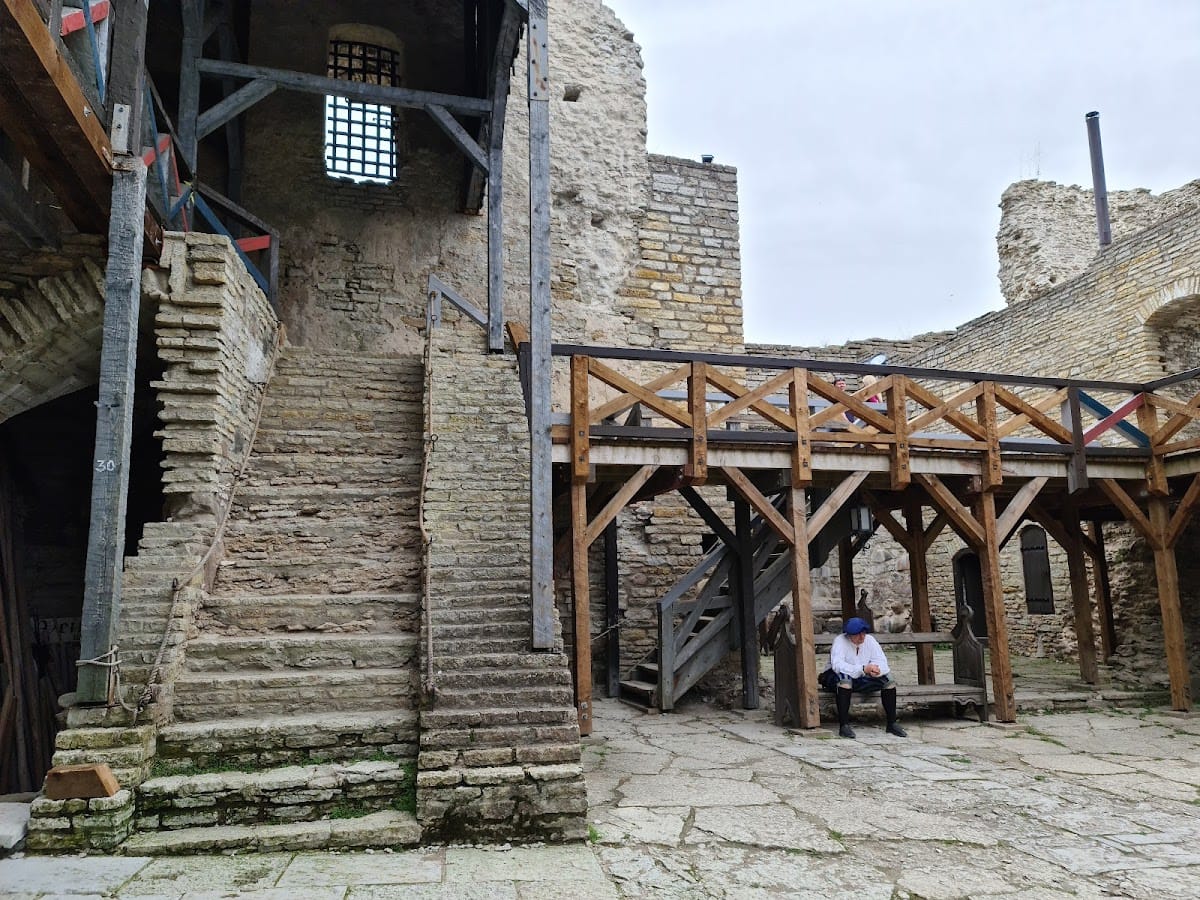
After the Swedish capture, bastions were constructed at the northern, southern, and eastern ends corresponding to the former Russian stone wall. The western curtain wall was thickened since the terrain made building earthworks there impossible. Modifications included adding a ceremonial staircase to the eastern side of the western tower and repairs to the southern wing. The castle courtyard has retained largely the same dimensions as during this period.
Among the castle’s preserved artifacts is a collection of six cannons from different eras, including a 15th-century Burgundian cannon known as “Tont,” a Swedish field cannon dating from the late 17th to early 18th century called “Ööbik,” two 17th-century signal guns, and two bombards—large early artillery pieces. Black powder is still used to demonstrate cannon firing.
Today, the castle ruins are partially restored, with the southern wing and corner towers among the best preserved sections. The Estonian flag flies from one of the towers, symbolizing the site’s enduring cultural heritage. The layered architecture and archaeological features at Rakvere Castle vividly illustrate its complex history as a wooden stronghold, a medieval stone fortress, and a center of military and administrative power through the centuries.