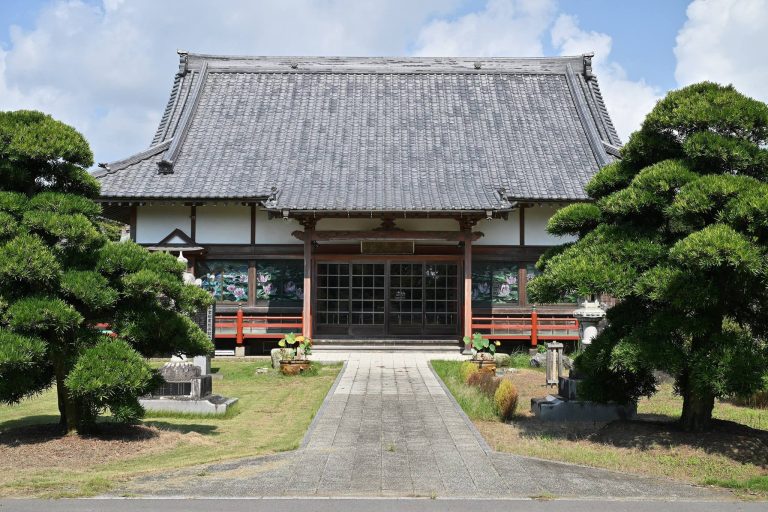
Raikō-ji Temple: A Jōdo Buddhist Temple in Katori, Japan
Site at a Glance
- Rating
- 4.2
- Popularity
- Very Low
- Country
- Japan
- Primary era
- Medieval
- External website
- Open
- Eras represented
- Medieval
- Civilizations
- Kamakura shogunate
- Site type
- Religious
- Remains
- Monastery
On this page12 sections
History
Raikō-ji Temple is a Japanese Buddhist temple in Katori, Japan, associated with the Chinzei branch of the Jōdo school and traditionally founded in 1088. Jōdo Buddhism is a Mahayana tradition centered on devotion to Amida Buddha and hope for rebirth in his Pure Land. The temple’s formal name is Tōkōzan Hōju-in Raikō-ji, and Amida Buddha is its principal object of worship.
Foundation and relocation
Temple tradition attributes the foundation to Taira no Tsunemasa, a member of the powerful Chiba clan family in Shimōsa. The institution was first established at Hirayama, in present-day Tōnoshō. In 1198, its Shaka Hall, a Buddhist hall dedicated to Shakyamuni, the historical Buddha, was moved to the site it occupies today.
Myōe is traditionally regarded as the founder at the present location. He was a major Buddhist monk of the Kamakura period, known for religious scholarship and practice. The temple’s succession identifies him as its founder and gives his death as 1232. A later first abbot associated with the conversion to Jōdo Buddhism is described as a restorer, suggesting that the institution originally belonged to another Buddhist affiliation before its Jōdo revival.
Minamoto no Yoritomo is traditionally said to have established a resting place at the temple in 1198 while visiting Kashima Jingū. The grounds also preserve a memorial tradition associated with three Minamoto shoguns: Yoritomo, Minamoto no Yoriie, and Minamoto no Sanetomo.
Abbesses and abbots through the centuries
The temple’s succession preserves a long sequence of religious leaders after its Jōdo conversion. The second through sixth abbots died between 1553 and 1601, while no death dates are given for the seventh and eighth. Among the ninth through nineteenth abbots whose dates are supplied, deaths fall between 1669 and 1770. The tenth abbot’s entry gives only February 9.
The twentieth abbot’s entry gives only the ninth day of the sixth month in year 5. The twenty-first through twenty-fourth abbots died between 1803 and 1840. The twenty-sixth and twenty-seventh died in 1853 and 1863, followed by the twenty-eighth, twenty-ninth, thirtieth, and thirty-first abbots in 1908, 1927, 1947, and 1988. No death date is given for the twenty-fifth abbot.
Memorial traditions and religious associations
One memorial tradition concerns O-fū, the wife of the Sengoku-period military figure Matsudaira Iemasa. The Sengoku period was an era of prolonged political conflict and civil warfare in Japan, generally associated with the fifteenth and sixteenth centuries. O-fū is described as the daughter of Sakai Tadatsugu and the adopted daughter of Tokugawa Ieyasu. She recited the nenbutsu, the devotional repetition of Amida Buddha’s name, during her lifetime and became a devotee of Jōdo Buddhism.
According to the tradition, O-fū’s hair was buried at Raikō-ji in accordance with her will, and a stone monument was erected. The Matsudaira family later made an annual contribution for tea offerings and donated paintings of the Buddha’s birth and death for her memorial observances.
Another tradition links the temple with Yotsume Tōshirō, who came from Owari and was associated with Myōe’s interest in tea. Myōe is said to have commissioned him to make tea utensils. Tōshirō later returned to Buddhist practice, took the name Shunkei, and was also regarded as a skilled maker of lacquerware.
Memorials also commemorate members of the Chiba family, including Chiba Tsunetane and his son, as well as a person identified as Chiba Hiratane. A separate gravestone honors a member of the Fuma family who held the office of Saemon-no-jō, a governmental position connected with palace security and related judicial or policing duties. Another monument commemorates his wife under the Buddhist posthumous name Ryōgetsu Myōkun.
Remains
Temple entrance and stone monuments
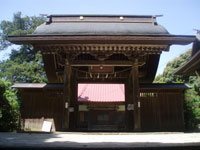
Sanmon
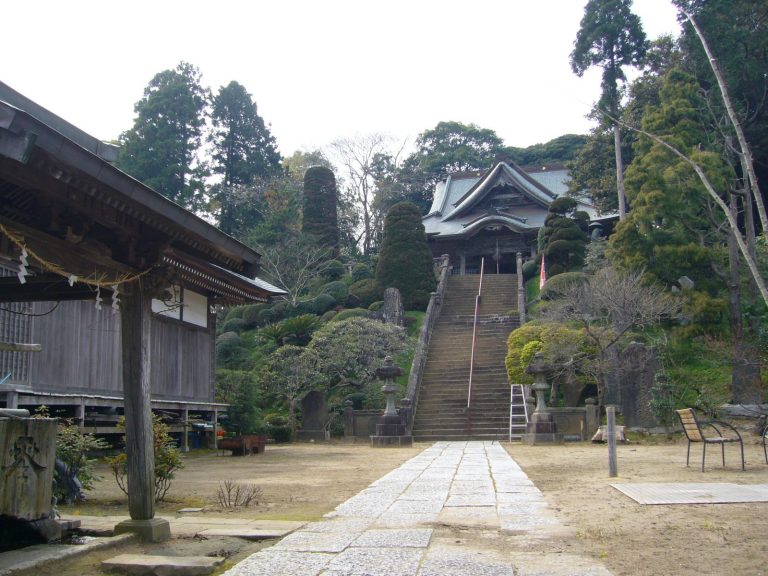
The temple complex includes a sanmon, the main entrance gate of a Buddhist temple. It forms part of the surviving arrangement of the grounds and provides the architectural entry to the religious precinct.
Itabi and Buddhist imagery
An itabi, a stone memorial stele, stands within the grounds with a raigō image dated 1306. The image presents Amida and his attendants descending to welcome the dead to the Pure Land. A second stone stele bears Sanskrit characters representing Amida Buddha, Kannon, and Seishi, bodhisattvas commonly shown beside Amida.
Memorial and grave monuments
A group of memorial stones and grave monuments occupies the temple grounds. It includes the monument associated with Minamoto no Yoritomo, Minamoto no Yoriie, and Minamoto no Sanetomo; a monument for Jinno Kakusuke; the Fuma-family memorials; the Chiba-family memorials; and monuments connected with Yotsume Tōshirō, O-fū, and Chiba Hiratane.
Former buildings and associated objects
Shoin site
The land now occupied by the cemetery is said to have contained a shoin, a reception, study, or residential building associated with a temple, until relatively recently. This tradition preserves the memory of an earlier building within the present grounds.
Religious objects and paintings
Several religious objects formerly transmitted by Raikō-ji are no longer extant. They include an image of Amida attributed to Ennin, a private devotional image attributed to Genshin, an autograph nenbutsu inscription attributed to Hōnen, and a rainmaking nenbutsu inscription attributed to a Jōdo priest. Ennin and Genshin were influential Buddhist monks associated with major developments in medieval Japanese Buddhism.
The temple also received paintings of the Buddha’s birth and death from the Matsudaira family for O-fū’s memorial observances. Their present survival and location are not stated.